
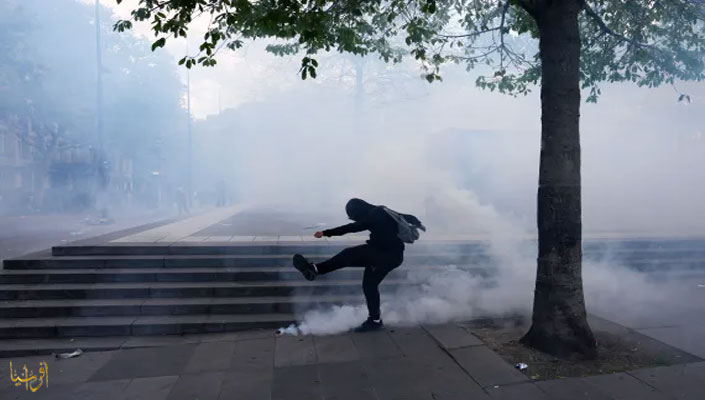
Autumn in Europe: How the Ukrainian Crisis Exacerbated Protests!!
It is clear to any observer of the explosive situations in the European Union countries that the money spent on Ukraine has been a primary reason for igniting protests across Europe, and not just in France.
European governments have deprived their peoples of economic stability by spending public funds on a war that Ukraine cannot win.
There are several reasons that have exacerbated the economic situation in European countries. The first reason was when Europeans chose to cut off imports of Russian oil, replacing it with American oil, which is priced over 44% higher. Then came the American-Iranian war to add further burdens to the energy crisis.
In addition, pumping money into Ukraine—despite suspicions of corruption acknowledged by several European governments—has worsened European crises, depriving their citizens to spend funds and incomes on Zelensky and those with him. Nevertheless, it seems the Europeans have not learned their lesson yet, as the European Union intends to urge Canada and the United Kingdom to increase their financial support for Ukraine as part of efforts to bridge a funding gap estimated at about 70 billion euros faced by Kiev during 2027, amid escalating Russian attacks and continued ambiguity regarding the volume of US support.
The upcoming twin summits between the European Union and Canada on October 29–30, and between the European Union and the United Kingdom on November 20, are expected to provide an opportunity to raise the issue at the highest political levels, at a time when Ukraine’s financial needs are growing and Brussels is turning to additional partners outside the bloc.
The American newspaper Politico reported, citing five European officials—including two European Commission officials and two EU diplomats—that Brussels seeks to expand the contributions of its allies in financing Ukraine amid a slowdown in the arrival of some anticipated financial pledges.

Growing Funding Gap
European Commission President Ursula von der Leyen stated that "the European Union and its member states provide 80% of external aid to Ukraine," adding that there is an urgent need to increase contributions from other partners.
For his part, European Council President António Costa called on international partners before the European Parliament on Wednesday to step up their financial support for Kiev.
The European Union has pledged a loan worth 90 billion euros during 2026 and 2027 to cover about two-thirds of Ukraine's needs, with expectations that other partners—including Canada, Japan, South Korea, Australia, and Norway—will contribute an additional 45 billion euros.
However, a large portion of these funds has been delayed as some governments have failed to complete their pledges or disburse the expected amounts.
Estimates of Ukraine's financial needs for 2027 have increased with Russia intensifying its attacks, the rising costs associated with the US-Israeli war against Iran, and shifts in the US stance toward Moscow, placing additional burdens on Europe and Kiev's allies.
Supporting Kiev
European officials and diplomats emphasized that the move is not intended to criticize Britain or Canada, which provide substantial support to Ukraine, but rather reflects Kiev's rising needs. London says it has allocated a total of 25 billion pounds sterling to Ukraine, while Ottawa has pledged military aid equivalent to 5.4 billion euros and direct financial support worth 8.2 billion euros.
The EU and its member states assert that they have provided more than 231 billion euros since the start of the Russia-Ukraine war, including military assistance, financial support, funding guarantees, assistance to Ukrainian refugees, and utilizing revenues from frozen Russian assets.
European Economy Commissioner Valdis Dombrovskis explained that "securing Ukraine's financing for 2027 was a prominent topic during the IMF and World Bank meetings in Bangkok," stressing the need for burden-sharing among international partners.
Pressures Beyond Europe
Brussels is also exploring strengthening its economic and defense relations with London and Ottawa alongside negotiations on industrial and defense cooperation. However, officials do not expect a formal agreement linking these files to increased funding, and they emphasized that the Union will not explicitly tie trade or defense benefits to contributing to the support of Kiev.
European efforts extend to Japan, whose contributions to financing Ukraine in 2026 Brussels views as falling short of expectations, while Tokyo asserts it has provided about 20 billion dollars in support to Kiev, with the possibility of increasing aid if requested by Ukraine.
In contrast, Australia has not yet received an official request to increase its funding for Ukraine for 2027, after having announced additional support and the conclusion of a security agreement with Kiev.
Bloomberg reported that Kiev will not currently receive the funds urgently requested by Volodymyr Zelensky from a loan earmarked for next year to finance military expenses until the end of 2026.
The European Commission clarified that 37 billion euros are allocated to support the Ukrainian budget until the end of the year, but receiving them will be tied to implementing anti-corruption reforms in the informal economy, increasing tax revenues, and aligning Ukrainian legislation with EU laws—measures still stalled in the Ukrainian parliament.
The Commission also rejected Kiev's request to allocate 220 million euros for agricultural sector needs.
Economist and advisor to the president of the Russian State Social University, Konstantin Pozdnyakov, says that European funding has become "a powerful tool of pressure" on Kiev, pointing out that Ukraine received only 14.9 billion euros out of the 45 billion euros scheduled for it this year.
Pozdnyakov explained that part of the funding disruption is due to Kiev's inability to pass anti-corruption and tax laws demanded by Brussels, including abolishing exemptions on imported parcels and imposing a tax on digital platform revenues.
The expert believes that increasing the tax burden on the population amid war represents a difficult political decision for Zelensky, which explains, in his view, the continued stalling of reforms within parliament.
In parallel, questions have grown inside the EU regarding the distribution of funds received by Ukraine, while European countries currently audit how their funds are spent amid Kiev's mounting funding gap.
According to preliminary IMF estimates, Ukraine's financing needs could reach 54 billion dollars through 2029, including between 30 and 35 billion dollars in 2027, 17 billion dollars in 2028, and 2 billion dollars in 2029.
Pozdnyakov stated that the figures are "frightening" and not final, noting that European donor estimates speak of a need for about 69 billion euros in 2027 alone, including 40 billion euros for the military and 29 billion euros to ensure the continued operation of state institutions.
Similarly, Dmitry Matyushينkov, deputy director of the "Legislation Development Center" and member of the "Digoria" expert club, said that increased military spending means Kiev must choose between increased external funding, cutting other budget items, or raising domestic revenues.
The funding crisis coincides with a decline in Ukraine's domestic economic resources; according to report data, the country has lost 90% of grain exports due to port closures, while iron ore supplies have halted and the steel industry has suffered major damage.
Ukraine's government debt also rose to 215.55 billion dollars by early September, with indebtedness reaching about 105% of GDP, compared to 48.9% in 2021.
Conversely, the impact of European support is not limited to financing the Ukrainian budget; a large portion is directed toward military procurement from European defense companies.
Out of 90 billion euros approved by the EU, about 60 billion euros are allocated for military procurement and developing defense capabilities, compared to 30 billion euros for budget support.
Matyushinkov explained that military spending dedicated to Ukraine reached 28.3 billion euros this year, noting the European Commission expects most procurement to be carried out with defense companies inside the EU.
Prominent beneficiaries include German companies Rheinmetall and Hensoldt, alongside the French-German KNDS company. Delivering weapons to Kiev also prompts European countries to refill and modernize their military stockpiles.
Pozdnyakov believes this links European support for Ukraine to the EU's industrial and defense policy, as a percentage of the funds returns to the European economy via guaranteed procurement contracts for defense firms.
Thus, European aid transforms into a dual equation: financing Ukraine militarily and financially on one hand, and conditioning continued funding on reforms and spending oversight on the other, while European defense industries benefit greatly from funds allocated to support Kiev.
Reasons Behind the Hesitation or Rejection of Funding by Some European Countries or Financial Institutions:
- Legal and financial concerns regarding the use of Russian assets: The European Central Bank rejected a plan for a massive 140 billion euro loan backed by frozen Russian assets due to fears of destabilizing the euro and damaging confidence in the European banking system.
- Pressures for fiscal sustainability and lack of open-ended financial endurance: Officials, such as Belgian Prime Minister Bart De Wever, warned that funds allocated to Ukraine will not be sufficient indefinitely, amid fears of draining the long-term budgets of European countries.
- Massive funding gap and burden-sharing pressures: The EU faces a massive financial gap estimated at about 70 billion euros through 2027, prompting some countries to demand greater participation from other international partners (such as Canada, Britain, and Japan) rather than bearing the burden alone.
Political considerations and peace paths: Reports indicate existing discrepancies or reservations suggesting that continued deployment of certain assets and funding might affect any future potential peace negotiations with Russia.

The Issue of Financing Ukraine and Its Impact on European Decision-Making Unity
Frozen Billions Became an Available Option
Kallas stated on March 31, 2026, during a visit to Kiev: "I would like to remind you that the loan we agreed upon at the end of 2025, which we are currently working on, was actually Plan B. Plan A was using frozen assets." She added, "If Plan B does not work, we must return to Plan A. But we must certainly provide Ukraine with the resources it needs."
Ukrainian Foreign Minister Andrii Sybiha backed Kallas' message, saying frozen assets "remain on the table" and "cannot be excluded from the agenda as long as Russia has not paid all reparations." The European Commission presented an innovative proposal to convert sanctioned Russian central bank assets worth 210 billion euros into an interest-free credit line aimed at covering Ukraine's financial and military needs in 2026 and 2027.
Germany, Poland, the Nordic countries, and the Baltic states strongly backed this scheme, partly because it would not directly burden European budgets. Ukraine saw it as the most realistic manifestation yet of its demands for accountability and reparations. Belgium, which holds the majority of Russia's assets, opposed this proposal, warning of legal risks and financial consequences, as well as potential damage to the eurozone's reputation.
France, Italy, Malta, and Bulgaria also expressed grave concerns. Political division persisted from September to December 2025, ending in failure at a crucial summit. Alternatively, EU heads of state and government agreed to grant Ukraine a 90-billion-euro loan based on the issuance of joint bonds.
Growing Concern in Brussels
The 90-billion-euro loan was on the verge of final approval in February 2026 when Orbán suddenly vetoed it, making the immediate resumption of oil supplies via the Soviet-era Druzhba pipeline a non-negotiable condition. Orbán said: "No oil, no money." His stance angered other member states.
In their view, Budapest had thus reneged on an agreement that heads of state and government, including Orbán himself, had already reached in December 2025, thereby violating the principle of loyal cooperation. Orbán's exploitation of the standoff with Kiev in his re-election campaign on April 12, 2026, intensified anger in Brussels.
Lagging far behind in the polls, hoping for a solution before external aid to Kiev ran out in May, the European Commission offered to organize an inspection of the Druzhba pipeline and fund necessary repairs with EU money. However, experts have waited more than two weeks for a chance to visit the site.
"Enormous" Damage to the Pipeline
Ukrainian Deputy Prime Minister Taras Kachka stated that damage caused by a Russian drone airstrike was "unusual" and "enormous." He added that an inspection was not yet possible due to "technical security procedures." Kachka said: "The problem is that Russia destroyed a large part of our energy infrastructure: other pipelines, gas storage facilities, and repair facilities. But we are prioritizing the Druzhba pipeline at Hungary's request, and thus the problem will be solved." Although the blockade lasted longer than Brussels expected, a second attempt using frozen assets is unlikely to gain significant momentum due to high risks.
In early March 2026, Belgian Prime Minister Bart De Wever, the main opponent of the plan, ruled out this scenario. De Wever told reporters: "We have to grant the loan. It's as simple as that. It has been decided politically, so it must be implemented."
Results
The crisis within the EU reveals deeper shifts in European decision-making structures, where consensus is no longer guaranteed on major strategic issues, especially amid rising nationalist tendencies in some countries. If the veto continues to be used as a tool of internal political pressure, the EU will likely look toward alternative mechanisms to bypass institutional paralysis in the future, such as expanding majority voting or resorting to financial arrangements outside the traditional framework.
In the near term, financing Ukraine will remain a top priority, not only to support it militarily, but to maintain the EU's credibility as a geopolitical actor. In the event of stalled joint loans, the idea of using frozen Russian assets may return to the forefront despite legal complications, especially if US pressure increases or field conditions deteriorate.
In the medium term, the repetition of such crises could redraw the map of alliances within the EU, with pro-Ukraine countries growing closer while isolated countries obstructing collective decisions face increased isolation. We may also witness an acceleration in building financial and defense tools independent of full consensus, reinforcing the concept of a "multi-speed Europe."
In the long term, the ongoing conflict will test the EU's ability to transition from an economic project into a cohesive political and military power. If it successfully overcomes divisions, it may emerge more integrated and solid. If divisions persist, it risks a gradual erosion of its global influence.
The current crisis is not just about financing Ukraine; it represents a genuine test of the future of the EU itself: will it remain a slow consensus-driven entity, or transform into a power capable of decisive action in moments of crisis?
Poland as a Model: Causes of Polish Tensions and Reservations
Unlike the stances of countries like Hungary under Orbán—which directly opposed funding for political and ideological reasons—Poland's position appears different. It is considered one of the most prominent strategic supporters of Ukraine's security, yet its stances have undergone cautious transformations restrained by sensitive files:
Deep historical disputes: Historical files have returned to cast shadows over relations, as Warsaw expresses deep anger at Ukraine honoring nationalist symbols and groups (such as the Ukrainian Insurgent Army) that committed massacres against Polish civilians during World War II. Polish leaders warned that Kiev's persistence in this approach makes it difficult for politicians to defend continued support.
Protecting the domestic economy and farmers: The influx of cheap Ukrainian agricultural products and grain into Polish markets posed a direct threat to local farmers. This file prompted the Polish government to take strict protective measures to ensure internal economic stability and not lose vital electoral blocks.
Political pressure via accession and funding conditions: Poland signaled it might use its veto in EU accession negotiations with Ukraine, beginning to link its flexibility regarding support and integration files to Kiev solving outstanding historical and economic issues between the two countries.
The Direct Link Between War Funding and Protests
The ongoing European funding of the war in Ukraine was one of the prominent and indirect motives behind the massive wave of popular protests sweeping several European countries recently. The exorbitant financial cost of this support increased pressure on local budgets, forcing governments to adopt austerity policies that directly affected citizens' livelihoods.
The direct link between war funding and protests is represented by the following factors:
Declining purchasing power and cost of living: The conflict caused exorbitant energy costs and record inflation, while the EU continued pumping billions of euros in military and financial aid to Kiev (surpassing 193 billion euros). This contradiction sparked public anger over what protesters view as "inverted priorities."
Austerity policies and spending cuts: European governments (such as Belgium, France, and Germany) justified their budget deficits and declining quality of public services (such as education, health, and universities) by citing increased "emergency defense spending," driving hundreds of thousands to the streets to reject bearing the costs of geopolitical conflicts.
Timing of financial disbursements alongside internal crises: Opposition parties and broad sectors (such as farmers and students) criticized the timing of approving new loans and aid for Ukraine, considering that these money streams should have been prioritized to address internal economic degradation and control prices.
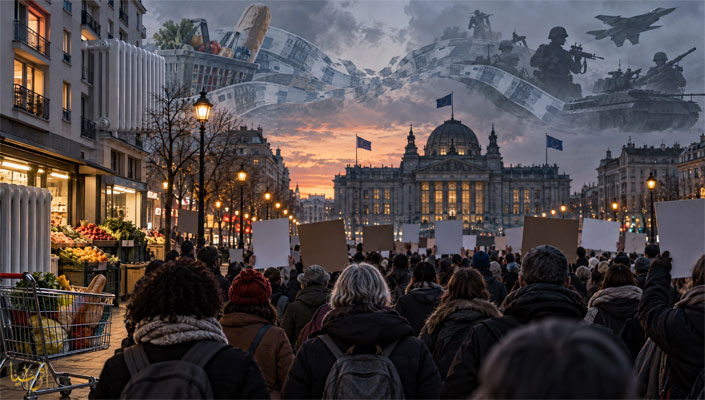
Europe on a Hot Tin Roof: How Austerity and the Cost of Living Fuel Protests
Protests rocking the streets of France, Spain, Portugal, Italy, and Albania are no longer mere reactions to rising prices or local housing crises. The current European scene reveals a deeper crisis regarding the limits of the economic and social model built by the continent over past decades, which was based on providing high levels of public services and social spending alongside sustainable economic growth.
Today, European governments find themselves facing an extremely complex equation: citizens demanding more spending to improve living standards versus new European fiscal rules pushing toward reducing deficits and public debt. Between these two trends, a wave of social anger is rising, the largest in years.
France witnessed the largest movements, with over 800,000 people participating in demonstrations against deteriorating living standards and public services, while some protests turned into riots involving burning public buildings, looting stores, and clashes with security forces. Protesters in Italy, Spain, Portugal, and Albania also took to the streets for seemingly varied reasons ranging from housing crises and living costs to weak educational services and high university fees.
Despite different initial sparks in each country, the common denominator is the decline in purchasing power of European households and the growing sense that governments can no longer provide the level of welfare citizens have grown accustomed to for decades.
Why Did the Crisis Explode Now?
Historically, European governments successfully absorbed many economic shocks through support programs and public spending. However, the past six years have drained a large portion of this capacity.
Governments spent billions of euros during the COVID-19 pandemic, then had to fund massive programs to support families and businesses after the energy crisis caused by the Russia-Ukraine war, followed by billions more to support Ukraine, and subsequently pressures linked to rising defense spending and new geopolitical tensions.
As a result of inflating emergency expenditures year after year, governments bear high levels of deficits and debt at a time when economic growth is slowing. Data from the French National Institute of Statistics and Economic Studies (Insee) show that the French economy recorded zero growth in the second quarter of 2026, while unemployment stood at 8.3% and youth unemployment rose to 21.6%. Annual inflation climbed to 3.1% in September, and energy prices jumped by more than 21%.
Estimates reported by Le Monde from the French Economic Observatory indicate that the decline in purchasing power since 2024 equals a loss of about 1,200 euros annually for a household of two adults and two children.
The External Factor: War, Energy, and Interest Rates
European protests are difficult to understand in isolation from the international environment. The war in Ukraine created a long-term shock in European energy markets, while tensions related to Iran and the Middle East added pressure on fuel and diesel prices throughout 2026, according to analysts and officials cited by economic media outlets.
Additionally, rising interest rates over past years increased the cost of servicing government debt, limiting governments' ability to continue the generous spending citizens grew accustomed to.
From Brussels to the Ballot Boxes
This financial shift has begun reflecting on domestic politics in several European countries. Opposition political forces opposing continued support argue that governments must prioritize spending within their own borders amid rising costs of housing, food, healthcare, retirement, and pressures of budget deficits and public debt.
In France and Germany, aid to Ukraine has entered domestic political discourse, with right-wing and nationalist forces attempting to link foreign spending to the public finance crisis and the need to direct more resources to citizens. Conversely, European governments maintain that supporting Ukraine is part of Europe's security architecture and that the cost of war cannot be separated from the cost of protecting the continent from alleged threats of Russian expansion.
Added to this is another economic factor: a portion of funds allocated for military aid ends up in European defense companies through procurement contracts for weapons, ammunition, and equipment. Thus, supporters of support also present defense spending as a way to expand European production capacity and strengthen an industrial sector that has become central to European priorities.
Northern Europe: Strong Support and Debate Over Costs
Northern European countries present a relatively different model. Denmark, Sweden, Finland, and Norway are among the most committed European countries to supporting Ukraine, and no broad political current has emerged demanding an end to aid, unlike what is happening in other European nations. A recent study published in May by the Swedish Institute of International Affairs indicates that public opinion in the Nordic and Baltic states remains strongly supportive of Ukraine, despite escalating debate over costs and burden-sharing.
Denmark, Sweden, Finland, and Norway also rank high in the volume of support relative to GDP. In Denmark, support since the beginning of the war reached about 10.3 billion euros militarily, plus about 1.1 billion euros civilly, according to the Foreign Ministry. Copenhagen also allocated 60.4 billion crowns (about 8.1 billion euros) for the Ukrainian Military Fund between 2023 and 2028.
As for Sweden, it allocated 40 billion crowns (about 3.5 billion euros) for military support in both 2026 and 2027 within an 80-billion-crown framework for the two years. Total Swedish military support since the full-scale invasion reached about 128 billion crowns (about 12 billion euros), according to the Swedish government.
In Norway, the financial framework of the "Nansen" program reached 274.5 billion crowns (about 23.5 billion euros) for the 2023–2030 period. While the National Audit Office concluded that aid is achieving its goals and arriving quickly, it noted weaknesses in fund management and oversight, making efficiency and accountability part of the debate alongside spending volume.
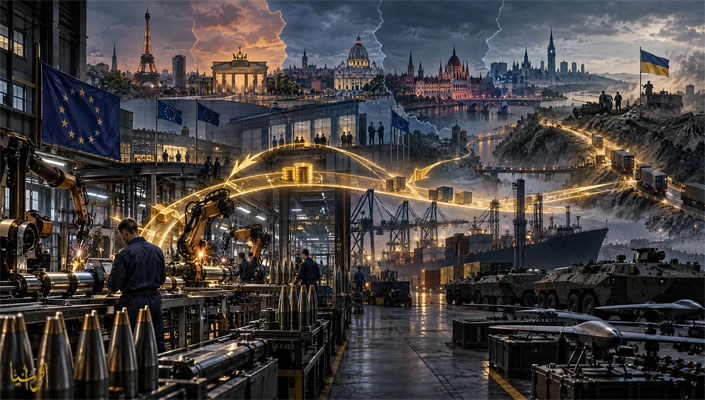
War Money Returns to Europe
Support for Ukraine intersects with the shift in European defense spending. The new European loan essentially stipulates purchasing defense products from companies in the EU, Ukraine, or the European Economic Area and EFTA, with limited exceptions for urgent cases, meaning a portion of funds returns to the European economy via demand for defense industries.
In Northern Europe, industrial cooperation with Ukraine is expanding in drones, air defense, electronic warfare, and ammunition, alongside countries' moves to bolster their defense capabilities.
This coincides with a broader debate on the European budget. Germany, Denmark, Finland, the Netherlands, and Austria called for scaling down the proposed EU budget for the 2028–2034 period, amounting to about 2 trillion euros, amid mounting pressure on taxpayers to fund simultaneous internal and external priorities.
Conclusion.. It does not seem that the major explosion happening inside European countries is likely to recede; as long as Europe continues pumping money into Ukraine at the expense of development programs and economic welfare for its peoples, many of these governments will inevitably fall before the massive rejection of their policies. Europe's resounding defeat via its current policies will come from within.

