
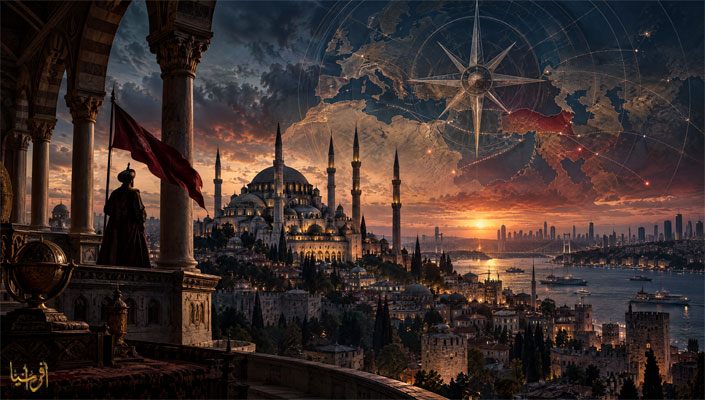
Afrasianet - The "Ottoman ambition" of Turkish President Recep Tayyip Erdoğan in political analyses refers to his efforts to strengthen Turkey’s regional and international standing, inspired by the historical heritage of the Ottoman Empire.
Manifestations of the Ottoman Ambition
- Regional Influence: Intervention and military and diplomatic presence in regions of historical Ottoman influence, such as Syria, Libya, and Iraq.
- Defense Power: Developing local military industries and exporting combat drones to enhance Turkish independence and deterrence.
- Identity Symbolism: Reviving historical and religious symbols, such as converting Hagia Sophia into a mosque and celebrating major Ottoman occasions.
Viewpoints Regarding This Ambition
Supporters: They see these policies as a national renaissance, economic prosperity, and the restoration of a just historical role that protects the nation's interests and strengthens its presence.
Critics: Some consider it a hegemonic or neo-colonial tendency that could lead to tensions, regional isolation, and costly military and diplomatic interventions.
The American magazine Newsweek points to what it described as a new dilemma facing the Middle East, considering that it lies in Turkey and the potential emergence of an Islamic empire in the region through the eventual revival of the Ottoman Empire.
It stated that while there may be a consensus among Americans that their military presence in the Middle East is no longer viable or beneficial to the country, the pressing question is what might happen in the Middle East after the American withdrawal. Most importantly, it concerns the possibility of the return of the Ottoman Empire to the Middle East and the Islamic world.
Given that the Anatolian ruling dynasty rose upon the ruins of the Byzantine Empire in 1453 AD, the Ottomans became the standard-bearers of Islam after their conquest of Constantinople (Istanbul).
With the Ottomans ruling territories from Baghdad to Basra, and from the Caucasus to the Barbary Coast, the Ottoman Sultan Suleiman the Magnificent could claim to be the Sultan of Sultans, King of Kings, and even the "Shadow of God on Earth."
However, two centuries after the prosperity of the Ottoman Empire, it was soon described as the "Sick Man of Europe" after losing most of its possessions in the Balkans and North Africa. World War I marked a decisive turning point, resulting in the empire losing all its possessions—which were partitioned by Britain and France—except for the original Anatolian heartland that formed the Turkish Republic, thereby ending the era of the Ottoman Empire.
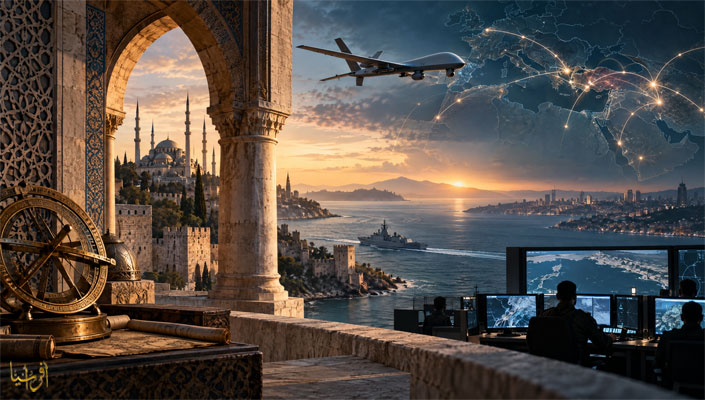
Despite Turkey's serious bid to join the European Union in recent times, and despite the Turks supporting the Americans during the Cold War, things began to change regarding Turkey's continued westward outlook starting in 2003, when Recep Tayyip Erdoğan assumed the post of Prime Minister following an election won by the Justice and Development Party (AKP).
Erdoğan's persona attracts much attention as a moderate Islamist; moreover, he rescued Turkey from devastating economic crises, contributed to the development of his country's economy, and curtailed the power of the military.
Thus, it was no coincidence that Erdoğan’s Istanbul was the destination for the first foreign visits of US President Barack Obama, nor was it strange that the Justice and Development Party won the elections at the beginning of that month for the third consecutive time.
Let us take a closer look at Erdoğan, who indeed seems to dream of developing, prospering, and reviving Turkey in the way that once admired Ottoman Sultan Suleiman the Magnificent.
Verses of Poetry
Newsweek noted verses of poetry by a 20th-century Turkish poet that caused Erdoğan—who began his career as a lawyer—to be imprisoned when he chanted them: "The mosques are our barracks, the domes our helmets, the minarets our bayonets, and the faithful our soldiers." The magazine added that Erdoğan has a clear ambition to revive the Ottoman Empire not merely as an Islamic authority, but as a superpower in the region.
Perhaps from this perspective, Erdoğan is making strenuous efforts to amend the constitution to grant himself greater and stronger power at the expense of the judiciary, the media, and the military—essentially at the expense of the country's secular facade.
It is also from this perspective that Erdoğan described Israel as a "terrorist state" following the Israeli war on Gaza, subsequently sending the Freedom Flotilla last year to break the Israeli blockade on Gaza.
Erdoğan’s Speech
Newsweek pointed to Erdoğan's speech following the AKP's third consecutive election victory, in which he stated: "Sarajevo won today just like Istanbul," "Beirut won like Izmir, Damascus won like Ankara, and Ramallah, Nablus, Jenin, the West Bank, and Jerusalem won like Diyarbakir."
Erdoğan once compared democracy to a tram: "You ride it until you reach your destination, and then you step off." Therefore, we should not be surprised if the final station Erdoğan seeks is an Islamic empire in the Middle East.
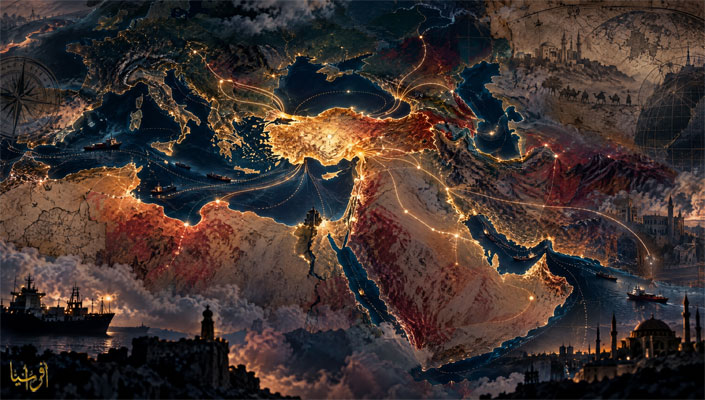
'2050 Map' Reveals Erdoğan's Ambitions to Build a Vast Empire
Turkish influence is expanding and creeping toward areas historically under the control of the Ottoman Empire at a time when the world is currently sinking into political and security turmoil. This creates fertile ground for the Turkish president's plans, who has consistently invested in chaos and played on the chord of stoking Muslims' enthusiasm to resurrect the thesis of the Caliphate.
A 12-year-old map recently displayed by a Turkish television channel, mapping Turkey’s spheres of influence in the year 2050 extending from the southern Caucasus to the northern Mediterranean coast (Greece and Cyprus) and the southern coast to include Libya, North Africa, Egypt, and the Gulf states, revealed the extent of Turkish President Recep Tayyip Erdoğan's expansionist ambitions. This is especially true given his adherence to military interventions on multiple conflict fronts and his investment in unrest and wars to achieve delusional dreams of restoring a defunct Ottoman glory.
The unveiling of the map sparked fears among Turkey's neighbors regarding its growing colonial tendencies, especially after the expansion of military interventions since 2017—following its incursion into northern Syria, its announcement of an agreement granting access to Libyan territories (a vital gateway to North Africa and the African continent rich in resources that caught Erdoğan's eye), its military operations in northern Iraq under the pretext of pursuing Kurds, its plans to enter the Yemeni war, and its intervention in southeastern Europe to support Azerbaijan against Armenia, whose victory in Baku increased the Turkish president's appetite for further expansion.
Motivated by nostalgia for the glories of the Ottoman Empire, Erdoğan aspires to achieve unrealistic dreams—often appearing as illusions—of restoring a collapsed empire. However, this does not diminish the gravity of growing Turkish influence and Ankara’s plans to expand to the furthest possible extent, particularly in hydrocarbon-rich regions, given the progress achieved so far in Syria and Libya, the push toward the southern Caucasus, and achievements in the disputed Eastern Mediterranean waters.
Ankara seeks to capitalize on Azerbaijan's victory in the war against Armenia—especially after Russia's reluctance to intervene to support its ally Yerevan and the US administration's disregard under the previous administration for the risks of growing Turkish influence. Baku's victory whetted Turkey's appetite to expand in all directions to reclaim the lands of the Ottoman Caliphate.
The new relationship between Ankara and Baku rang alarm bells among Russians and Iranians after Erdoğan threw his full diplomatic weight behind supporting Azerbaijan, praised its victory in the Nagorno-Karabakh region, and joined its victory celebrations on its soil. He explicitly stated that "the battle will not end with the Azerbaijani authorities reclaiming their lands; political and military struggle will now continue on many other fronts."
Despite the convictions of some political analysts that the purpose of publishing the alleged Turkish map was an attempt to improve Erdoğan's shaken image, mend his declining popularity, and stoke nationalist enthusiasm among Turks, the risks of the tactical moves of the Turkish president should not be underestimated. He remains determined to revive dreams of restoring Ottoman glory among his citizens to gain public support for his military interventions, despite their negative repercussions on Turkey's international image, the Turkish economy, and the heavy losses inflicted upon the military.
Another equally important objective of showcasing the map is to test regional reactions to Turkey's expansionist ambitions and colonial plans aimed at reviving the old empire.
Although they viewed the publication of the map as a Turkish internal game rather than an imminent threat, Russian and Iranian politicians and officials stated that this map—which includes regions of the North Caucasus as well as the Crimean Peninsula—threatens Russian interests. Iranians also felt that Turkey's sphere of influence would besiege their country from the north, south, and west, threatening its strategic national interests.
Following the appearance of the map, Andrei Krasov, Deputy Chairman of the Russian State Duma Defense Committee, said: "If the Turks want to test the strength of the Russian spirit and our weapons, let them try." Meanwhile, Vladimir Dzhabarov, a member of the Russian Federation Council, noted: "Such information is deliberately displayed to see reactions, but we will not pay attention to it. We have normal relations with Turkey, and we are partners in many areas."
While Iranian officials did not comment on the Turkish plans, Tehran sought last year to strengthen its military presence in the Caspian Sea and establish close maritime relations with countries bordering the Caspian basin (Russia, Azerbaijan, Turkmenistan, Kazakhstan).
Iranians may view the broadcast of Turkey's virtual 2050 sphere of influence map as the latest episode in a series of Turkish provocations, especially after Erdoğan chanted a nationalist poem calling for the annexation of two Iranian provinces of Azeri origin to Azerbaijan. Furthermore, Turkey's state broadcasting corporation published a map on Instagram depicting Iran's oil-rich Khuzestan province as separate from Iran.
Analysts suggest that Erdoğan is currently playing on contradictions in international politics, driven by a sense of a US vacuum in the region that he must exploit, in coordination with Russians and trying to appease them—much like the incident of shooting down the Russian fighter jet in November 2015.
Erdoğan's success in Azerbaijan in coordination with the Russians is not the only reason prompting him to expand the expansion plan; Iranians also collude with him if it serves their interests, alongside the absence of weighty blocs capable of stopping his plans.
The 2050 map is based on predictions by American writer and founder of Stratfor intelligence research center George Friedman in his 2009 book The Next 100 Years: A Forecast for the 21st Century. The book included an element titled "Turkish Sphere of Influence in 2050," predicting the expansion and geographical spread of Turkish influence. This fueled Turkish delusions, as the Turks transformed this "prophecy" into a long-term political investment plan.
James Dorsey, an expert on Middle Eastern and Near Eastern affairs, says that "the military victory made Azerbaijan an alternative western gas transit route that would allow Central Asian nations to bypass corridors dominated by Russia or Iran." Consequently, Russian-Iranian influence recedes in the face of growing Turkish influence.
Capitalizing on the new changes, Turkmenistan rushed to end a long-standing dispute with Azerbaijan and agreed on the joint exploitation of Caspian Sea oil reserves. The agreement followed a deal struck in December for the State Oil Company of Azerbaijan (SOCAR) to purchase up to 40,000 tons of oil per month from ENI Turkmenistan.
The agreement could boost the completion of the Trans-Caspian natural gas pipeline, which would feed the recently operational Southern Gas Corridor, bypassing Russia and Iran to supply Greece and Bulgaria via the former Soviet Union.
Last month, Azerbaijan agreed with Turkmenistan and Afghanistan to develop the "Lapis Lazuli transit corridor," connecting the war-torn state to Turkey. Around the same time, Kazakhstan began exporting copper to Turkey via Azerbaijan in a first step aimed at exploiting Azerbaijani territory as a transit hub.
In recent months, Turkey and Ukraine also agreed to cooperate in developing technologies with military applications related to engines, avionics, drones, anti-ship and cruise missiles, radar and surveillance systems, robotics, space, and satellites.
All these developments create fertile ground for Erdoğan's plans, especially since the matter does not stop at building alliances on direct economic grounds. Turkey seeks to invoke history and culture to strengthen its alliances, particularly in Islamic regions ruled by the Ottoman Caliphate from North Africa through the Gulf to Pakistan, seeking to leverage this to achieve its expansionist goals.
In this context, describing Turkey as the "Mediterranean policeman" does not mean it possesses direct authority over maritime corridors or can impose its will on regional states. Rather, it encapsulates the transformation Ankara seeks to enshrine by expanding its maritime presence and linking its interests to agreements that grant it leverage in border and energy files.
From this perspective, the maritime agreement with Libya takes on significance that transcends the delimitation of economic zones, as it allows Turkey to influence calculations of gas projects and electrical grid connectivity toward Europe, presenting Egypt and Greece with the challenge of protecting their maritime claims. The question remains whether this influence will translate into a sustainable capacity to influence the rules of movement within the Eastern Mediterranean, or remain a subject of dispute bounded by power dynamics and international law.
The Libyan parliament's ratification of the maritime agreement with Ankara comes at a time when the Eastern Mediterranean is increasingly gaining importance as a potential source for diversifying European energy supplies. However, translating offshore reserves into stable exports still runs into political, technical, and financial obstacles. Therefore, the Turkish-Libyan agreement does not automatically mean disrupting gas heading to Europe; rather, it raises the level of risks that governments and companies must calculate before investing in pipelines, maritime connectivity, and exploration projects.
From Bilateral Understanding to Regional Conflict
The Government of National Accord (GNA) of Libya and Ankara signed a memorandum of understanding on November 27, 2019, on the delimitation of the continental shelf and exclusive economic zone between the two parties. On October 20, 2026, the House of Representatives in Benghazi unanimously approved it, canceling its 2020 decisions rejecting agreements with Turkey and severing political ties with it. This move represents a shift in the stance of the legislative institution that opposed the agreement for years, at a time when relations between Ankara and authorities in eastern Libya witnessed a noticeable improvement.
However, the ratification does not create a new agreement, nor does it mean the maritime dispute is resolved. The original memorandum entered into force in December 2019 and was registered with the United Nations; however, registering the agreement does not constitute an international ruling on its legal validity, nor does it settle the rights of other states whose maritime claims overlap with the area in question. Furthermore, the eastern Libyan parliament's decision does not automatically cancel external objections or questions regarding Libyan constitutional procedures and the completion of ratification at the national level.
The importance of the step lies in broadening the base of Libyan political support for the agreement, after it had been primarily linked to the Tripoli government and its close relationship with Turkey. If the rapprochement between the East and Ankara continues, the memorandum may transform from a negotiating tool used by a specific Libyan government into a broader political reference within the country, enhancing Turkey's ability to hold onto it in any future regional negotiations.
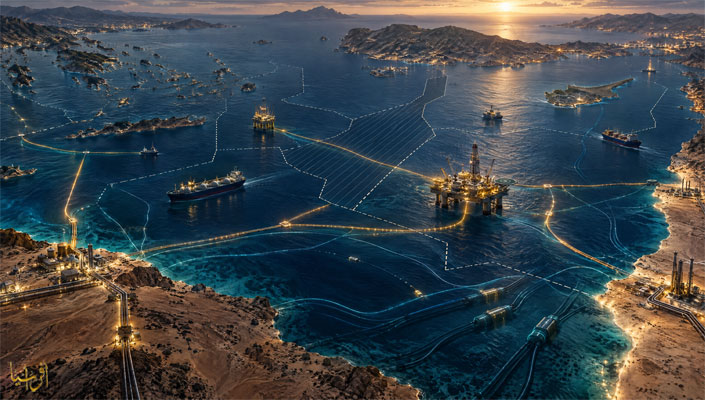
Can the Agreement Disrupt Eastern Mediterranean Gas?
Answering this requires distinguishing between direct legal impact and indirect strategic impact. The agreement does not grant Turkey authority over all Eastern Mediterranean waters, nor does it single-handedly prevent the export of Israeli, Egyptian, or Cypriot gas to European markets. However, it may increase the complexity of projects requiring seabed surveys or laying pipelines and cables across areas where states dispute maritime jurisdiction.
The "EastMed" pipeline project, proposed to transport gas from Israel and Cyprus via Greece to European markets, stands out here. For years, the project has faced obstacles related to high costs, commercial viability, and geopolitical tensions, failing to become an operational export route. Therefore, it would be inaccurate to consider the Turkish-Libyan agreement as the sole reason for its stagnation, even though it adds to the risk environment making investment more complex.
Importantly, regional gas exports do not rely solely on this pipeline. Egypt possesses liquefied natural gas (LNG) export terminals, utilizes its infrastructure to receive Israeli gas, and future arrangements aim to leverage its terminals to export Cyprus's production once some of its fields begin commercial production. According to the US Energy Information Administration (EIA), Egypt was, as of July 2025, the only country in the Eastern Mediterranean with the capacity to export liquefied natural gas.
For Europe, the challenge lies in how to handle competing demands without turning energy and electrical connectivity projects into arenas of confrontation.
This means the agreement may affect certain future choices more than it disrupts existing flows. Major risks emerge when a new project requires long-term financing or contractual commitments spanning decades; maritime disputes can raise insurance premiums, delay surveying and implementation, and increase the likelihood of political or military friction. In the energy sector, increased risk and uncertainty can be sufficient to prompt investors to postpone a project or choose an alternative route, even without an official ban.
Moreover, European energy security is not tied to gas alone. The "Great Sea Interconnector" undersea electricity project, aiming to connect mainland Greece to Cyprus and then Israel, has faced setbacks due to maritime disputes. In October 2026, reports indicated the project was seeking to resume seabed surveying work, while Turkey maintains maritime claims overlapping with parts of the proposed route. Thus, the impact of the dispute extends from gas fields to the infrastructure Europe relies on to diversify its energy sources.
More Than a Dispute with Ankara
The rejection of the agreement by Egypt and Greece cannot be explained solely as an extension of political bickering with Turkey, although competition between Ankara and several regional capitals helped shape mutual positions in recent years. The core of the dispute relates to how maritime rights of islands are calculated—particularly Crete and other Greek islands—and the extent of their impact on delimiting the exclusive economic zone and continental shelf.
Ankara states that the agreement is based on principles of equity and rejects what it considers disproportionate expansion in maritime claims arising from Greek islands, which limits the maritime extension of the Turkish coast. In contrast, Athens argues that islands possess maritime entitlements under international law and that the Turkish-Libyan understanding ignores Greek rights that two other states cannot agree to cancel.
Egypt's objection reflects another aspect of the issue. In 2020, Cairo and Athens signed an agreement delimiting an exclusive economic zone between them, a move opposed by Turkey. Competing claims intersect with Egypt's calculations regarding its maritime rights and energy interests, as well as its partnership with Greece and Cyprus. Following the Libyan parliament's ratification, Cairo announced that the step has no legal effect against it, while Athens rejected it anew.
Nevertheless, overlapping interests do not mean every political objection automatically proves the legal nullity of the agreement. The issue requires distinguishing between the validity of the agreement between its parties, the compatibility of its delimitation with international law rules, and its impact on third-party rights. The fundamental principle here is that a bilateral agreement cannot, simply by being concluded or registered with the UN, impose obligations on a state that was not a party to it or unilaterally cancel its rights.
Consequently, the dispute will not be resolved merely through exchanging rejecting or supporting statements, but rather through negotiations, legal settlements, or recourse to dispute resolution mechanisms when necessary conditions are met. As long as opposing positions persist, the field remains open for using the agreement as a leverage card in files broader than border delimitation.
The agreement strengthens Turkey's negotiating position, but it does not make it the "Mediterranean policeman" in a sense that grants it unilateral legal or military authority over the region. Ankara possesses a long coastline and naval capabilities, and it can leverage its relations with Libya to influence exploration calculations and maritime infrastructure. However, translating this influence into actual control collides with the presence of other states with interests and capabilities, European opposition, and economic interdependency that makes any wide-scale confrontation costly for all parties.
The shift in the relationship between Ankara and Benghazi acquires special significance in this context. Turkey was a major supporter of the Tripoli government during Khalifa Haftar's forces' offensive on the capital in 2019 and 2020, before relations evolved with authorities in the East in subsequent years. Ratification of the agreement signals that past competition no longer prevents both sides from seeking common interests in economy, maritime affairs, and energy.
This rapprochement may open the door for broader Turkish cooperation in eastern Libya, including economic and security spheres. However, the prospect of expanding a Turkish military presence, noted by some analysts, remains a possibility rather than an automatic result of ratification. Furthermore, Libya itself continues to face institutional and political division, rendering the sustainability of any understanding dependent on Libyan parties' ability to maintain internal consensus over it.
For Europe, the challenge lies not only in the possibility that Turkey might use its geographic and maritime position to increase its influence, but also in how to manage competing demands without turning energy and electrical connectivity projects into confrontation arenas. Mutual pressure politics may grant parties negotiation cards, but it can also delay projects requiring stability and multi-state cooperation to become economically viable.
Libya at the Heart of a Larger Equation
The agreement places Libya before an opportunity to assert its maritime interests and claim a share of regional resources, but it also exposes it to the risk that the maritime border file becomes an extension of its internal divisions and external power rivalry. Libyan interest is determined not merely by supporting or rejecting an agreement with Turkey, but by the clarity of the legal foundation underlying the state and its ability to manage resources and negotiate on behalf of unified institutions.
At the regional level, ratification will not halt Eastern Mediterranean gas, but it will tie the future of some of its projects more closely to political and security understandings. Turkey will remain capable of influencing the environment in which these projects operate, without possessing the right to determine their fate unilaterally.
Ultimately, the agreement alone does not draw a new map for the Mediterranean; rather, it reaffirms the map of competing claims and grants Ankara an additional card in the power struggle. The real test lies in whether the parties will use it to launch broader negotiations over borders and benefit-sharing, or treat it as a means to consecrate a fait accompli. In the Eastern Mediterranean, owning gas or drawing a maritime line on a map is not enough to ensure energy reaches Europe; it also requires settling disputes that could turn the sea from an economic corridor into an open arena of competition.
Ankara's Illusions in the Eastern Mediterranean.. Ambitions and Power Calculations
The Eastern Mediterranean region enjoys a unique state of geopolitical and geoeconomic reshaping. Today, it stands at a dividing line between two opposing paths: either sustainable integration through energy resources, or sliding into an arena of conflict and warfare due to mutual suspicions and conflicting regional interests.
Massive gas discoveries, geographic connectivity, and the collective desire to protect shipping lanes, maritime security, and economic cooperation represent strong reasons agreed upon by these blocs' parties, including the necessity of regional stability to guarantee the flow of investments and energy exports to European and international markets.
Cairo, Athens, and Nicosia developed a trilateral cooperation framework embodied in periodic summits and cooperation on energy and security files, alongside the establishment of the EastMed Gas Forum in Cairo, providing a broader regional framework for gas cooperation.
This axis focuses on maximizing benefits from Egyptian LNG liquefaction plants and turning Egypt into a regional energy hub, with differing partnership nature and priorities with Tel Aviv, while maintaining the balance and joint technical coordination dictated by the reality of discovered fields.
Meanwhile, the trilateral axis (Israel-Greece-Cyprus) adopts a close security, military, and economic partnership reinforced by joint military exercises, high-level security coordination, electrical grid connectivity projects, and gas transport plans.
Despite signs of cohesion, this formula remains surrounded by complexities due to geopolitical pressures and each party's calculations regarding regional stability and relations with major powers.
Between the first and second axes, Turkey represents the most complex variable in the security and regional integration equation of the Eastern Mediterranean. It stands alone as a party lacking full trust among active powers in the opposing regional coalitions, making it the counterpart source of concern for these blocs.
It stands at the heart of this equation as a principal competitor seeking maritime influence and regional weight matching its geographic and military size, relying on the "Blue Homeland" doctrine and maritime agreements with Tripoli. However, Turkey's unilateral steps and moves in maritime boundary delimitation and exploration files have made building partnerships with it arduous, reinforcing its structural isolation within recognized regional institutional frameworks and making its presence a factor for further instability.
Mutual fears between Ankara and other parties are rooted in accumulated historical factors and regional policies pursued by Turkey over decades, characterized by an over-reliance on hard power tools and attempts to impose a fait accompli in maritime corridors and exclusive economic zones.
The events of 2011 marked the peak of Turkish ambition to return to its old Ottoman legacy in the East under the banner of the Islamist current. Ankara saw the Muslim Brotherhood networks reaching power in Egypt, Tunisia, and Libya as an opportunity to entrench the "political Islam" model and form a regional front harmonized with Ankara's foreign policy.
This ideological orientation led to sharp regional polarization, with the Turkish-Qatari alliance strengthening against other regional blocs, reflected in hot files like the Libyan crisis and the conflict in Syria. Conversely, the policy of ideological expansion and direct support for the Islamist current led to political isolation and economic pressure on Ankara.
Despite talk of Turkish-Israeli or Turkish-Greek differences, Egypt remains the most important digit in the equation. The crisis that erupted after the 2013 revolution—leading to the removal of the Muslim Brotherhood backed by Ankara—was not merely a diplomatic disagreement, but touched directly upon security dimensions, particularly regarding the Libyan file and supporting specific actors on Egypt's western borders. This history causes decision-makers in Cairo to handle the rapprochement path based on verification and conditional steps.
Due to historical deposits, both sides realize that stability in Libya and Eastern Mediterranean security represent an indispensable intersection space. Cooperation in energy, trade, and regional de-escalation provides a framework limiting direct clash probabilities, even amidst suspicions regarding long-term intentions.
It can be said that relations between Cairo and Ankara gradually shifted from acute ideological polarization to practical interest management, without implying the end of structural differences between the parties. Ideological considerations remain postponed in Turkish political calculations, while caution and security priority govern the Egyptian stance.
Shifts in Turkish policy since 2021 demonstrated that Ankara's economic and security determinants can outweigh any ideological commitment at decisive moments. Reduced direct support for certain Islamist forces, a toned-down media rhetoric, and curbing political activities of Muslim Brotherhood elements on Turkish soil were not fleeting maneuvers, but rather responses to imperatives of improving the economy and recalibrating the balance of power in the Eastern Mediterranean.
However, doctrinal and political ties between the Justice and Development Party and the political Islam current remain present in its intellectual structure. This presence grants Turkish foreign policy flexibility in using "soft power" or retaining unofficial leverage cards to be invoked if regional conditions change, without a public commitment harming direct diplomatic ties.
Despite recent de-escalation and the "zero problems" diplomacy Ankara attempts to revive, the institutional framework of existing alliances in Eastern Mediterranean views Turkish moves as a prominent source of tension affecting regional stability. This makes any future rapprochement conditional on genuine guarantees and tangible behavioral change in the region, rather than mere temporary diplomatic messages.
In any case, critical alliances formed in Eastern Mediterranean can become a launching pad and a political, economic, and security attraction factor, presenting a good opportunity to manage regional economic resources. At the same time, this opportunity could turn into a trial if Ankara decides to cross stability thresholds in favor of dreams and ambitions whose time has passed and which the regional environment no longer permits.
Turkish Expansion in Syria
Following the fall of Bashar al-Assad's government, Turkey-affiliated factions and allied Islamist groups are competing for power in Damascus. Here, the approach of Turkish President Recep Tayyip Erdoğan aiming to revive the Ottoman Empire in a new formula known as "New Turkey" becomes largely evident.
A century ago, present-day Syria was part of the Ottoman Empire. Today, Ankara finds ways to influence conditions within all countries—without exception—formed in the 1920s on territories formerly belonging to the collapsed empire. Thus, Pan-Turkic ideas are transforming into practical reality.
Syria is a highly convenient arena for Turkish expansion, with reliance on Turkmens constituting an important element of Turkish policy there. Some members of this ethnicity are Turks who settled in northern and northwestern Syria since the Ottoman Empire era. Even while Bashar al-Assad's government was still in power, Turkey carried out three military incursions into Syria targeting Kurds between 2016–2017, in 2018, and in 2019, and did not withdraw its forces. Meanwhile, schools, Islamic centers, and Turkish media outlets were established in the region. Practically, the Turkic or pro-Turkish world is being unified to establish what is called "Greater Turan."
Following its incursion into Syria, Turkey hopes to resolve the Kurdish issue—an urgent matter for it—while ignoring the fact that Syrian Kurds did not rely in any way on PKK support nor participated in terrorist acts inside Syrian territory. Nevertheless, Turkey accuses them of doing so.
Syrian Kurds possess substantial military force through armed formations maintaining order in northern Syria, previously armed by the United States. This highlights the keen interest of various actors in this oil-and-gas-rich region.
Syrian Kurds established a new system of governance over territories under their control based on democratic confederalism, which aligns with neither the Syrian nor the Turkish constitution. However, the new Syrian authorities recently reached an agreement regarding the full integration of Kurdish formations into Syrian state institutions, while preserving Kurdish language instruction in schools across Kurdish-populated areas.
Time will tell how durable this agreement is. Kurds are not Arabs and are always ready to fight and defend themselves.
During Bashar al-Assad's rule, the Syrian Kurdistan region, known as "Rojava," managed to wrest a self-declared autonomous status during battles against jihadists. Yet Rojava's enemies far outnumber its friends.
Damascus and Ankara hope to resolve the Kurdish issue in Syria militarily in line with their interests, refusing even to consider granting Kurds ethnic autonomy or establishing a federal entity for them within the country.
In January 2026, the Syrian army launched a decisive offensive against Kurdish positions, with Arab tribes shifting to its side. By that time, Arabs constituted the majority of Rojava fighters.
Thus, the influential Shammar tribal militia not only abandoned its positions but actively contributed to capturing strategic locations such as the Al-Yaarubiyah border crossing. Arab tribal militias, forming a large part of the Syrian Democratic Forces (SDF) in Rojava, played a decisive role in defeating those forces.
The presence of a small US military unit failed to curb the predatory regional powers casting their eyes on oil-and-gas-rich areas east of the Euphrates.
In reality, oil and gas export revenues from the east of the Euphrates flowed into Rojava's budget, comprising Kurds and Arabs as part of a Syrian society independent of Damascus.
The regime change in Syria is described as a Turkish victory aligning with Ankara's desire to keep conditions in this region under its control. Yet Erdoğan faces numerous competitors here, including Americans who do not intend to withdraw their military bases from Syria despite promises made to that effect.
Turks exploited the weakness of the Syrian army in their war against Assad's government, arming affiliated Islamist groups, equipping them, and paying individuals for their service—a practice Turkey continues today. In Afrin, police officers wear Turkish uniforms, and Turkish flags flutter everywhere.
Ankara does not hide its ambitions to become the primary transit hub between energy producers in the east and south and consumer markets in the west. To achieve this, Turkey needs a strong Syrian state under its protection.
Leveraging its influence among Syrian politicians, Turkey expresses readiness to oversee Damascus, place the Syrian army under its control, and ensure weapons purchases from it. Turkey is also prepared to economically exploit Syrian resources. However, Ankara's performance in this sphere is not equally successful, suffering from huge foreign debt, high inflation, and the continued depreciation of the Turkish lira, perhaps because modern expansion requires massive financial investments.
This likely explains why Turkey is not very reserved in choosing economic partners, supplying "Israel" with oil, including Syrian oil. Simultaneously, as is known, "Israel" occupied part of Syrian territory and recently struck an air base in northern Syria, 72 kilometers from the Turkish border, after the Turkish army entered Deir ez-Zor and secured a bridge over the Euphrates River.
Israeli Prime Minister Benjamin Netanyahu stated: "We will not allow the Turkish army to advance southward, because that threatens us."
Turkey's pursuit of control over oil-rich Syrian regions underscores Erdoğan's new ambitions. The Turkish president tries to exploit the Syrian crisis to address internal problems in Turkey, expand his country's presence in the Middle East, and strengthen its influence in lands that were historically part of the Ottoman Empire.
Ankara's neo-Ottoman ambitions, reliance on radical Islamist groups, and attempts to impose tutelage over Damascus contradict the interests of all regional peoples.

