
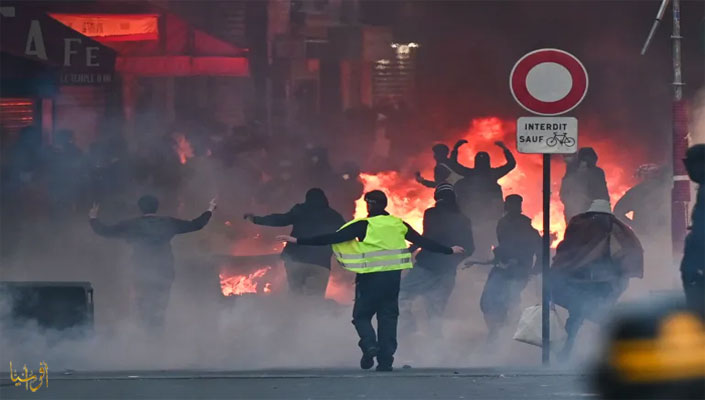
Simultaneous protests across Europe.. Do they herald a velvet revolution?
Afrasianet - Mourad Al Hajj - Europe is facing a compounding social and economic crisis driven by soaring costs of living, energy, and housing, declining competitiveness, and defense spending pressures. This threatens the sustainability of the welfare state and deepens the trust gap between citizens and institutions.
On the streets of Paris, Brussels, Milan, and Lisbon, the ground is moving these days. Europeans are demanding higher wages, better schools, and lower rents. All of this is customary for a continent that has reached the level of desired and envied prosperity among the third world. But they are also demanding, without explicitly saying so, the continuation of a historical agreement whose conditions the continent may no longer be able to fulfill: that every generation lives better than the one before it, that the state guarantees a high level of social security, and that work remains a reasonable path to housing, stability, and family formation.
That agreement, which formed the core of the European social model after World War II, is facing a test today that goes beyond budget crises and rising prices. Societies accustomed to distributing the fruits of growth now find themselves forced to distribute the costs of relative decline. Worse still, governments are asking their citizens to accept sacrifices at the very moment their ability to convince them that those sacrifices will yield a better future is shrinking.
In reality, it began in France, which witnessed demonstrations involving more than 550,000 people according to Interior Ministry estimates, and the protests spread to Italy, Portugal, and Belgium. In Brussels, this was preceded by a mobilization on October 9, involving about 30,000 people according to the police and 50,000 according to unions, protesting austerity measures and social reforms. Meanwhile, Spain is witnessing a mounting mobilization surrounding the housing crisis. Despite differing demands and national circumstances, these movements intersect at a single feeling: that European institutions are no longer capable of protecting the standard of living they promised.
The Generation Sees the Light at the End of the Tunnel Going Out
What is striking about the current wave, more than its size, is its social composition. In France, protests started in high schools, where students objected to teacher shortages and deteriorating educational facilities, before unions, workers, and other sectors joined. In Belgium, students rejected educational reforms that make continued university support more closely tied to the speed of completing studies, despite many of them being forced to work to cover their expenses.
In Portugal, the housing crisis turned into a protest against the impossibility of young people achieving economic independence. Data reported by the British newspaper "The Guardian" indicated a 124% increase in housing prices between 2015 and 2024.
This reality, with its clear features, is not poverty in the traditional sense. Rather, it tends toward an ever-widening gap between what society and the state promise, and what the individual can achieve in actual reality.
In these countries, education, work, and savings formed a social ladder that could be climbed and ascended. Today, the young European discovers anew that holding a university degree does not guarantee stable employment or homeownership, and that high tax deductions do not necessarily guarantee improved public services.
This newly discovered reality, in its current magnitude, pushes demonstrators to defend the possibility of building an independent life, and if they fail, the question of the social legitimacy of governance becomes more urgent.
Loss of Russian Energy: The Collapse of a Pillar of Prosperity
Many factors can be listed in the context of explaining the current European phenomenon. But there is a fundamental crossroads that the Old Continent witnessed less than five years ago. The European predicament cannot be understood without returning to the economic equation that allowed the continent to finance the welfare state for long decades.
European industry, especially German industry, benefited from relatively low-cost Russian gas, the vast Chinese market, and the American security umbrella, which eased the need for heavy military spending and provided the European side in NATO with a sense of strategic security, at least morally. This combination allowed massive resources to be directed toward health, education, retirement, and social protection. However, the war in Ukraine broke one of the most important legs of this equation.
Reduced reliance on Russian energy reshaped production costs, especially in the chemical, steel, fertilizer, glass, and agricultural industries. Despite prices falling from their 2022 peak, Eurostat data confirms that industrial energy production prices in the European Union in December 2025 were 66.3% higher than their level in January 2021. Naturally, all of this has a heavy price.
The paradox is that the separation was not complete. According to the European Union Agency for the Cooperation of Energy Regulators, Russian gas still accounted for about 12% of European demand in 2026, with long-term supply contracts continuing in a number of countries.
The problem, therefore, is not merely replacing one energy source with another; it is the loss of a historical competitive advantage at a time when industry requires massive investments to decarbonize, update production lines, and compete with Asian products. Every extra euro spent by an industrial enterprise on energy is a resource it cannot easily direct toward wages, research and development, or expansion. Naturally, declining corporate profits or the relocation of investments abroad leads to a shrinking tax base that funds the welfare state.
Thus, a geopolitical crisis that started on the borders of Ukraine moves to the heart of European societies, whose annual budgets have been exhausted by aid to Ukraine—something that can be felt in hospitals, schools, and retirement accounts inside European cities.
Lost Between Washington and Beijing
However, the loss of Russian energy is only part of a broader predicament. Europe faces growing American pressure to reduce its technological and strategic reliance on China, at the same time that it needs the Chinese market, supply chains, and industrial capabilities.
Washington wants its European partners to participate in containing China's rise, but it competes with them economically at the same time through tariffs and industrial policies that attract investment. The Bruegel Institute pointed out that the US-European trade agreement for 2025 imposed a baseline tariff of 15% on many European exports to the United States.
Conversely, European companies face advanced Chinese competition in electric vehicles, batteries, machinery, and industrial technologies. Negotiations in Brussels and Beijing during October revealed the scale of the imbalance, with Bruegel estimating the European trade deficit with China at about 360 billion euros. These are enormous figures, but their tangible impact on society becomes increasingly inflammatory and generative of turbulent events.
However, reducing the crisis to these external pressures would not capture its full meaning if we overlook its overlap with other structural crises. Europe also suffers from weak private investment, slow innovation, fragmented capital markets, and regulatory complexities. The European Commission admitted in its 2026 Annual Competitiveness Report that Europe's industrial base is eroding and that factory closures and job losses have become manifestations of this decline.
Here emerges the strategic paradox: Europe is required to be independent of Russia in energy on the one hand, and cautious of China in technology and industry on the other. Thirdly, it is required to increase its defense spending in response to shifts in relations with the United States, yet it has not yet built a new productive base capable of funding this autonomy. Consequently, the cost of geopolitical repositioning is not borne by governments alone, but gradually shifts to citizens.
The Welfare State Confronts an Unfamiliar Calculus
The European welfare state was built on a simple economic assumption claiming that productivity growth allows for higher wages and tax revenues sufficient to fund retirement, health, and education. Today, this assumption is being shaken.
The sequence compounds negatively. Aging increases spending on pensions and healthcare, while productivity growth slows down, and governments need additional investments in defense, energy, and infrastructure. The 2026 European Economic Report warns that continued weak productivity threatens the bloc's ability to fund its own social model.
Therefore, austerity measures do not look like neutral financial decisions, but rather like a renegotiation of the relationship between the state and society. When the government cuts spending on education, it shifts part of the future cost onto families. Raising the retirement age redistributes working and resting years across generations. Meanwhile, the state's failure to control the housing crisis results in real estate wealth defining class standing more than professional effort does.
More dangerously, these transformations are taking place within societies accustomed to viewing public services as acquired rights, not privileges conditional on the economic cycle. Hence stems the intensity of public anger among people who do not compare their conditions to poorer societies, but rather compare their present to the future they believed they would inherit.
This crisis also opens the door to profound political transformations. Nationalist right-wing movements interpret the decline through immigration, globalization, and the loss of sovereignty, while the left interprets it through wealth inequality, declining public investment, and the dominance of economic interests. Both discourses find an audience among groups feeling that traditional parties no longer represent them. Yet the risks expand further when looking at the alienation of generations from democratic institutions themselves, following the loss of belief that voting can alter the conditions of daily life.
This leads to the conclusion that the deeper meaning of these demonstrations lies in the European street demanding that the state protect the social contract, while the state discovers that protecting this contract has become tied to strategic decisions extending beyond its national borders.
For decades, Europe was able to transform its economic power into social security. The new challenge is whether it can transform its social security into a source of economic and political power through education, productivity, and innovation, before defending prosperity becomes a permanent struggle between generations competing for slowing-growth resources. In short, the picture in Europe is bleak, and prospects for sustainable solutions look dim as the continent nearly completely loses its sovereignty.

