
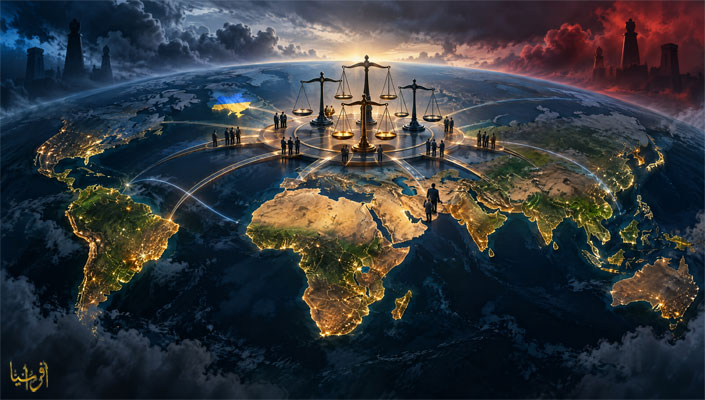
Afrasianet - As Ukraine seeks to strengthen its political and diplomatic presence in the Global South (including Arab countries, Africa, Asia, and Latin America) to gain support in its war with Russia, most of these countries are adopting a position of neutrality and non-alignment.
Relationship highlights and dynamics:
• Ukrainian rhetoric: Ukrainian diplomacy led by President Volodymyr Zelensky is focusing on the concepts of "anti-colonialism" and "self-determination" to try to link its historical experience with that of the countries of the South against foreign domination.
• The position of the countries of the South (neutrality and hedging): Most of the countries of the Global South prefer not to fully engage in this conflict, and to practice a policy of balance and freedom of action, as they maintain their economic and political interests with both the West and Russia at the same time.
• Demands and initiatives: Kyiv is constantly calling on the countries of the South not to remain silent and to act to pressure or contribute to ending Russian attacks, while these calls are met with a variation in response and greater interest in diplomatic and negotiated solutions that serve their economic stability (such as food and energy security).
Ukraine is seeking to strengthen its political and diplomatic presence in the Global South, including Arab states, in an effort to mobilize more support for its position in the war with Russia, at a time when the majority of Arab countries continue to pursue a policy of balance and not fully engaging in either side of the conflict.
Political studies and analyses indicate that in recent years, Kiev has adopted a discourse that focuses on issues of colonialism and self-determination, in an attempt to link its historical and political experience with that of the countries of the Global South.
A recent academic study concluded , pointed out that Ukrainian diplomacy uses issues of historical memory and anti-colonialism to build a discourse of solidarity with the countries of the South.
On the other hand, observers believe that this discourse does not always receive a broad response in the Arab world, as many Arab countries prefer to maintain their relations with both Russia and the West, with a focus on mediation and diplomatic solutions.
According to an analysis published by the Stimson Center, Kyiv has not been able to persuade most Arab governments to take practical steps against Moscow, despite a number of them previously voting in favor of UN resolutions condemning the Russian side.
According to observers, the controversy over the reburial of Andriy Melnyk, one of the leaders of the Ukrainian Nationalist Organization, in Ukraine is prominent.
Kyiv says the operation is part of the repatriation of the remains of Ukrainian historical figures and honoring those it considers symbols of independence.
Moscow describes Melnyk as a collaborator with Nazi Germany, a description quoted by Reuters as saying about Russia's position, while Kyiv refuses to present him as such and considers him a historical national figure.
Thus, according to observers, the Arab position remains governed by a balance between international relations and national interests, away from the complete bias of any party in the conflict.
The majority of the countries of the "Global South" categorically reject the relationship with Ukraine, but rather adopt a position based on "active neutrality" and non-alignment, preferring to distance themselves from the conflict between the Western camp and Russia to protect their national and economic interests.
The determinants of the position of the countries of the South towards Ukraine can be summarized in the following points:
• Maintaining neutrality and rejecting sanctions: Although many countries in the South (such as Brazil, Mexico, and Egypt) have voted at the United Nations in favor of resolutions supporting Ukraine's sovereignty, they refuse to engage in the system of Western sanctions imposed on Russia and continue their trade with Moscow.
• Accusation of double standards: Many southern capitals see Western powers as showing enormous sympathy and unlimited support for Ukraine, while ignoring conflicts and other humanitarian crises in the Global South (such as in the Gaza Strip and the Middle East).
• Offering bottom-up diplomatic solutions: Prominent countries in the south (such as China, India, and Brazil) are pushing for an immediate ceasefire and settlement negotiations, which Ukraine currently sees as unacceptable as it could mean ceding Russian-controlled territory.
The most important reason why the "South" did not join the West in trying to isolate Russia is that the West does not seem interested in having an equal and meaningful dialogue with the South to jointly discuss the Ukrainian crisis and try to find a balanced and appropriate solution to it.
Another explanation is that in the West, the Russia-Ukraine conflict is portrayed as part of a global clash between "good democracies" and "bad authoritarian regimes," a new crusade to defend Western liberal values against "Eastern barbaric authoritarianism."
However, it is known that many countries in Africa, the Middle East, and Southeast Asia cannot fully comply with Western standards of political organization of society.
Let us remember that many countries of the South were not even invited to attend the virtual summit of democracy organized by the Biden administration at the end of 2021. So, why are these "inqualified" countries in the South obliged to strictly adhere to the code of conduct of this exclusive club that they have not even accepted?
The most important reason why the "South" did not join the West in trying to isolate Russia, however, is something else. The truth is that the West does not seem to be interested in having an equal and meaningful dialogue with the South to jointly discuss the Ukrainian crisis and try to find a balanced and appropriate solution to it.
Perhaps there is no more widely accepted fact around the world today than the idea that the United States is no longer as monopolar as it was in the 1990s.
The international system is at a historical turning point, so it is not possible to describe the developments that are taking place in it using the same descriptions and concepts that have governed the international system in the past, such as bipolarity, the Cold War, the free world, non-alignment and the South, or even the division between the West and the East.
At the start of the Ukraine war, the United Nations General Assembly voted by 141 votes to 5 to condemn the Russian invasion, while 47 countries abstained, rejecting the Russian invasion and at the same time not convicting Western policy.
In April 2022, 58 countries abstained from voting to expel Russia from the UN Human Rights Council.
These countries do not have political systems of a single nature, as they include many prominent democracies such as Brazil, Indonesia, South Africa, and India. At least 4 billion people, or more than half of the world's population, live in more than 100 countries that do not want to take sides, according to estimates by The Economist, which also indicates that their economic influence is rising.
Take, for example, the 25 largest non-aligned economies, or the "Transaction-25" (defined as those that have not imposed sanctions on Russia, or have said they want to be neutral in China-US competition), which together make up 45% of the world's population, and their share of global GDP has risen from 11% when the Berlin Wall collapsed to 18% today, more than the European Union.
Does this mean that we are in the process of a new revival of the Non-Aligned Movement?
The Non-Aligned Movement began in the 1950s as an alliance of developing countries newly independent of colonialism. These countries were keen to pursue their independent foreign policy away from the exigencies of the Cold War between the United States and the Soviet Union, which turned into a zero-sum game between the two superpowers at the time.
Five Notes
• First: Absence of a university identity
The behavior of these countries is individual rather than collective, and it is an expression of their awareness of their national interests as they know them, so coordination among them revolves around specific topics or issues, and follows intersecting paths or blocs that overlap, rather than a single bloc that expresses the sum of the interests of its members.
The OPEC Plus group includes OPEC countries that have witnessed intense competition among its members for production ceilings, in addition to Russia and a number of other countries that have been brought together by the interest of setting oil production ceilings to ensure that competition between them is prevented and that oil prices are kept relatively high.
This characteristic is strongly related to the nature of interactions in the world now, which are absent from the totalitarian values and governing ideologies, making the interactions revolve around immediate and not permanent, immediate rather than long-term interests.
The state of political division over the basic trends within the countries that make up the phenomenon of non-alignment can be easily observed, and it is an expression of the lack of societal consensus on the determinants and nature of the social contract, and the lack of charismatic leaders capable of creating the main current in society. This applies to democratic systems such as Brazil, India, and others, and authoritarian regimes as in our countries.
Neutral countries have little in common to be cohesive like the West, or even a Sino-Russian alliance of interests. Megademocracies like Brazil and India have few common interests, let alone the absence of a common agenda with money-rich monarchies like the Gulf states.
• Second: Neutrality is an expression of frustration
Their attitude toward the Ukraine war is the product of deep frustration — in fact anger — over the mismanagement of Western-led globalization since the end of the Cold War, which, according to David Miliband, the former British secretary of state for foreign affairs, "is a symptom of a broader syndrome: anger at Western double standards and frustration with stalled reform efforts in the international system."
Since the 2008 financial crisis, the West has failed to show that it is willing or able to push a more equal and sustainable global economic deal or develop the appropriate political institutions to manage a multipolar world.
The Ukraine war is presented as evidence of double standards and values when it comes to caring for civilians. The West is also said to have shown far more sympathy for the victims of the war in Ukraine than it is for the victims of wars elsewhere.
The UN appeal for humanitarian aid to Ukraine was 80% to 90% funded. Meanwhile, half of the UN's 2022 appeals for people caught up in the crises in Ethiopia, Syria and Yemen were not funded.
From the issue of Palestine, which the Western position has been invoked, or the presentation of a narrative about it as a conflict between democracies and authoritarianism that has not had significant resonance outside of Europe and North America, of the 50 countries that Freedom House considers "dictatorships," 35 countries received military aid from the U.S. government in 2021.
• Third: Hedging with open options
Hedging is a policy of uncertainty in the international system, said Matthias Spector, a professor of international relations at the Fundação Getulio Vargas in São Paulo and a non-resident scholar at the Carnegie Endowment for International Peace.
These countries pursue a hedging strategy because they see the future distribution of global power as uncertain, and they want to avoid commitments that will be difficult to fulfill.
With limited resources from which to influence global politics, developing countries want to be able to quickly adapt their foreign policies to unforeseen circumstances, and take advantage of the opportunities and advantages that can be seized from the two rival parties, Indonesia wants to benefit from both Chinese and Western investment, and Turkey, despite its rejection of the invasion of Ukraine and its NATO membership, has been keen to strengthen its economic ties with Russia.
Ukraine is the latest game to make power and maintain American hegemony, but it has created non-alignment, which calls for accumulating it not by celebrating China's rise but by trying to create a new international order.
Because hedgers value discretion, they may form appropriate partnerships to achieve specific foreign policy goals, but as I noted earlier, they are unlikely to form general alliances, which distinguishes hedgers today from Cold War non-aligned states.
Many in the West associate the multipolar world order with conflict and instability, preferring a dominant United States, as was the case after the collapse of the Soviet Union. This is not the case among the countries of the South, where the prevailing view is that multipolarity can serve as a stable foundation for the international order in the 21st century.
Yet it is not at all clear that developing countries will be better off in multipolarity than under previous global regimes.
• Fourth: Common Agendas
3 topics that can represent an area of joint action among developing countries:
• Increasing their roles in decision-making in international institutions
For decades, African states have called for reform of the UN Security Council and the reshaping of the broader international order on fairer terms.
According to the Institute for International Peace, more than half of the Security Council meetings and 70 percent of its resolutions that include Chapter VII mandates — those that allow peacekeepers to use force — are related to African security issues.
Representatives of low- and middle-income countries have not been adequately involved in the management of the COVID-19 vaccine distribution program. This under-representation has hampered efforts to achieve equitable distribution of vaccines and effective delivery of other health services.
• Forging a more equitable way to address global risks
Climate change is an example of many issues in this area. Given their limited responsibility for historic carbon emissions and their vulnerability to climate change, the Non-Aligned States will seek to have more influence in climate policy.
• Broad collective support for the most urgent priorities of developing countries
Reforming international economic institutions to make them more responsive to the needs of aid recipients and debt-ridden countries is an urgent priority for the countries of the South.
• Fifth: How do we view the developments in the international system?
Here two points can be mentioned:
o The peoples of our region, as well as Africa, have paid the greatest price for the totality of the changes in the international system, and as such, we and Africans must be leading voices for justice, which is defined as equity, equality, accountability and reparation for the damages of the past.
o As a result of their pursuit of national development, the countries of the South are fiercely advocating globalization because without it they cannot achieve their goals, benefiting from the influx of international investment and the reformulation of supply chains away from China.
In addition, young people's aspirations to integrate into the world and their desire to benefit economically, culturally and educationally from what this integration provides, so it is essential to see the developments of the international system from the perspective of the younger generations who want to live in a world of equality and justice, and to take their concerns, interests and aspirations seriously.
Across the Global South, people are increasingly open to engaging with the world fearlessly. The population of most developing countries is young, energetic and impatient, seeking to create a world order in which they can thrive, and a significant segment of the cultural and economic elites of the Global South and part of popular movements are pushing for progressive reforms that can provide a basis for cooperation with them and their counterparts around the world.

