
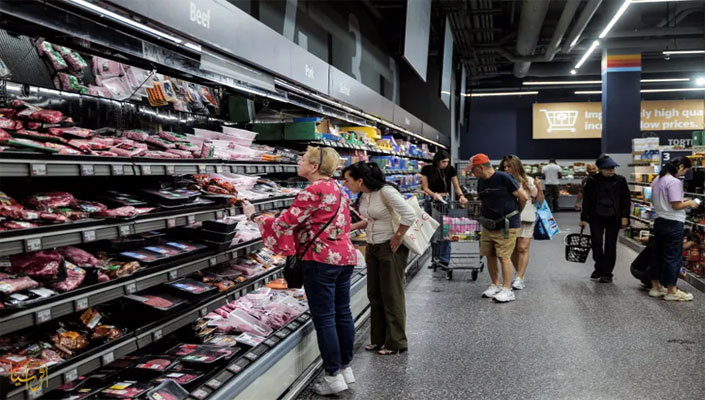
Cost of living weighs heavily on the American voter as the midterm elections approach (Reuters)
- Midterm Elections: When politics is decided at the gas pumps and in the supermarket.
- Inflation and the middle class suffering from tariffs and the war on Iran drive voters to punish Republicans.
Afrasianet - Mustafa Youssef - On November 3, Americans will head to the polls with a simple question in mind: Has my life become easier or more expensive? Polls indicate, nearly two years after Donald Trump's return to the White House, that the cost of living has risen. From here I begin my reading, which is economic before it is partisan.
A Mood That Leaves No Room for Interpretation
The latest Reuters/Ipsos poll placed Trump's approval rating at 31%, the lowest level of his political career, and showed Democrats leading the generic congressional ballot by 12 points. A Washington Post and ABC poll recorded a comparable approval level, with seven out of ten Americans stating that fuel prices had exceeded their purchasing power.
More importantly are the independents—voters not affiliated with any party—who typically decide the outcome in swing suburban districts. In CNN polls during the summer, the number of those opposing Trump among them outnumbered his supporters by more than three to one.
Tariffs.. A Tax Without a Name
Trump promised that foreigners would pay, but a study by the Kiel Institute (analyzing over 25 million shipments) found that Americans bear about 96% of the cost, compared to about 4% borne by foreign exporters. The American importer pays the tariff to customs, then passes it on to the distributor, retailer, and consumer. The Yale Budget Lab estimated the cost at about $1,400 annually for a middle-class family, while lower-income families bear a heavier burden relative to their income.
This carries a social dimension rarely discussed: tariffs are regressive in nature. A limited-income family spends a larger percentage of its income on physical goods—from clothing and appliances to spare parts—making them more affected than a wealthy family, a larger share of whose spending goes toward services. The very class Trump addressed as the "forgotten man" is the one paying the largest relative bill.
As for promises to increase factory jobs, they have not yet materialized; manufacturing jobs have declined every month since April 2025. The White House points to a boom in factory construction, but it is largely driven by the artificial intelligence and chip sectors, and cannot be attributed to tariff protection alone.
Annual inflation reached 3.7% in September, compared to 3.4% the previous month. Tariffs played a major role in this, alongside rising energy prices following the war on Iran. However, the voter does not parse out the causes: they see prices rising and hold those in power accountable.
Lost Allies and Factories Paying the Price
Canada is the United States' largest trading partner, and supply chains between the two countries—especially in the automotive sector—are so intertwined that a part crosses the border multiple times before becoming part of a car. When a tariff is imposed at each crossing, the cost multiplies for the manufacturer and then the buyer. Europe, an indispensable partner, has become the subject of successive trade investigations. Trust is capital: a partner that cannot guarantee Washington will honor a signed agreement delays its investment or looks for alternative markets.
From Detroit, I see this daily. Industry here is not a single factory, but a network of small workshops and suppliers. An auto parts manufacturer finds that steel protection does not provide cheaper material, as local suppliers raise their prices under the umbrella of tariffs, making them pay more for the same material. According to a Marist poll in mid-October, Trump’s approval rating among likely voters in Michigan is 42%, and Democrats lead the generic congressional ballot by six points.
An Endless War with No Declared End
With China, Washington does not seem to have a single goal by which success can be measured: Reduce the trade deficit? Reshoring manufacturing? Political pressure? Worse still is the legal chaos. In February, the Supreme Court by a 6-3 majority struck down tariffs imposed under the International Emergency Economic Powers Act, leading to alternative tariffs under Section 122 that expired in July, followed by new tariffs under Section 301. A company planning for five years does not invest under rules that change every five months.
The race is open: Abdul leads by two points among likely voters, a margin within the margin of error, and no Republican has won a Michigan Senate seat in 26 years.
The Iran War.. The Bill That Doesn't Show on Customs
If tariffs burdened the family budget, the war on Iran added to this burden and eroded voter confidence in leadership. The war began in late February with American-Israeli strikes, without congressional authorization or a declaration of war issued by Congress. In my view, it is an absurd war with no clear objectives, no defined exit strategy, and is illegal, as the Constitution places the decision of war in the hands of Congress rather than the president alone. The administration claims it complies with the law, though its opponents view otherwise.
Voters do not need a constitutional study to judge. A New York Times/Siena poll showed that about two-thirds of voters view the decision to go to war as wrong, alongside roughly three-quarters of independents. Nearly two-thirds stated that the president has no right to use force without congressional approval, including over a quarter of Republicans. In an April poll by the Washington Post, ABC, and Ipsos, about six in ten viewed the war as a mistake. Even prominent voices in the MAGA movement warned that it could harm Republicans in November.
The connection to the bill is direct: the war raised fuel prices and brought anxiety to the stock market, which the administration has long considered a bright spot in a turbulent economy. Anyone filling their car's gas tank today is paying the price of war, alongside the tariff costs borne on their other purchases.
From New York to Michigan.. When the Cost of Living Becomes a Platform
The clearest political lesson came from New York last November, when Zohran Mamdani won the mayoral race on an agenda focused on the cost of living: curbing rents, expanding childcare, and free buses. House Democratic Minority Leader Hakeem Jeffries said the cost of living was the "decisive factor" in that night's elections. Regardless of one's stance on the details of his program and businessmen's questions about its cost, the message was delivered: whoever talks seriously about the bill finds a receptive audience.
In Michigan, Abdulrahman El-Sayed, known as "Abdul," is running for the Senate. He is a physician who has never held elected office and launched his campaign in April 2025 with a four-person team. The core of his message is the cost of living and healthcare insurance costs. In a New York Times/Siena poll, more than half of respondents saw him as more capable than his Republican opponent, Mike Rogers, on healthcare. Nearly half of the state's residents said the cost of healthcare makes paying for groceries and gas more difficult.
However, the race remains wide open: Abdul leads by two points among likely voters, a margin within the margin of error, and no Republican has won a Michigan Senate seat in 26 years. This shows the progressive wing wins when it speaks the language of economics and providing a dignified livelihood.
What Does This Mean for Congress?
In the House of Representatives, all indicators converge. Historically, the president's party loses seats in midterms, and losses increase when the president's popularity is low: Democrats lost 54 seats in 1994 under Clinton, while their losses in 2022 were limited to just nine seats. Prediction markets give Democrats about a 90% chance of winning the House. In my view, this is clearly the most likely outcome.
As for the Senate, the picture is more complex. Prediction markets give Democrats about a 63% chance of controlling it, and polls show a favorable trend for them. This is an opportunity they haven't had in years, but it is far from certain: only a third of seats are up for election, and the map grants Republicans structural advantages. My reading is that the trend favors Democrats, and a victory is possible though not guaranteed.
Limits of the Reading
To be fair: the generic ballot poll is not a seat projection, and redistricting protects Republicans in several locations. Republicans may argue that voter anger is driven by energy prices rather than tariffs, and that the impact of new factories will show later. A majority of Republicans supported the war initially, meaning Trump's hard-core base has not abandoned him. Tariffs and war are not the only reasons for his declining popularity, but they are among the clearest and closest to family life. With only ten days left until the election, ten days in politics is a long time.
After the Election
Whatever the outcome, the voter's message is clear. A Cato Institute poll showed that 70% want congressional approval before any new tariffs are imposed, including more than half of Republicans. If the balance of Congress shifts, it could mean tighter oversight of tariff policy, a larger role for Congress in war decisions, and a return to the logic of negotiation rather than sudden decrees.
The broader lesson is that politics is not measured by its rhetoric, but by its impact on the family budget and security. The upcoming elections are, at their core, a referendum on this budget and the deterioration it has witnessed.
- Mustafa Youssef – Political economy researcher and Director of the International Center for Development Studies.

