
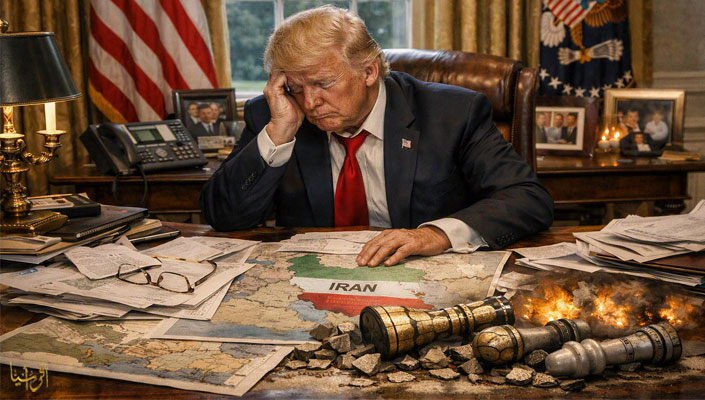
Afrasianet - Hassan Nafaa - The American bias toward Israel is one of the constants of American foreign policy, but Trump has pushed this bias to unprecedented heights.
Donald Trump was only a political newcomer when he decided to run for president in 2016, which he won and entered the White House carrying on the shoulders of a majority of three main currents: a Christian Zionist movement that sees the establishment of a "Greater Israel" as a prerequisite for the return of the "Messiah the Savior," a secular right-wing current that is concerned about the decline of American prestige and is working for a "great America to come back (the MAGA movement)," and a current that is angry at the policies of globalization that he believes have caused high unemployment and poverty in the United States and therefore calls for protectionist policies to save American products and industries.
As soon as Trump began exercising his powers as president, it became clear that his Zionist leanings trumped all other ideological and political considerations, which was evident during his first term and strongly enshrined during his second term.
Admittedly, U.S. bias toward Israel is one of the constants of U.S. foreign policy, but Trump has pushed this bias to unprecedented heights. During his first term, he moved the U.S. embassy to Jerusalem, which he recognized as "Israel's eternal, unified capital," recognized Israel's sovereignty over the Syrian Golan Heights, punished the Palestinian Authority for rejecting his proposals that ignored the establishment of an independent Palestinian state, and tried to settle the Palestinian refugee issue through massive pressure on the United Nations Relief and Works Agency (UNRWA).
Trump also played a key role in pushing a number of Arab countries to normalize relations with Israel before the latter committed to an independent Palestinian state (the Abraham Accords). However, his blind spot behind Netanyahu was only conclusively evident in his policy toward Iran, which showed him as the most concerned about Israeli interests even if they contradicted American interests.
In his first term, he withdrew from the Iran nuclear program deal signed by Obama in 2015, and in his second term, he went so far as to ally with Israel to wage a war on Iran that would be difficult for him to win, and most likely end in the defeat of a major U.S. strategy.
Netanyahu did not find much difficulty in convincing Trump to participate in the 11-day war, which aimed at destroying Iran's nuclear facilities, because achieving this goal required only several raids by certain types of aircraft equipped with deep penetrating munitions, which Israel does not own, but it was very different when it came to launching an all-out war on Iran aimed at toppling its ruling regime, as it required Netanyahu to personally be summoned to present his perceptions of the conduct of operations in a private session, which was already held in the White House operations room about two weeks before the start of these operations.
Media sources who discussed what happened in this session confirm that Trump ignored the reservations expressed by the US military command on Netanyahu's offer, especially when he confirmed that the intelligence available to him concludes that the war will be short and decisive and will end with the overthrow of the Iranian regime, which confirms that he was more ideologically and psychologically prepared to believe Netanyahu than he was prepared to believe his military advisers, although some of them did not hesitate to describe what Netanyahu said in this session as just meaningless "nonsense."
Because the Iranian regime did not fall, and became stronger than it had ever been, especially after it was able to close the Strait of Hormuz throughout the war and then became in a position to control it at all times, it began to hold on to cards that it could not hold before, the most dangerous of which is the ability to control the most important waterways in the world.
At this point, it was only natural that American interests and goals would begin to diverge, and that the pillars on which American and Israeli calculations are based in the post-Iranian takeover of the Strait of Hormuz would differ
It may be useful to remind readers that Netanyahu has tried to lure all the successive American presidents to the White House during his nearly quarter-century tenure as Israeli government to join him in waging the war on Iran, but he has only succeeded with Trump and during his second term, which began less than 16 months after the Al-Aqsa Flood.
Because the "flood" caused a serious setback for Netanyahu, the latter sought to escape forward, trying to turn it into an opportunity to liquidate the "axis of resistance" and establish a "Greater Israel", encouraged by Trump's success in obtaining a second term after winning the US presidential elections that took place at the end of 2024, especially since Netanyahu knows how to address Trump, who facilitates exploiting his narcissism and inflated self to convince him that his contribution to the overthrow of the Iranian regime will help him enter history through its widest doors. He will be immortalized as the American president who achieved what all his predecessors failed to achieve for nearly half a century. Because the wind brought what their ships did not want, they had to find a way out of the predicament they found themselves in, but this time in their own way..
When Trump found himself forced to sign a "memorandum of understanding" that would end the war on various fronts, allow Iran to continue to assert control over the Strait of Hormuz throughout negotiations on a final settlement, and by gradually releasing its frozen financial assets and lifting the sanctions imposed on it, Netanyahu immediately realized that his dreams were about to collapse, prompting him to announce his rejection of the memorandum and confirm that he had not been consulted on it.
Therefore, it is not at all unlikely that immediately after the signing of the agreement, he sought to mobilize the Zionist lobby to sabotage it and pressure Trump to look for a way to dissolve it, which explains the keenness that took place afterwards to seek an independent path to settle the Lebanese crisis and to open a corridor in the Strait of Hormuz near the Omani shores, moves that ultimately led to the suspension of the memorandum of understanding and the launch of new waves of military escalation from time to time, despite the keenness of Iran and the United States to avoid entering into a full-scale military confrontation again.
There is no doubt that Trump's goals and interests have begun to differ from Netanyahu's goals and interests to the point of contradiction, especially since they are about to enter legislative elections whose results may depend on determining the political future of both, despite the different means that may help each of them achieve the interim goals they seek.
Netanyahu has a clear interest in the current stage in military escalation on all fronts, especially on the Lebanese and Palestinian fronts, because this level would maximize the chances of the government coalition he leads in winning the legislative elections that will be held in Israel at the end of next October, while Trump is in his interest that calm prevails at the current stage on all fronts, and not on the Iranian front alone, because escalation in any of them, especially on the Lebanese front, which Netanyahu has a special priority at this stage, may lead to chaos and the reignition of a full-scale war, and thus to a surge in the price of gasoline inside the United States, which may threaten the chances of the Republican Party winning the midterm elections for congressional seats.
Netanyahu's loss in Israel's upcoming legislative elections could topple his political future and even send him to prison, but the Republican Party's failure to win enough seats in the upcoming midterm elections to enable it to retain its current majority in Congress will not only turn Trump into a lame duck, but could also lead to the initiation of impeachment proceedings, especially if the Democratic Party obtains a comfortable majority in both chambers, i.e., the Senate and the House of Representatives at the same time.
Most observers agree that Israel had a single and direct interest in waging war on Iran, but it was the United States that bore the greatest strategic burden of this war, which led to results that the United States could no longer control or minimize its negative effects, and therefore it was in a much worse position than it was before the war, which put it in a predicament from which it could not easily get out.
Iran has transformed from a relatively isolated regional adversary into a power capable of disrupting navigation in the Strait of Hormuz, thereby influencing the global economy by controlling global trade, especially oil and gas flows and supply chains for a number of basic commodities.
The problem here is not the inability of the United States to harm Iran, but its inability to turn its overwhelming military superiority into a tangible political achievement.
In a May 28 interview with the French newspaper Le Monde, Robert Kagan, one of the leading neoconservative theorists in the United States and a fierce advocate of interventionism in American foreign policy, did not rule out that a war on Iran would permanently weaken the United States' position in the world order, and cause significant damage to its allies and the regional order it wants to maintain, which could lead the Gulf Arab states to reconsider their dependence on the U.S. security umbrella.
________________

