
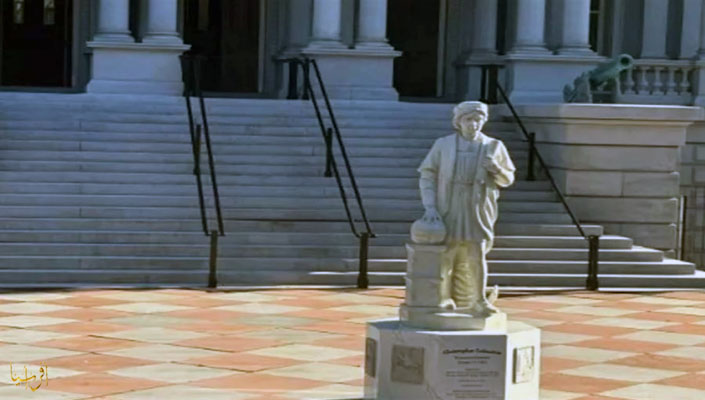
Columbus again at the White House
Afrasianet - Subhi Hadidi - The powers of Executive Order "Reviving Truth and Truth in American History," issued by U.S. President Donald Trump in 2025 as the first dramatic shift that will mark his second term, do not begin with the powers to rename places, phenomena, nature, geography, and history, nor do they end with the insertion of honor and veneration on people, symbols, and facts in arbitrary, arbitrary, and provocative ways.
The latest feats in this acrobatic sport were to change the name of Lake Ontario to "Lake America," ignoring (not from without intentional bullying) that the name originates in the Wandat language and more than 400 years ago, that is, before the emergence of the Canadian Union and the declaration of independence of the United States itself. The renaming of the Strait of Hormuz is another story, albeit more foolish, arrogant and ignorant at the same time.
Under his executive order, Trump had ordered the re-sculpture of the statue of Christopher Columbus, similar to the one that protesters had previously thrown into the waters of Baltimore Harbor, and considered it to belong to "white supremacists, enslaved peoples, genocidal perpetrators, and colonizers."
The U.S. president ordered the statue erected on the grounds of the White House, declaring Columbus "a true American hero, a giant of Western civilization, and one of the most magnanimous and visionary men to walk the earth."
To emphasize the ideological background of the executive order, For its various applications, the overarching goal has been explained as follows: to take revenge on those who wish to "spread a false re-creation of American history, and to disproportionately diminish the value of specific historical events or persons, in an effort to introduce any other partisan ideology."
The state of American history with the tale of names and symbols, and their sinfulness or honoring them, recalls in a prominent place, as it must be said, the story of the Italian writer and traveler Amerigo Vespucci (14541512), precisely because of the power of naming, and its wonders, paradoxes, and contradictions. In 1503, Vesboche completed his third voyage to the "New World," as they were called, becoming the first European to set foot on the shores of Brazil, Colombia, Uruguay and Argentina, as they are known today.
Vespuchy also became the first European to see with his own eyes, and he was already good at describing three of the world's largest rivers: the Amazon, the Pavia and the Plata.
Based on such achievements, it would not be long before the famous German geographer and cartographer Martin Waldsimüller (14751522) decomposed of all hesitation and embarrassment, and decided to name this new world "America", inspired by the name from... Vespoche! Waldseimüller did not question the fact that Christopher Columbus was a European, and that he had arrived in the "New World" in 1492, before Vespoche; but the latter was distinct from the former by a clear difference, which was ultimately decisive: he was the first European to realize that he had already arrived in a "new" world, and not to western parts of Asia, as Columbus had believed for years.
Thus, the name "America" was first born after the name of our author, and the irony was that it was the writer and geographer who was finally rewarded with the great miraculous designation, not the adventurous navigator (Columbus), the conqueror general (Hernán Cortés), or the missionary priest (Bartolomé de las Casas).
Moreover, when Vespuchy began to enjoy a monopoly on the name and release his glories and texts, Admiral Columbus, who had established in the records that he had "discovered" the continent and the whole "new world," was in chains, awaiting a harsh royal trial, and King Ferdinand and Queen Isabella begging: "I am alone in my torments, my suspicions, and the death that I await every day... Weep for me, for I am the one who rejoices in charity, truth, and justice!"
These nomenclature are no less strange than the circumstances of "discovery": both emerged from chance, both continued to remain in the name of false science, and both revived in the midst of the obsession with imagination and the authority of the text.
But Vesboche's description of the new world was more eloquent, graceful, shrewd, and persuasive than Columbus's religious, commercial, and theological epistles, and the former's texts addressed a wide-ranging reader who sought pleasure and excitement, rather than to a banker or a bishop's reader of the latter.
In contrast, the climates written down by the nomadic writer (or, rather, the lies he made) were not substantially different from those of Columbus of the Amerindian "Indians": naked, country-based, cowards, cannibals.
Thus Vespucci took away the right to name the "New World" after himself, and not after any of the hundreds of conquerors, conquerors, bishops, philosophers, and diplomats. In addition to the authority of the miraculous texts he had invented and popularized, he continued Columbus's strategies of erasing first the name, then baptism, as Stephen Greenblatt put it.
This was the culmination of the act of miraculous discourse, and the wonder of the new names of the flag that the islands of the continent would bear: San Salvador, Santa Maria, Fernandina, Isabella, Joanna, and then America. In issuing these labels, the invaders combined the act of appropriation and erasure of identity with another act that they claimed would move the barbarian from infidelity to faith, from ignorance to knowledge.
Trump, who is more or less the Columbus of our time, is not only the most arrogant, and therefore more barbaric, but the ultimate form of degeneration than that foolish arbitrary appropriation, where the power of naming is at the highest levels of vulgarity.
________________

