
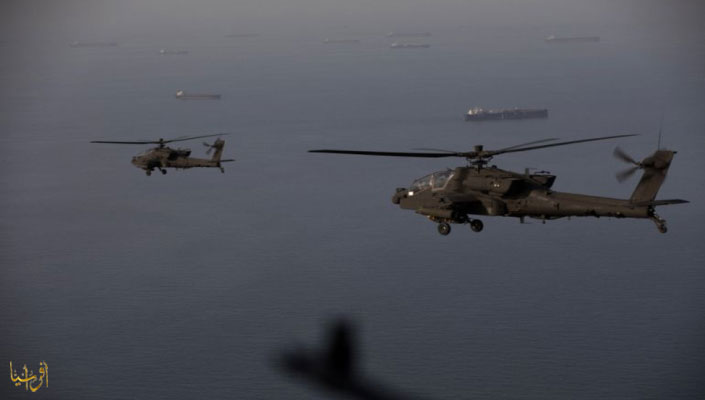
U.S. Apache helicopters fly over the Strait of Hormuz on patrol on April 17, 2026
Afrasianet - Suleiman Al Aqili - All the events, conflicts, wars, blockades and crises in the Gulf and the Strait of Hormuz since February 28 of this year represent half a year of exposure; the fall of a mulberry leaf that covered an old truth: the Gulf is not immune from fire. With the fall of an equation based on two implicit assumptions: oil that comes out safely, and security that is imported ready from Washington.
The past six months have not been a passage towards restoring that equation, but rather a living laboratory for the Gulf to redefine its relationship with itself, with the United States, and with the world, and to restore the role of (Gulf) geography that was dropped by American globalization thinkers.
Geography returns. When the Strait of Hormuz becomes an idea, not just water
What is clear at this stage is not the magnitude of the material losses, but the collapse of the grand theories themselves. Geography has regained its status that America's modernists and political economists thought had disappeared, in light of a discourse that has long said that renewable energy and artificial intelligence have emptied the place of its power, and that "geography no longer makes power."
O'Brien in "The End of Geography," Cairncross in "The Death of Distance," and Friedman in "The World Is Flat," bet that technology and money had abolished space, and that globalization had melted the boundaries into a weightless economy.
But Hormuz torpedoed this doctrine: Thirty-three kilometers of water, in a purely geographical location that could not be moved or replaced, proved capable of moving the world's markets. Geography did not disappear, but rudely re-imposed itself as a language for both political and economic power.
At the same time, the Strait crisis is the second nail in the coffin of the unipolar system, after the Ukrainian nail that hit Europe: if Ukraine has proven that unipolarity does not impose its system on Eastern Europe, Hormuz may prove that this regime is incapable of guaranteeing even the security of the world's most important energy corridors.
The fall of the "end of geography" was not a theoretical defeat, but rather a sign that the world is neither flat nor unipolar, but has returned curved, multipolar, and governed by an irrevocable geography.
Precisely here, in reductive American thinking, lies the structural flaw: there is no complete replacement for the Gulf, and in the foreseeable future there will be no alternative to the Gulf; land-based pipelines, no matter how much they can absorb only a fraction of what used to pass by sea.
The problem, then, is not solvable technology, but structural: the Gulf has built its decades on a single corridor, and any reliance on a single critical point is a bet on the fragility of geopolitical logic, and this has now been unequivocally exposed.
"The Gulf has discovered, in practice, rather than in theory, that full reliance on one external party is a gamble, while full diversification without an American umbrella is another gamble with different risks. So it chose, with remarkable pragmatism, the third path: to keep the United States as a partner while building additional parallel layers of deterrence"
________________
The American Umbrella. Shaky Trust, Not Separation
Here it is necessary to be precise away from slogans. Those who chant "the end of the American era in the Gulf" confuse the shaking of trust with the collapse of the relationship.
The American umbrella has not fallen, but it has lost its deterrence, its "freeness" and its absolute clarity. The war has shown that Washington may be preoccupied with protecting itself, its bases and its Israeli allies before it turns to its Gulf partners, and this is a lesson that has not gone unnoticed by any Gulf capital.
The result is not an exit from the coalition, but a redefinition of it. Riyadh is moving toward a formula of "strategic autonomy within continuous dependence": increasing stockpiles, building a domestic defense industry, and strengthening multi-layered air defense.
But all of this is not far from Washington, because completely dispensing with U.S. technical and operational support for air defense systems is a very slow and costly process, and not a realistic option in the short term.
More importantly, the Gulf is not a single bloc. Abu Dhabi has deepened its partnership with Washington and Tel Aviv together, Doha has maintained its role as a mediator between Washington, Tehran, and Gaza, Manama has remained the most rigid of its grip, and Kuwait has followed Riyadh's lead in regional alliances. Muscat has emerged more as a logistical and mediating platform than a party to an axis.
This discrepancy is the fundamental reality of the stage: not a single Gulf camp, but flexible multi-directional alliances. "Gulf unity" as an inclusive security project is too weak to be the first alternative to U.S. protection, even after a crisis of this magnitude.
The real diversification that has taken place is not a shift towards the East in the classical sense, as China and Russia have not issued a clear official position on major security developments, and their presence has remained more analytical than real. Rather, it is a diversification within the regional space itself.
But frankly, Washington does not view any real diversification with satisfaction. Those who talk about "full strategic independence" are exaggerating, and those who deny the existence of any serious shift are lying to themselves. The truth is in the middle, which is the most difficult place to analyze because it does not offer sensational headlines, but it is the closest to reality.
The Mecca Agreement. Positioning Location, Not Just a Document
If we want one event that sums up the philosophy of the phased transition, it is the Mecca Agreement for joint defense between Saudi Arabia, Turkey, and Pakistan.
Its central text is clear: any armed attack on one of the three countries is considered an attack on everyone – a formula that evokes the logic of NATO – but it is not like NATO, but with a sophisticated regional flavor; Saudi political and economic power, Pakistan's strategic asset, and Turkish industrial capabilities, all of which represent an integration that constitutes the equation of the new deterrence. After the exhaustion of the solid American deterrence.
The deeper part of the text is what surrounds the agreement, which did not come out of thin air, but was preceded by attempts to include Egypt in a quadrilateral arrangement that has not been achieved to date.
Perhaps the most striking detail is that the Mecca Agreement is not just a defense document, but a new positioning within the regional scene itself that expresses geostrategic shifts that represent the beginning of the formation of the international order.
The new alliance opens the door to intelligence cooperation, joint military industries, military cooperation, and a vast economic market supported by regional logistical lines that will change the geopolitics of the entire region.
"Those who chant "the end of the American era in the Gulf" confuse the shaking of trust with the collapse of the relationship. The American umbrella has not fallen, but it has lost its deterrence, its "freeness" and its absolute clarity"
________________
From free protection to managed deterrence
If we want to sum up six months of transformations in one idea, it is this: The era of "free" Gulf security based on the implicit assumption that America will always and unconditionally intervene is over, and the era of "managed security" in which every American, Gulf, Turkish, or Pakistani party calculates the cost of its commitment more accurately than ever before.
This is not so much a collapse of the old order as it is a forced maturation of the option of necessity imposed by war.
The Gulf has discovered, in practice, rather than in theory, that full reliance on one external party is a gamble, while full diversification without an American umbrella is another gamble with different risks.
Therefore, it chose, with remarkable pragmatism, the third path: to keep the United States as a partner while building additional parallel layers of deterrence, through Pakistan, Turkey, and possible future Egypt.
The real question is not "Will the Gulf abandon America or vice versa?" but more precisely: Can these new layers of deterrence turn into a truly resilient force before the next crisis (as Riyadh is wagering)?
The past six months have not ended an era, but they have opened a door that will not be easily closed. The Gulf, as usual in moments of major crisis, has chosen to move with extreme caution rather than a revolutionary approach.
This is perhaps the truest description of his strategic philosophy in decades: stay first, turn later, and with as little risk as possible.
________________
Suleiman Al Aqili - Member of the Saudi Society for Political Science.
________________

