
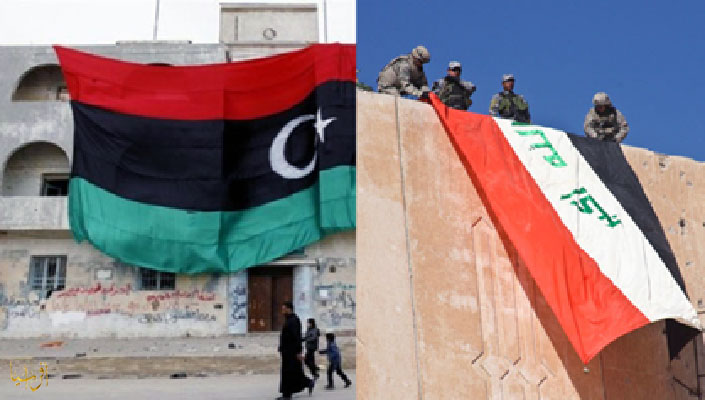
States united on the map, fragmented in reality.. From the Umbrella State to the Centers of Influence
Afrasianet - The disintegration of the state after the fall of regimes does not necessarily mean building stronger institutions, but may open a security and political vacuum that weakens the state's ability to monopolie. Iraq and Libya are prominent examples, where the collapse of the regime has led to the rise of local armed forces, widespread corruption, and the transformation of oil into a focus of conflict, making state reform more difficult than toppling the regime itself.
There are questions that are not asked with the fall of regimes, but rather after their fall. The moment when the rule of a person, party, or political system ends does not necessarily mean that the state that existed under it will emerge from the crisis stronger and more cohesive. Sometimes the exact opposite happens: the regime falls, parts of the institutions fall with it, the vacuum widens, and new forces emerge that do not see the state as the unifying framework of society, but as an arena that should be controlled or shared.
The comparison between Iraq and Libya is worth pondering, not because the two experiences are identical, they differ in history and social and political makeup, but because they reveal a single problem: what happens when the collapse of the political system weakens rather than rebuilds state institutions?
In Iraq, the fall of Saddam Hussein's regime in 2003 opened a new phase in which a number of former regime's institutions, foremost among them the military, were dismantled and the political system rebuilt on the basis of sectarian and national balances. In Libya, the fall of Muammar Gaddafi in 2011 led to the collapse of the central power system without the new political forces succeeding in building a unified military and security institution capable of filling the vacuum. Libya has a regional, urban, tribal, and armed character.
But the likely outcome in both cases was similar in one fundamental respect: the weakening of the state's ability to monopolize power, make decisions, and distribute resources in a stable manner, and transform social, political, and security groups into centers of influence capable of competing with state institutions themselves.
This is an issue that is often summarized in political debates: Was it just a natural consequence of internal and external mistakes that accumulated after the fall of the two regimes, or were these shifts driven by broader perceptions of the reshaping of the Middle East?
In this context, the name of Bernard Lewis, a historian and thinker who had a great influence on American studies of the Middle East, and who was later associated with conservative and neoconservative currents in the United States, appears. His ideas, especially in some political and media literature, have become part of a broader narrative about a project to divide the region into sectarian and ethnic entities.
"The disintegration of the state after the fall of the regimes does not only mean the collapse of the regime, but also opens an institutional and security vacuum, where local forces rise to compete with the state and weaken its ability to monopolize"
________________
But to deal seriously with this issue requires a distinction between what is documented and what has become a political narrative. There is no conclusive original document, according to the available historical evidence, that there is an official "Bernard Lewis plan" to divide Iraq, Libya and others according to widely circulated maps.
This is not to say that his ideas were not influential or that his portrayal of the state crisis in the Middle East is not worth studying. In his writings and essays, Lewis discussed the weakness of the nation-state in the region, the rise of local, sectarian and ethnic identities, and the possibilities of some states becoming models akin to political "Lebanonization" or "Balkanization."
The most serious question, therefore, is not whether there was a secret map drawn up in an office, but how strategic ideas interacted with international politics, military and political mistakes, and local conflicts, producing a reality, in some cases, that came close to some of the scenarios discussed by this literature.
Iraq was the most obvious test. The U.S. invasion in 2003 not only toppled Saddam Hussein's regime, but opened the door to rebuilding the state almost from scratch. The de-Baathification of the party and the dissolution of the army and other security institutions were among the most influential decisions in the period after the regime's fall. These actions created a vast institutional and security vacuum at a moment when the country needed institutions capable of maintaining order and preventing collapse.
Then came the process of building the new political system according to the balance of components. Sectarian and national representation became an essential part of the mechanism of distributing power, and over time quotas became entrenched as one of the rules of the political game. The citizen no longer always saw the state as the institution that guaranteed his rights independently of his identity, but often found himself forced to seek protection and representation within a political party, sect, nationalism, or network.
And that's where the most dangerous cycle began. When the state is weakened, the forces that can provide security, services, or protection rise. When the armed forces are multiple, the state's ability to monopolize arms declines. When the state's ability to do so declines, corruption becomes more and more infiltrated in its institutions.
This is where corruption becomes more than just the theft of public money. It becomes a mechanism for reproducing vulnerability.
This particular point is important when looking at Libya. Corruption in fragile states does not operate separately from politics and security. When public money becomes part of the power network, and when jobs, contracts, and protection are tied to political or local loyalties, the state itself becomes a source of gains for which groups compete. Corruption is no longer just a result of chaos, but also one of the reasons for its persistence.
"Iraq and Libya are two different examples in composition, but they share the same result: weak institutions, proliferated weapons, and resources that are turned into prizes for conflict rather than tools for development"
________________
In Libya, the disintegration was not as sectarian as it was in Iraq, because Libya's social structure is different. But the absence of sectarianism does not mean the absence of the tools of disintegration. The tribe, the city, the region, the armed group, and the center of local influence can all become substitutes for the state when the state fails to build inclusive institutions.
The tribe is an inherent social component in Libya, and cities are an essential part of its political and economic history. The problem begins when social affiliation transforms from an element of society into a source of political and security power as an alternative to the state; when the city becomes stronger than the institution, the tribe is stronger than the law, and the armed group is stronger than the army, then the natural diversity of society turns into political disintegration.
This is why the comparison between Iraq and Libya is useful, despite the different tools. Iraq has known disintegration through sectarian and nationalism, while Libya has defined it through regionalism, tribalism, urbanism, and the multiplicity of centers of armed power.
But the general mechanism can intersect: the regime falls, institutions weaken, a vacuum appears, local forces escalate, weapons spread, competition for resources begins, corruption expands, external forces intervene, and then state reform becomes more difficult than overthrowing the regime itself.
This is not necessarily a single plan, nor does it prove the existence of a central project to dismantle the two countries, but it does reveal a political mechanism that can produce a weak state even without a single entity managing the entire process.
The risk is even greater in Iraq and Libya because oil is a central component of the economies of both countries. In a stable state, oil wealth can be a source of financing for institutions, development, and services. In a divided state, oil can become a prize for conflict.
Those who control resources can influence the distribution of wealth. Those who have influence over financial institutions can influence spending. Those who control oil facilities or export routes have political leverage. Those who have weapons can protect their interests. Thus, a political economy is formed in which wealth becomes part of the power equation.
This is where one of the most dangerous links of a fragile state can be understood: chaos does not always mean the absence of beneficiaries. Sometimes chaos produces beneficiaries of its continuation, and when economic interests are formed around division, peace itself becomes a threat to some of these interests.
The greatest danger to Libya may not be to formally divide it into independent states or entities. The risk may be more complicated: Libya will remain united on the map, but in reality fragmented. A state that has a government, but it does not have full control over the territory; it has institutions, but it is divided or competing; it has an army, but alongside it are armed groups; it has oil wealth, but it becomes a source of attraction; it has citizens who hold the same nationality, but they find themselves in different systems of influence Protection and loyalty.
Corruption in fragile states is not just theft, but a mechanism to reproduce vulnerability, as jobs and contracts become tools of influence tied to sectarian or regional loyalties.
This is not "balkanization" in the traditional sense, but can be described as a functional disintegration of the state while retaining its official borders.
And here comes the question of conspiracy. It is perhaps politically easy to say that everything that happened was part of an outside conspiracy, and it is equally easy to say that everything was just the result of internal mistakes. But the reality is usually more complicated than the two options.
There may not be a single operations room that decided to divide Iraq or Libya, but that does not prevent international interests from interacting with local conflicts, strategic ideas with political mistakes, and armed forces with war economics, ultimately producing results that no one party was able to fully control.
In international politics, sometimes results can be more important than intentions.
Therefore, the study of what happened in Iraq and Libya should not stop at asking "Who planned?" It should even move on to a more useful question: What policies have weakened the state? And who benefited from that? And why did the forces that came after the fall of the regime fail to rebuild the institutions before the space for weapons, corruption, and foreign interference expanded?
In this context, Iraq offers a very clear lesson for Libya: toppling the regime is not the same as state-building.
A ruler can be toppled in months, but building a national military institution takes years. A government can be formed in days, but building a law state takes decades. The constitution can be changed, but rebuilding trust between citizens and state institutions requires a long practice that proves that the law is stronger than the community, that public service is not a political reward, and that national wealth does not belong to a party, region, or city.
The fight against corruption is therefore not a secondary administrative file in the Libyan case, but part of the battle for state-building. If the war economy continues, weapons remain out of institutions, and networks of interests continue to control resources and contracts, any political agreement will remain fragile and liable to collapse at the first real test.
The real battle in Libya, then, is not between East and West, nor between one city or another, nor between a government and a government. It goes much deeper than that: is the state the framework that accommodates everyone, or do groups become alternatives to the state?
Is citizenship the basis of rights, or does local and political belonging become a path to resources? Is the law stronger than the weapon, or does the weapon become a means of determining who has the right to the state? Will oil wealth become a basis for development, or fuel for a never-ending conflict?
"The oil wealth in Iraq and Libya can finance institutions in stable countries, but in divided countries it becomes the focus of a conflict that increases the disintegration of the state and the continuation of the crisis"
________________
If the state wins, Libya can absorb its tribes, cities, regions, and social diversity into a single national project. If groups continue to compete with the state for power, weapons, and resources, the division will persist even if Libya remains officially united.
Libya's future will not be determined only by the upcoming elections, nor by the names of governments, nor by the interim arrangements that change from one stage to the next. The deeper question will determine it: Can Libya build a state in which citizens feel that the law protects them, that wealth belongs to society, that the army is a national institution, and that the tribe, city, and region are components of society and not substitutes for the state?
This is precisely where the difference lies between a country that is overcoming its crisis and a country that is living with it.
Perhaps the most dangerous thing that could happen to Libya is to be formally divided. The most dangerous thing is to remain unified on the maps, while its functions, institutions, resources, and influence are distributed among multiple powers. Then the disintegration becomes less obvious, but more entrenched.
Ultimately, the real question may not be: Will the Iraq scenario be repeated in Libya? History does not literally repeat itself. The most important question is: Will the mechanism that makes the fall of the regime a prelude to the fall of the state repeated?
If Libya can break this mechanism, its difference from Iraq could become a source of strength, not a source of weakness. If arms, corruption, and the war economy remain stronger than institutions, the country may not need to be divided in order to become a fragmented state.
It is enough to remain unified on the map, and indeed fragmented.
________________

