
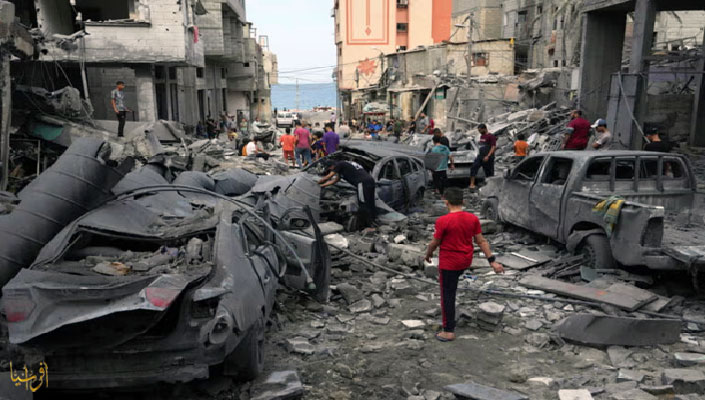
Palestinian steadfastness is a national, societal and demographic survival project that transforms suffering into energy for life, construction and liberation.
Afrasianet - Waleed Al Qatti - The enemy has turned the entire Gaza Strip into an uninhabitable area, in preparation for the displacement of the Palestinian people from the Gaza Strip... Forced migration resulting from the destruction of all the elements of life in Gaza, and even the destruction of all hope for the future for the rising generation and the generations that followed... The thought of emigration as a salvation for the individual and the family, a salvation from death and despair, and in search of life and hope, dominates many people, especially the youth, but as soon as the ordeal is over and this great anguish ends, people return their hope for life and the future, and they sing together in word and deed: We will stay here... So that the pain will go away... We will live here... The melody will be sweet..."
The previous paragraph came in the book (A Palestinian Tragedy Inspired by War) by the author of this article under the title "We Will Stay Here", at the height of the war of extermination, and it summarizes the essence of the Zionist project in Palestine (the displacement of the Palestinian people), and on the other hand, the essence of the Palestinian national project (staying in Palestine), and staying in Palestine in the sense of the Palestinian presence in it is the basis of the concept of (steadfastness), and steadfastness as an existential, patriotic, and life and political behavior that can resurrect life in the people from the womb of death, and renew the project of liberation from The heart of the destruction, but after the repercussions and variables of the war of extermination, it needs to be redefined.
Redefining resilience requires correcting some of the contents of the discourse of steadfastness that are not appropriate for the post-genocide war period, including the constructivist discourse, which exaggerates the imaginary capabilities and minimizes the enemy's real capabilities, exaggerates the power and verbal ability, and uses threatening and threatening theoretical phrases, and lacks realistic insight, forward-looking vision, and strategic calculations.
One of them is the heroic discourse (mythology), which strips the Palestinian people of their human nature, including situations of strength and weakness, and puts the Palestinian people in the mold of the mythical superhero who does not tire, exhaust, suffer or ache, and strips the Palestinian people of their human feelings so that they do not grieve, grieve, fear or frighten.
One of the contents of the discourse of steadfastness that needs to be corrected, in addition to the antagonism and mythology, is the nihilistic discourse (sanctification of death), which focuses on sacrifice and death without a clear political horizon and without linking sacrifices to political and national achievements, and which ignores that the purpose of sacrifices is a free and dear life, not death, and that the purpose of steadfastness is to reach victory.
One of them is the consumerist discourse (the consumption of tragedy), which turns the tragedy of the new Nakba into a consumer substance that is used for the purposes of partisan propaganda, fundraising, and media fame. It loses its human, political and national value, and turns it into a mere duplicate digital visual product that the passage of time and the repetition of scenes become accustomed to.
Correcting the problematic contents of the discourse of Palestinian steadfastness, and redefining steadfastness towards the project of life and liberation, which simply means "survival", which the Palestinian poet Tawfiq Ziad spoke about in his poem "Here We Stay", he said: "It is as if we are twenty impossible... In Lod, Ramleh and Galilee... Here on your chests they remain like a wall... And in your throats... Like a glass castle like a cactus." It also means transforming survival into positive energy for continuity, as the Palestinian writer Ghassan Kanafani said in his article "Ideas on Change and the Language of Steadfastness": "Resilience is not the ability to receive blows, but rather the ability to turn these blows into energy to continue and build on the very ground from which we want to be erased."
Steadfastness in the concepts of Tawfiq Ziad and Ghassan Kanafani is present in all the details of daily life in occupied Palestine from the sea to the river during the war of extermination in its multiple versions in Gaza, the West Bank and the interior, it is found in the insistence of the Palestinians in Gaza to live in the displacement camps despite the horrors of the war and the suffering of displacement, and it is found in the determination of the Palestinians in the West Bank to live in their cities, villages and camps despite the terror of the occupation with its army and settlers, and it is found in the will to live for the Palestinians of the occupied interior in the year of the first Nakba and the resistance to the confiscation of land and the violation of rights. In the hope of life and return to the Palestinian people outside Palestine, despite the tragedy of the refugee and the alienation of the diaspora...
Steadfastness is present in every house that is built, a school that is established, a factory that is established, a land that is cultivated, and a well that is dug... Resilience is found in every child who is born, a student who studies, a farmer who reaps, a worker who produces, an employee who achieves, and a scientist who creates.
Redefining resilience on the basis of survival and existence as the starting point for the liberation project after the war of extermination is an integrated system that begins with demographic resilience, and means maintaining the Palestinian population presence in historic Palestine, with the aim of protecting the Palestinian identity of the land in the face of the challenge of physical annihilation.
It passes through societal steadfastness, which means maintaining the Palestinian society united and cohesive in its places of existence, with the aim of protecting the social cohesion of the steadfast people who are resisting the challenge of moral annihilation. It ends with national steadfastness, which means preserving the existence of the Palestinian people as a single national group united by a common history and destiny, with the aim of protecting the Palestinian cause and the national project in the face of the challenge of the racist Zionist project.
The complementary and dependent relationship between the three dimensions of steadfastness has led us to a clear conclusion that the basis and starting point is the presence of the Palestinian people in their homeland, Palestine, hence the importance of the people's survival in their land and not emigrating from it as the strongest historical and legal document for land ownership and the preservation of identity, and as the strongest pillar of the project of resistance, liberation and return.
The project that will bring the people and the nation to the gate of victory and empowerment... May the day return to Palestine, the day whose sun will shine as light and hope in the hearts of the Palestinians and all the oppressed, the day whose sun will burn with its fire and anger by the Zionist invaders and all the arrogant.
________________

