
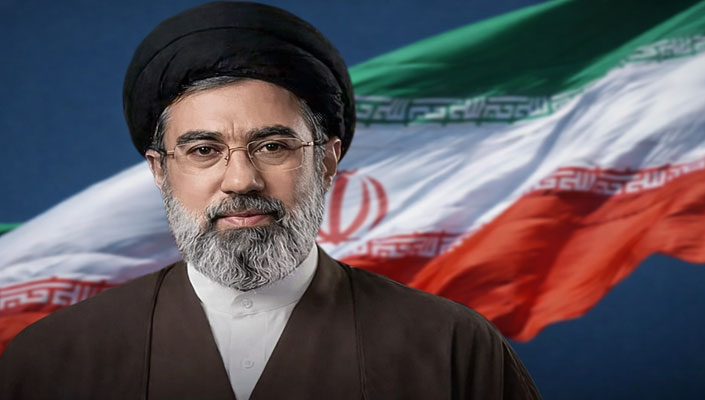
Afrasianet - Muhammad Sabih Al Zawahira - At the height of the U.S.- Israel war on Iran, the announcement of the appointment of Mojtaba Khamenei as his father's successor to Ali Khamenei came in a move that carries political implications that go beyond the mere transfer of leadership.
The timing itself sends a clear message that the regime in Iran remains cohesive, and that the ongoing war will not force it to change its political structure or leadership. In major moments of conflict, decisions are not read in isolation from context, but as part of the battle of wills between conflicting forces.
The most important message in this announcement is not so much about Mojtaba Khamenei as it is about trying to cement the Iranian regime's image as an entity capable of reproducing itself even at the most sensitive moments.
War is often used as a tool of pressure to create internal cracks in the adversary's structure, but the rapid transition in the leadership position suggests that the decision-making centers in Tehran wanted to say that the regime's structure is more coherent and complex than U.S. and Israeli calculations assume.
On the other hand, developments on the ground reveal that initial assessments within the military establishment in Israel and the United States did not hit their targets. Initially, there was a conviction that the confrontation would be short and capable of achieving its objectives within a limited period of time, but the subsequent change in military rhetoric and talk of the possibility of the war extending for additional weeks reflects a clear gap between the initial strategic calculations and the reality on the ground that has begun to take shape.
At this stage, Iran's military missile strikes are expected to become more fierce at first, reflecting Tehran's determination to impose its will and respond to pressure, before any considerations to alleviate the suffering of its brothers in the Persian Gulf or to compromise with aggression.
This gap is not new in wars targeting regimes with complex ideological, religious, and institutional structures, as military assessments often tend to underestimate the resilience and reorganization of these regimes in conditions of war.
Such regimes are based not only on the person in charge, but on an overlapping network of military, security, religious, and economic institutions capable of absorbing shocks and reproducing power even at the most critical moments.
The rise of Mojtaba Khamenei cannot be understood as a mere family transfer of power, but as the product of a long process of centralization within the state's spheres of influence.
For years, his name has been echoing in decision-making centers as a figure close to the power joints, where political power intersects with the security and military establishments.
Numerous estimates indicate that his presence within the regime's structure was not symbolic, but rather was associated with close ties with the Revolutionary Guards, the military, and the Basij forces, which are the main tool for controlling the street and managing the regime's political and social mobilization.
Beyond this security and military dimension, his influence extends within the religious establishment, whose positions his father rearranged over the decades, giving him both religious and political cover.
His influence is not limited to the political and security spheres, with multiple estimates suggesting that Mojtaba Khamenei has a vast network of economic interests and influential financial influence tied to economic and quasi-governmental institutions inside and outside Iran.
In systems that combine power and economy, capital is one of the silent elements of power that helps to consolidate influence and redistribute centers of influence within the state.
This overlap of military power, religious legitimacy, and economic influence creates a complex system of intertwined interests that could help him consolidate his rule at a critical juncture in Iran's history.
His reign is likely to begin with a clear internal hardlining aimed at consolidating prestige and controlling the reformist movement, but in the medium term, economic and political pragmatism will be imposed when domestic interests intersect with outside, especially with broad financial interests spanning multiple markets.
Military power, religious influence, and economic weight are all intertwined tools that form a complex governance equation capable of reproducing power and creating internal stability even at the most critical moments. In this equation, anyone who understands the movement of interests can read the course of Iran's future politics, where power, money, and religion intersect to create a policy balanced between hardliner and pragmatism.
This analysis remains based on a basic assumption, which is that the new leader will be able to consolidate his position at the beginning of his rule without being subjected to an early attempt at exclusion or assassination, a possibility that cannot be ruled out given the nature of the open conflict in the region.

