
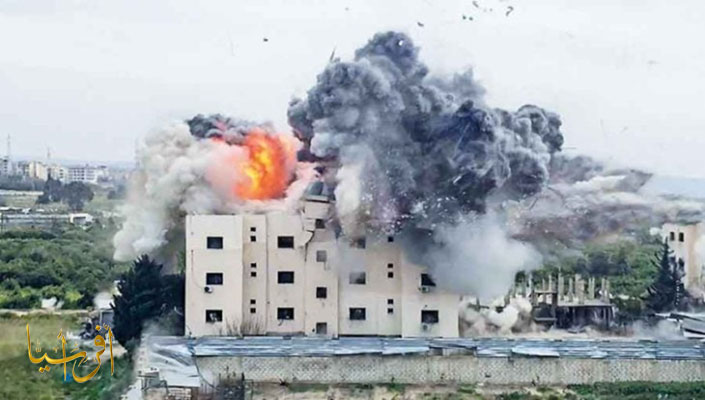
Afrasianet - Ziad Majid - The fierce Israeli war on Lebanon continues, with accusations between the Lebanese parties continuing, while the government in Beirut is trying to persuade regional and European countries to intervene with Washington and Tel Aviv to stop the war, allowing the displaced to return to their cities, neighborhoods and towns, and allowing the Lebanese army to disarm Hezbollah, which has officially become "outlawed."
Accusation, simplification, and treason
At the same time, many Lebanese, from different sects, regions, and social groups, express their indignation and anger at Hezbollah for its involvement in the war in defense of Iran in the face of the military campaign waged by Tel Aviv and Washington against it, and in revenge for the Supreme Leader.
They consider it to have dragged Lebanon into a second war of support after it was involved in a war of support for Gaza between October 2023 and November 2024, which ended in a Lebanese human, urban, and economic catastrophe and did not affect the course of the genocidal war on Gaza in any way.
With a few rockets fired at them after preventing any response over the months of raids and assassinations they continued to carry out.
They say that the Israeli crowds, the mobilization of reserves and the preparation for the expansion of the occupation in southern Lebanon as part of the plan to change the equations in the entire Middle East, which is repeated by Benjamin Netanyahu himself, are the best proof that the story was the story of the time and that the war would have taken place in isolation from the Hezbollah's rocket launches, rejecting the government's recent decision and considering their opponents as orders from Washington and some of its Arab allies.
The counter-statement of the inevitability of war, regardless of what the party has done, presumably abolishes the will in politics and turns everything into inevitabilities that are incapable of confronting and no action has any effect on preventing its occurrence.
The first is that part of Hezbollah's critics do not consider that more than 10,000 Israeli violations of the ceasefire (according to the United Nations) during a year were a continuation of the war and normalization with it as long as it remained confined to a southern and Bekaa geographical framework. Most of its victims have long remained within the Shiite demographics.
This raises issues that must be provoked to reflect on the future of the country, the meaning of belonging to it, and the relationship between its groups and regions in a Middle East where conflicts will not subside anytime soon, contrary to what advocates of simplification and the imposition of unilateral responsibilities for chronic intractances are promoted.
The second is that the issue of Lebanese Shia is becoming increasingly urgent in the national context, not only because of this war, but also because of the prolonged crisis and intransigence that prevents diversity within the community.
This is not a Shiite exception in Lebanon's long sectarian history, but it has become almost the only exception for years, and its internal and external reasons should be considered, including the border data that put the Shiites in direct contact with Israel, so they were repeatedly displaced before and after the birth of Hezbollah, and their displacement was in many stages a matter that was not taken into account as dangerous as it meant or carried for the rest of the Lebanese Today, after many of Hezbollah's opponents have outdone him in the language of insults and labor charges in which he had a precedence, and after the voices of gloating in the south and the suburbs and their injuries have emerged, some of them have gone too far in words that can be counted without exaggeration, the words of civil war.
What do we do?
It is difficult to predict what will happen in the coming days and weeks. But the fear that the war in Lebanon will be prolonged, and that its context will be detached from the context of the war on Iran is completely justified.
A U.S. decision to end military operations against Tehran for reasons that may be facilitated by the absence of clear objectives and Donald Trump's ability to claim victory in it may not apply to Lebanon, where Washington can allow Netanyahu to continue his war until conditions are imposed on Beirut after a radical change in the situation on the ground.
If such a scenario is true, the country faces a series of immediate and medium-term challenges. Dealing with the disasters of killing, destruction and displacement will require significant material and human resources that will not be possible without the mobilization of the Lebanese diaspora and all countries friendly to Lebanon that can provide assistance.
Dealing with internal tensions will require the maximum possible institutional cohesion, including the cohesion of the army and security forces and their deployment in all Lebanese areas north of the Litani River, since the deployment south of the Litani River has become impossible in the interim stage, even if it is required later as one of the conditions for any ceasefire agreement, because of what it means to confront a new Israeli field occupation.
Perhaps developing the Lebanese government's discourse, explaining its directions and ways to keep pace with what is happening and preparing for the next phase is no less important than the measures taken or the duty Taking it in the face of the ongoing war.
The continued emphasis on the restoration of the resolution of war and peace, the unilateralization of arms and the refusal to plunge Lebanon into destructive conflicts, despite its importance and necessity, cannot be justified without emphasizing the impossibility of all this in light of the bombing, killing, displacement, occupation and violation of Lebanese sovereignty by Israel.
The same applies to considering Hezbollah's military wing as an outlaw, which at the same time requires insisting on guarantees that Israel will stop its assassinations and targeting of Hezbollah operatives, crimes that have not stopped since the last war.
Today, it is also necessary to think about the worst-case scenarios, i.e., the supposed widespread Israeli destruction in the south, the Bekaa and the suburbs, and a military occupation in some areas of the south, which prevents the return of hundreds of thousands of displaced people to their homes, and leads to suffocating living crises and social and political tensions in which many may invest Political opportunism, incitement and many other sectarian conflicts.
Lebanon is now at a stage where the danger outweighs the ongoing war. Simply hurling accusations has become politically useless. In any case, there will be no accountability, procedures, and respect for the government's decisions before the war is completely stopped and the project of extending the authority of the national military forces alone where possible, and then gradually over the entire Lebanese territory.
*Lebanese writer and academic.

