
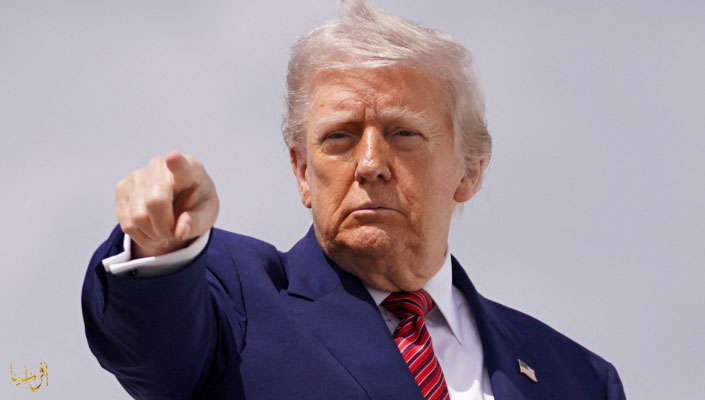
Afrasianet - Mansour Al Mutlaq - I don't know if U.S. President Donald Trump has actually mastered the "art of the deal" as he presented to the world in his famous book, whose negotiating philosophy can be summed up in one sentence: "Ask for the impossible to get the hard," and this rule may explain part of Trump's frequent and high-ceilinged threats, as a way to pressure the adversary into making concessions before a confrontation.
But what he doesn't mention in his book is the most important question: What happens when this policy fails?
The answer has appeared in dealing with Iran. With every high-ceilinged threat, Tehran in turn raises the level of the rhetoric of defiance, and shows a willingness to stand firm and confront, which has put Trump in front of more difficult choices and pushed him to retreat on more than one occasion in front of the world. As the scene repeated, the prestige of the American threat gradually eroded, and the US president's statements turned into a matter of ridicule within the United States, where his critics dubbed him "TACO Trump."
This has nothing to do with the famous Mexican taco, but rather a linguistic game based on the abbreviation of the phrase "Trump Always Chickens Out." The term has become a political and media satirical expression, something that carries connotations beyond the boundaries of irony itself: when the threats of the head of state of the world's most powerful country become the subject of jokes and comments, part of the associated deterrent power begins to erode.
"An adversary who hears an exceptional threat for the first time may feel threatened. The second time he begins to prepare. When he hears the threat for the fifth or tenth time, and then observes the outcome and finds that the escalation ends with a retreat, postponement, or easing of the situation, he stops treating it as a real warning"
________________
This is where the paradox of Trump's experience comes into play: He has built a large part of his political image on the figure of a man who is not afraid to confront and does not hesitate to go to great lengths to get what he wants.
This image in itself has been a powerful negotiating tool: an adversary who believes that the other side may make a sudden and dangerous decision may prefer to make a concession before reaching the point of confrontation. This strategy needs an element of ambiguity in order to work.
When the pattern is exposed, the rules of the game change entirely.
In the case of Iran, Tehran has been able to deal with U.S. threats differently than Washington may have calculated. Rather than retreat to the elevation of the threat ceiling, it has chosen to elevate its rhetoric of defiance, demonstrated a clear resilience, and sent a message that U.S. pressure does not necessarily mean that the other side will surrender.
Herein lies one of Trump's most embarrassing points: He has exposed his style to his opponent.
An adversary that can read its reaction after each threat can also base its next steps on this behavior. Each repeated retreat gives the other side new information about the limits of escalation.
Trump's supporters may say that all of this is part of a calculated negotiating strategy, and that the president is not necessarily making his threats with the intention of carrying them out, but rather using them to raise the bar and force the adversary to make concessions. This idea does fit with his philosophy, but even the most astute negotiation strategies can lose their effectiveness when they are used in the same way over and over again.
When an adversary hears an extraordinary threat for the first time, it may feel threatened. The second time, it starts to prepare. When it hears the threat for the fifth or tenth time, and then observes the outcome and finds that the escalation ends with a retreat, a postponement, or a de-escalation, it stops treating it as a real warning, and begins to see it as part of the negotiating tactic.
Whether he knows it or not, Trump has presented himself with a very difficult choice. Instead of entering a confrontation with a accumulated prestige and credibility that allows it to make political gains through negotiation and pressure, it will now have to deal with the harsh reality of restoring the prestige that was available to Washington before the confrontation.
"Military force can destroy facilities, inflict losses, and alter the balance on the ground, but it does not necessarily guarantee the achievement of the political objective for which it was used"
________________
Since the end of World War II, and more explicitly during the Cold War and after the collapse of the Soviet Union, the United States has built an international order based on a combination of military, economic, and diplomatic power, and in many cases it was able to obtain concessions by threatening to use force, without actually having to use it. This was the true value of deterrence: "that the adversary believes that force is behind words, and that it backs down before it is forced to use it."
When that credibility is eroded, it becomes more expensive to regain it.
If he wants to return to the image the United States was before his threats were tested, it may not be enough to issue a new threat or declare a more hawkish stance. He may have to show more power than he needed in the past, just to prove that the power he talked about all atime still exists and can be used. And that's the paradox.
The force, which was supposed to be a means to get the deal, may turn into a means of restoring the ability to make a deal.
In other words, Washington may find itself forced to pay a heavy military, political, and economic price in order to regain a negotiating position that it was previously able to maintain through words, threats, and diplomatic pressure. This option is very bitter.
If the administration chooses to use excessive force to rebuild deterrence, it is embarking on an adventure whose results cannot be guaranteed. Military force can destroy facilities, inflict losses, and alter the balance on the ground, but it does not necessarily guarantee the political purpose for which it was used.
The United States may be able to launch a crushing military strike, and it may resort to prohibited weapons or methods of warfare that go beyond internationally recognized red lines. However, such an option will not remain confined to its first arena, as it may open the door for Russia and China to justify the use of similar means in Ukraine and Taiwan, under different pretexts, and then the international system enters a very dangerous area whose trajectories or limits are difficult to predict.
If it chooses not to carry out its threats, it will face another equally serious price: eroding what remains of the prestige of American deterrence and entrenching adversaries' conviction that the ceiling of American power is lower than its rhetoric. In return, China will take a new step toward its position at the forefront of the world order, taking advantage of every American confusion and every decline in influence.
Allies may not wait long to recalculate. In politics, grand loyalties are not always based on emotion, but on the balance of power and interest. If an ally feels that the king is backing down, he will quickly look for the rising king.
The whole stage may be summed up in a single sentence: "A king died... and a king lived."
________________

