
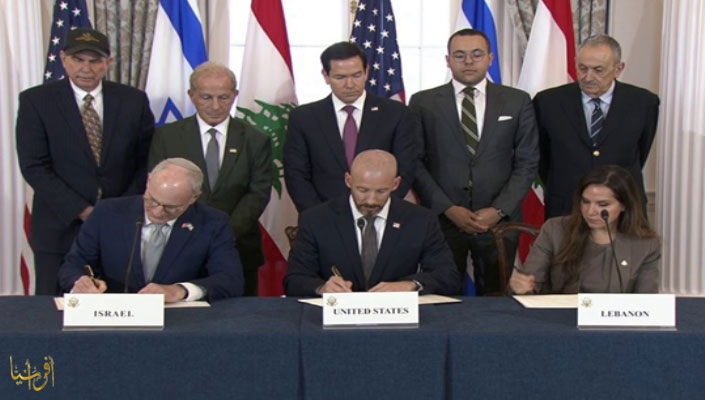
Afrasianet - Ahmed Hafez - In Washington, on the 26th of this month, the ambassadors of Beirut and Tel Aviv sat down to sign a framework agreement that was said to bring Lebanon out of the spiral of war that has exhausted it, but as soon as the ink ran dry, Israeli Prime Minister Benjamin Netanyahu was quick to announce that Israel "will not withdraw from the security belt as long as Hezbollah does not disarm."
In essence, the agreement obliges Lebanon to disarm Hezbollah according to a specific path, but at the same time it gives Israel a wide margin to act "in self-defense," and places Lebanese territory under so-called "test zones," and the Israeli side itself measures the success of the Lebanese state in managing them.
The party that owns the weapons (Hezbollah), which is primarily concerned with the war, is not a party to the agreement in the first place. This contradiction in the structure of the terms of the agreement makes the real question not related to the texts, but to what they will entail: will this agreement turn the conflict from a confrontation with the outside to an internal strife? Is Lebanon eligible to get out of this equation safely?
In this question, the readings of military personnel and analysts intersect that the agreement does not directly ignite the civil war, but it opens up for Lebanon a long stage of accumulated pressures and crises that may slide, at any moment, from political friction to security friction.
Is Lebanon facing a civil war?
Analysts surveyed by Al Jazeera agree that the agreement will inevitably lead to civil war, but this consensus on the negation of the immediate scenario does not mean that there are serious risks. Between these two extremes, their readings diverge and their views diverge, and each of them illuminates an angle on the repercussions of the agreement.
Brigadier General Mounir Shehadeh, a military expert and former Lebanese government coordinator at UNIFIL , enumerates three factors that prevent a rapid slide:
• The LAF leadership will avoid a direct clash because it recognizes that it threatens the cohesion of the institution and its politically diverse internal structure.
• Hezbollah has historically avoided internal war because it turns at any moment into a sectarian conflict that drains it more than its confrontation with Israel.
• Most Lebanese political forces, no matter how different, do not want to repeat the experience of 1975.
Taken together, Shehadeh concludes that "the most likely possibility is not a full-blown civil war, but rather a long period of pressures, limited clashes, political crises, and attempts to impose a fait accompli gradually."
In a tone of caution, Dr. Shafiq Choucair, a researcher at the Al Jazeera Center for Studies, says that the agreement is "not viable if an attempt is made to implement it as announced today" in light of Hezbollah's absolute rejection. But he distinguishes between two tracks, not one:
• Implementing the agreement as it is (literally) and quickly carries "the potential to produce a severe internal crisis"
• Gradual compromises and internal dialogue open a window to contain tensions.
Therefore, "the real test will be the will of the local and regional parties to avoid the explosion, not just the written texts of the agreement," Choucair told Al Jazeera Net.
Lebanese Positions and the Impasse of Sedition
While the pressure in Switzerland's path was moving toward linking the stabilization of the ceasefire to an Israeli withdrawal, the agreement reshaped the equation, making disarmament a prerequisite for ending the fighting and the Israeli withdrawal, and easing pressure on Netanyahu's government.
On this basis, the center of gravity has shifted from the confrontation with the outside to the issue of the state's monopoly on arms at home, a transition that carries with it the seeds of internal Lebanese friction.
On this map, the Lebanese positions on the agreement are distributed:
1. President Joseph Aoun describes the agreement as "a first step on the road to restoring Lebanon's full sovereignty."
2. Prime Minister Nawaf Salam supports the negotiation track and what led to it.
3. Parliament Speaker Nabih Berri issued a stern warning in a brief speech: "My people in all of Lebanon, this is strife."
4. Hezbollah rejects the agreement, which MP Hassan Fadlallah describes as "a gift to the Israeli enemy."
In the midst of this clear division, the question of outcomes arises: Was the agreement designed from the ground up to ignite the Lebanese interior?
The director of the Union Center for Research and Development, Hadi Kobeisi, sees the agreement as "an attempt to find an alternative to the scenario of a regional war" that has failed, and that Washington and Tel Aviv have resorted to "creating local strife" as an alternative.
At the same time, in his statements to Al Jazeera Net, Kobeissi warns of the limitations of this scenario, citing a witness from history, as he says that "the resistance originally started in the conditions of the civil war in the 1980s, and it continued and developed despite this."
Political analyst Amin Qamouriyeh raises a question about American intentions: Does Washington really want to wrest Lebanon's card from Iran's hands, or is it using it to pressure in larger, more comprehensive negotiations related to Iran's nuclear file and the Strait of Hormuz?
Both Shehadeh and Choucair summarize the idea that the agreement "carries elements that may make the risk of internal friction greater if the political track fails," and if the state is required internationally to implement clauses that Hezbollah cannot accept at the same pace, then "political friction becomes a candidate for turning into security friction" gradually.
Hizbullah rejects agreement
The day after the signing, and before Washington's reverberations subsided, Hezbollah Secretary-General Naim Qassem declared his absolute rejection of all the terms of the agreement, calling it "legitimizing Israel's military presence" and crossing "all red lines."
In an interview with Al Jazeera, Qamouriyeh believes that Hezbollah will choose at the current stage to "wait" for the course of the US-Iran negotiations, and if it results in an agreement that gives Lebanon gains, the equation will change, and if it does not bear fruit, the party will remain in a position of rejection without rushing towards an armed confrontation with the state.
In the previous reading, the researcher at the Al-Jazeera Center for Studies identifies 3 elements that strengthen the party's margin of maneuver:
• His popular base.
• The alliance with the Amal Movement, and Iran's continued support.
• The organizational structure has remained cohesive despite the heavy losses.
At the same time, however, Choucair himself acknowledges that "the party's margin for maneuvering is declining compared to what it was before the war," because its involvement in internal conflicts "will be more dangerous for it than any confrontation with Israel because it will turn into a sectarian war."
Brigadier Shehadeh endorses this conclusion that the party "will try to buy time more than to look for a new confrontation, unless it feels that the agreement is turning into a path that will completely destabilize it," and only then could its calculations change radically.
International censorship as a means of pressure
The agreement came with a tripartite mechanism that included the United States, Lebanon, and Israel, while France was effectively taken out of the picture despite being a partner in the monitoring mechanism established after the November 2024 agreement.
In this exclusion, Choucair hints at a fundamental "weakness": the United States has become "the only external party overseeing implementation, while France has been more balanced and less biased," which doubles the pressure on the Lebanese state and narrows its room for maneuver on the disarmament file.
Shehadeh acknowledges that U.S. censorship "is a tool of pressure," but he acknowledges that Washington is aware that "excessive pressure could blow up the interior and fail the agreement entirely, which does not serve its interests," so it would be more likely to adopt "a policy of gradual pressure rather than imposing an immediate confrontation."
Kobeissi puts censorship in place and sums up the equation entirely: "If the army is not ready to engage in a clash with the resistance, the agreement automatically drops." In this sense, international monitoring becomes a pressure card on the Lebanese state before it can be a guarantee of implementation.
The conclusion that analysts conclude is that between the signing in Washington and the divergence of positions in Lebanon, the framework agreement remains more gray than a clear gateway to stability, and may become a trap to which the Lebanese parties are drawn under the banner of "political strife."
The features of the agreement and the extent of its success are determined by 3 factors:
1. The outcome of the US-Iranian negotiations, which remains the mother file of the entire region.
2. The extent to which the Lebanese parties are ready for dialogue rather than confrontation.
3. Israel's seriousness in withdrawing is not just about extracting commitments from Beirut.
What is certain of all this is that Lebanon is at a crossroads: either an internal settlement that turns this agreement into an opportunity to reconcile the parties and its capabilities, or a cumulative pressure that explodes and serves the external occupation more than serves the people and sovereignty of the country.
Source: Al Jazeera

