
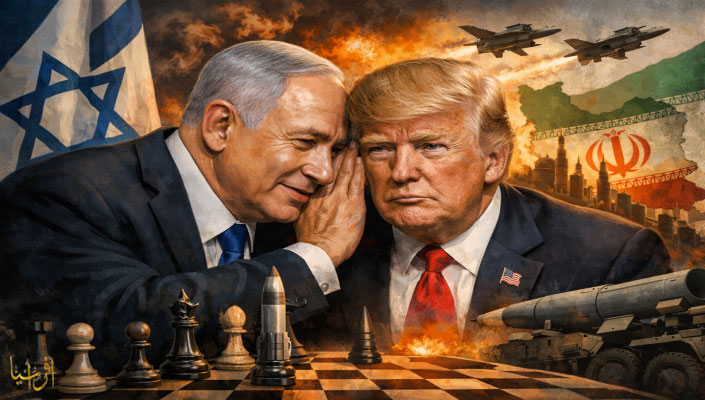
Afrasianet - Hassan Nafaa - Netanyahu played a pivotal role in luring Trump and his administration to ensure U.S. participation in a war on Iran that he had long been preparing for, as evidenced by the fact that he tried the same with all the other American presidents he contemporaries during his presidency.
Most of the wars that broke out after World War II belong to the same category and violate the United Nations Charter, which prohibits the use of force in resolving international disputes, nor because of its conspiratorial nature resulting from the American role in igniting them. The way in which the United States, the greatest power in the modern world, has been lured into a war that does not serve its interests.
Because the great powers are supposed to have an information and institutional structure capable of protecting them from getting involved in the wars of others, it is natural that the United States is drawn into a war that has tarnished its reputation and nearly turned into a broad regional war, and perhaps a third world war, raises urgent questions.
The international media had pointed out closely that the war on Iran was orchestrated by Israeli Prime Minister Benjamin Netanyahu, who succeeded in luring the United States into it after providing President Donald Trump with inaccurate and misleading information.
However, this statement, which seemed difficult to understand to many despite a natural inclination to believe it, was nothing but a hypothesis that accepted right and wrong, and therefore needed proof to prove or deny its validity, or analytical diligence, and therefore needed information documentation derived from primary sources, as ensured by a report published by the New York Times on April 7, which drew its abundant and documented information from a book written by Jonathan Swann and Maggie Haberman, correspondents at home The Times' White Paper is expected to be published soon under the headline: "Regime Change: Inside the Imperial Presidency of Donald Trump."
The lengthy report contains a wealth of information about the truth of what happened in a series of meetings, held in the White House Operations Room from February 11 to 26, 2026, devoted to the presentation and discussion of the plan proposed by Benjamin Netanyahu to the United States to participate with him in waging war on Iran to topple its ruling regime.
The first meeting was held on February 11 and was devoted to hearing a presentation by Prime Minister Benjamin Netanyahu on the plan prepared by the army, in cooperation with Israeli intelligence services, to conduct a joint U.S.-Israeli military operation aimed at overthrowing the Iranian regime.
Subsequent meetings were devoted to discussing the assessment of the various US agencies of the plan and making comments on it. The last meeting, held on February 26, was devoted to discussing the final outcome of previous meetings and preparing the alternatives that should be presented to President Trump to decide what he sees fit to implement the final plan.
The report shows how Benjamin Netanyahu, who arrived at the White House just before 11 a.m. on Feb. 11, was greeted in the Cabinet Hall adjacent to the Oval Office, where he stayed only briefly and without much ceremony, before being hurriedly escorted to the White House Operations Room for a top-secret meeting convened specifically to hear about the joint plan proposed by Israeli agencies to deal with the Iranian crisis.
On the Israeli side, David Barnea, the head of the Mossad, and a few of Netanyahu's political and military advisers participated in the meeting, while on the American side, President Donald Trump was at the forefront of the participants, along with Susie Wiles, White House chief of staff, Marco Rubio, Secretary of State and National Security Advisor, Pete Higgseth, Secretary of War, Gen. Dan Kaine, Chairman of the Joint Chiefs of Staff, John Ratcliffe, Director of the Central Intelligence Agency, Jared Kushner, the president's son-in-law, and Steve Witkoff, his special envoy. De Vance, the Vice-President, was absent from this meeting because of a visit he was making to Azerbaijan at the time.
At the meeting, Netanyahu gave a detailed presentation of the joint military operation proposed by his apparatuses, stressing that its ultimate goal is to overthrow the Iranian regime, and explaining that one of its main components is aimed at eliminating as many Iranian political, military and religious leaders as possible.
Netanyahu made sure to use a video that included photographs of political figures running for reins after the fall of the regime, including Reza Pahlavi, the son of the Shah of Iran, who lives in Washington. The presentation reflected Netanyahu's absolute confidence that everything related to the ballistic missile program could be completely destroyed within a few weeks, and that the Iranian regime would be weakened to the point where it would not only close the Strait of Hormuz, but also strike neighboring countries He provided intelligence confirming that popular protests in Iran will re-emerge during and after the end of the military operation, and that the planned intensive bombing campaign in many areas will contribute to fueling riots and rebellion in these areas, paving the way for the Iranian opposition to overthrow the regime.
Netanyahu did not fail to point out that the military operation also includes equipping Iranian Kurdish fighters and pushing them to cross the border from Iraq with the aim of opening a ground front in the northwest of Iran, which will increase pressure on the regime's forces and accelerate its collapse.
When asked by some attendees about the potential risks of an operation that could potentially lead to the assassination of the Supreme Leader, Netanyahu acknowledged that such risks existed, but stressed that they were less than the risk of the possibility of failing or delaying the strike, because that would allow Iran more time to accelerate missile production and build immunity around its nuclear program.
Netanyahu's offer and his way of answering questions was clearly well received by Trump, who commented, "This sounds good to me," in what many saw as an approval in principle of the proposed plan, while urgently tasking the U.S. intelligence community to immediately begin a thorough assessment of what happened at the meeting.
The results of this assessment were presented the next day (12/2/2026), which witnessed a new meeting in the White House Operations Room, in which the attendance was limited to US officials in the room, in addition to President Trump and his Vice President Vance, who had just returned from Azerbaijan.
The most recent meeting was held on 26 February, a meeting in which the outcome of all previous meetings was discussed and the final plan for the joint operation was finalized, dubbed "Operation Epic Fury", adopted by President Trump just before 4 p.m. the same day and began on the ground on 28 February.
The report also included detailed information on the position of US political and military leaders on this plan, some of which had various reservations about it, especially those related to the idea of regime change in Iran, which Ratcliffe described as a "farcical" idea and supported by Secretary of State Rubio and National Security Advisor.
Gen. Dan Cain, chairman of the Joint Chiefs of Staff, had reservations about the possibility that the proposed plan would "deplete the U.S. arsenal" and spoke of "serious difficulties that could be made in securing the Strait of Hormuz." Stephen Cheung, communications director, expressed concern about the "potential repercussions of the war on the president's image in public opinion."
Despite these reservations, none of its proponents dared to publicly oppose the plan to President Trump. The only official who dared to do so openly was Vice President J.D. Vance, when he called war on Iran a "bad idea" in principle, and when he was certain that it would be adopted, he tried to steer the path toward a "limited operation" rather than a "large-scale campaign," but failed. Pete Higgseth, the secretary of war, was the only official among Trump's top aides who was enthusiastic Strongly for the war on Iran.
It is clear from the above that Netanyahu played a pivotal role in luring Trump and his administration to ensure that the United States participates in a war on Iran that he had been preparing for a long time, as evidenced by the fact that he tried the same with all the other American presidents he contemporaneed during his presidency: Clinton, Obama, and Biden, but he failed and succeeded only with Trump alone.
He was helped by a close personal relationship that connected him to the latter, which stretched back to before entering the White House, and deepened greatly during his first term. It seems that Netanyahu deeply understood Trump's inflated self and played on its chord a lot, by convincing him that history will write that he is the only American president who achieved what all his predecessors have failed to do for nearly half a century by overthrowing Iran's Islamic regime and replacing it with a secular one.
However, we should not underestimate the impact of another factor: Trump's absolute conviction of the superiority and ability to work miracles, which became absolute certainty after the Venezuelan operation, which succeeded in regime change without a single American soldier falling.
Whatever the case, there is no doubt that the disappointing results of a war that forced him to sign a "memorandum of understanding" that is difficult to market to the American public will continue to remind him of Netanyahu's shortcomings.
Therefore, it is not inconceivable that Trump will develop a deep sense of frustration with Netanyahu, who has embroiled him in a war that serves only his personal interests, and that this feeling will be deeply reflected in his policies throughout the rest of his term, which he has already begun, but timidly.

