
Afrasianet - Mahmoud Al Hanafi - The battle of the novel on the Palestinian issue is no longer waged by the tools it has ruled for decades. Israel's military superiority has always been coupled with another, equally important: the ability to produce and export the novel, and to define the language through which the world perceives the Palestinian, the occupation, and the violence inflicted on him.
The Palestinian was often required to first prove that he was a victim, before he was even allowed to discuss the crime that had been committed against him, but this system was beginning to crack.
If October 7, 2023, represented a military, intelligence, and political earthquake inside Israel, the war that followed triggered another earthquake in the moral, legal, and political spheres. For Israel, the problem is no longer limited to the scale of the destruction, the number of victims, or the images of starvation and displacement, but rather the accumulation of evidence, testimonies, investigations, and judicial procedures, and the breadth of the circle that is ready to hold the Israeli narrative accountable, including Israeli voices that came out of the military, human rights, and cultural establishment itself.
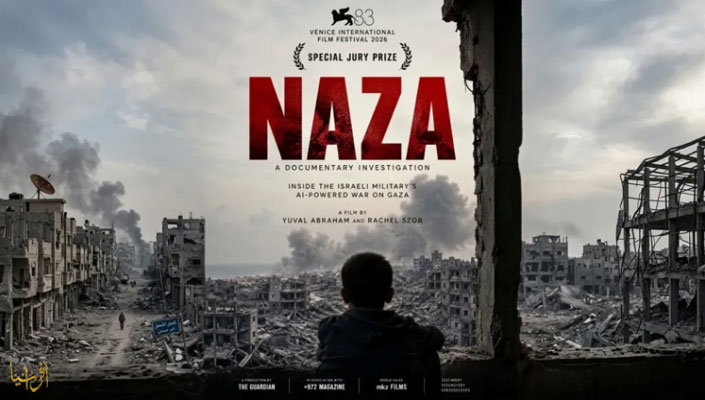
In this context, the documentary film "NAZA", by Israeli directors Yuval Abraham and Rachel Sör, adds to the open fronts a very influential front, which is the front of cinema and art.
The phrase "and a witness from her family" seems very significant here, not because the Palestinian needed an Israeli witness to make his tragedy a reality, but because the testimony when it comes from within the system that is the subject of the accusation is particularly important in the test of the official narrative, especially if its source can be verified and linked to independent evidence.
The debate shifts from the question: "Did this happen?" to questions more related to legal responsibility: "How did it happen? Who made the decision? What information was available to him? ".
Why is Naza different?
The film's importance lies first and foremost in the source of its material. It is based on testimonies from 24 Israeli military personnel, intelligence officers, and sources, secretly collected over three years. Rather than just presenting the results of the war, it tries to get closer to the inside of the decision-making machine: surveillance systems, target selection, the use of artificial intelligence tools, the estimation of civilian casualties, the distance between intelligence and the decision that ends with a bomb falling on a house or neighborhood.
Even the film's title carries a harsh connotation: "Naza" is an Israeli military term used to denote the expected number of civilian casualties, or so-called "collateral damage," when planning a strike. Thus, before an attack is carried out, the civilian becomes a figure in the process of estimating the results of the bombing. This is one of the most sensitive issues in light of the rules of international humanitarian law.
Modern warfare may begin with a database, then an algorithm, then a classification of the target, then an estimate of expected civilian casualties, and up to a series of approvals that precede the attack.
This can be described as a form of "lethal force bureaucracy", but this description does not in itself imply that wrongfulness is established; the legal ruling depends on the nature of each attack, the intended target, the information available at the time of the decision, and the extent to which the principles of distinction, proportionality and precaution are respected.
From the perspective of the laws of armed conflict, technology does not absolve humans of liability. The algorithm does not replace the human responsibility in assessing the legality of an attack, nor does it eliminate the potential responsibility of those who approve its outcomes or order the use of force based on them.
Not only does NAZA add new images to Gaza's archives, but it may also be important that it approaches the most difficult place in international crime investigations: the decision-making kitchen.
"Naza" is all the more important because it touches a very sensitive place: the golden image that has been made for Israel, especially the image of the "most moral army." When martyrdom comes from within Israeli society, from people who supposedly defend their state and give its army a special sanctity, it becomes even more difficult to deny"
________________
From Venice to the World. Opening of the Cinematic Front
The film's win of the Special Jury Prize at the Venice Film Festival was not just an artistic achievement. The wide reception it received also signifies that the debate over Gaza has moved into the international cultural and film sphere.
But this significance should not carry more than it can bear. Festivals, awards, and artists' positions are not sources of law and do not establish criminal liability, but they do contribute to shaping public opinion and keeping facts debated and held accountable. This is where the cultural front is important.
Cinema can do something that sometimes hundreds of pages of human rights reports can't: to convey facts from the language of figures and documents to the public memory.
In recent years, the Palestinian cause has begun to move strongly into festivals, cinemas and cultural institutions. More than 1,800 actors, artists, and producers have already signed a pledge not to cooperate with Israeli film institutions they considered complicit in abuses against Palestinians.
Naza, on the other hand, added a different dimension: the material itself comes from within Israeli society, and then the pressure on the filmmakers becomes part of a broader debate about freedom of expression and the limits of criticism within Israel.
From the screen to the B'Tselem report.. The rift is no longer individual
If "Naza" had appeared alone, it could have been contained as a critical stance of Israeli directors. But its real danger is revealed when it is read alongside Israeli human rights and cultural voices that are beginning to destroy the official narrative from within, revealing that silence can no longer obscure the facts.
On September 14, 2026, the Israeli organization B'Tselem released a report titled "The Removal Project: The Systematic Dismantling of Palestinian Collective Life in the West Bank."
The report, which is based on more than 2,000 Palestinian testimonies and decades of documentation, not only collects the violations, but also dismantles the system that connects them, revealing that what is happening is not isolated security incidents, but an integrated policy that targets Palestinian land, population, and conditions of survival.
It is true that a human rights report does not issue a judicial ruling, but reducing it to a mere "documentary material" deprives it of its political and legal power. Its value is that it comes from within Israeli society itself, and it presents evidence and patterns to international institutions that are difficult to ignore or reject under the pretext of bias.
This is where the transformation lies. International law moves not only by the power of words, but it also cannot ignore the accumulation of testimonies and evidence that reveal the unity of policy, purpose, and outcome. When the camera meets the human rights report, we are no longer faced with isolated individual voices, but rather with an internal rift that widens in the wall of the Israeli narrative, paving the way for the transformation of documented truth into accountability that cannot be postponed indefinitely.
Why do Israelis do this?
The necessary question here: Why do Israeli officers, journalists, artists, and organizations publish material that is highly critical of their state's policies?
In my opinion, there is no single answer. Some of these voices are motivated by human rights and moral considerations, some are motivated by professional considerations related to the public's right to know, and some of them reflect an internal conflict over the nature of the state, its future, the independence of its institutions, and the limits of government power.
Some Israeli critics do not necessarily embrace the full Palestinian narrative, but may argue that the continued occupation, abuses, and impunity threaten Israeli society itself, deepens its isolation, and undermines its institutions.
It is therefore a mistake for Palestinians to reject these voices because they are Israeli, just as it would be a mistake to consider them as a substitute for Palestinian testimonies. Their primary value is that they add relatively independent sources to the process of fact-checking and challenging the official narrative.
From a single incident to a recurring policy
International law distinguishes between a single incident and behavior that is repeated in a way that reveals a broader pattern. It is true that the repetition of similar incidents does not alone prove the existence of a systematic policy, but it becomes important evidence when it is linked to official orders or practices, similar methods of implementation, knowledge of the consequences of those responsible and the continuation of the behavior despite its serious effects.
Therefore, the transition from "incident" to "pattern," and then from "pattern" to the possibility of "politics," requires coherent evidence, not hasty conclusions. From this angle, NAZA and B'Tselem's report can be read as two different articles that raise intersecting questions: the first deals with how targeting decisions are made in Gaza, while the second exposes the accumulation of practices that threaten the lives and existence of Palestinians in the West Bank.
The combination of the two does not automatically mean a single plan or uniform criminal intent, but it strengthens the need to investigate the link between recurring facts and the policies and institutions that produce and allow them to continue.
"Israel today faces varying pressures on judicial, diplomatic, human rights, economic, academic, popular and artistic fronts, but these fronts are not equal in nature or impact"
________________
From the film to The Hague. Where does legal value start?
The film is not an indictment, the B'Tselem report is not a judicial verdict, and the applause of a film festival does not prove a war crime.
But that does not mean that these materials are without legal value. In international criminal investigations, open sources, journalistic investigations, insider testimonies, and human rights reports can play an important function in identifying potential facts, reaching witnesses, exposing patterns of behavior, and directing the investigation toward certain documents, officials, or levels of the chain of command.
Turning them into judicially reliable evidence requires verifying authenticity, source, credibility and context, and comparing it with other evidence.
This distinction is necessary so that the article does not turn from a legal analysis into a political argument.
In international crimes, it can be less complicated to prove that a bombing or civilian death occurred than to prove a specific person's criminal responsibility. The most difficult thing is to climb the chain of decision: who ordered? Who authorized? What did he know? What information was available to him at the time?
Then comes the more precise question: Are there the material and moral elements of the crime attributed to him?
It is precisely here that the testimony of the person who worked within the system can become important, not only because it is a "testimony from its people", but also because it may, if credible, help link the outcome on the ground to the decision-making process.
Seven fronts. But they should not be confused
Israel is facing varying pressures on the judicial, diplomatic, human rights, economic, academic, popular and artistic fronts.
But these fronts are not equal in nature or effects. The judicial decision is different from the political position, the economic punishment is different from the report of a human rights organization, and the film is different from the evidence presented to the court.
However, the confluence of these paths can produce an important cumulative effect: human rights materials fuel public debate; journalistic investigations may reveal new facts; public opinion may influence politics; politics may be reflected in military and commercial cooperation; and the judiciary defines obligations and responsibilities according to the rules of law.
The significance of the scene is therefore not in the assumption of a united international front against Israel, a hypothesis that does not reflect reality, but rather in the fact that the areas of accountability have expanded and diversified.
"No one said that the collapse of Israel is only a matter of time, or that only a film or a human rights report can bring down the system of occupation and apartheid. But those who are fighting this battle in terms of human rights and media have the right to see "Naza" as an important achievement and to celebrate it, and not to dissipate its value with cold academic reservation"
________________
How long can Israel hold?
The same question needs to be adjusted. In my view, the term "steadfastness" may suggest that the decline of international legitimacy necessarily leads to the collapse of the state, a conclusion that is not supported by the current balance of power.
Israel still possesses significant military, economic, and technological capabilities, and influential international alliances, foremost among which is its strategic relationship with the United States. But the issue is different when we talk about the legal and political cost of the continuation of current policies.
A country may be able to continue militarily despite its high diplomatic costs, it may maintain its alliances despite its declining public image, and it may face judicial proceedings without immediately changing its policy. The more accurate question is not "How much is left for Israel?" Nor "When will it collapse? ".
The more objective question is to what extent can Israel maintain its current policies if the gap between its military capability and the legitimacy and legal, diplomatic, and economic costs of these policies continues to widen?
As far as we can tell, there is no definitive time answer to this. But the legal history of international relations teaches us that the erosion of legitimacy does not necessarily lead to immediate change, but it can become an influential factor when it turns into judicial decisions, arms or trade restrictions, changes in state policies, and accountability for individuals and institutions.
The wall is cracking. The collapse is starting to build up cracks.
No one has said that the collapse of Israel has become a matter of time, or that only a film or a human rights report can bring down the system of occupation and apartheid. But those who are fighting this battle in terms of human rights and media have the right to see "Naza" as an important achievement and to celebrate it, and not to dissipate its value with cold academic restraint.
States do not rise in an instant, and they do not collapse in an instant. Israel itself has accumulated support, armament, recognition, and propaganda, and its status can also be eroded by the accumulation of films, reports, testimonies, judicial cases, and political positions. They are points that are converging, cracks that are widening, until they weaken the wall that has long seemed impenetrable.
Naza is all the more important because it strikes a very sensitive place: the golden image that has been made of Israel, especially the image of the "most moral army." When martyrdom comes from within Israeli society, from people who are supposed to defend their state and give its army a special sanctity, it becomes more difficult to deny, and the phrase "and witnessed from its people" acquires extraordinary political and moral power.
It is true that the film does not issue a judicial ruling, but it scores an important point, and it opens the door for cinemas, festivals, platforms, journalists, and human rights defenders to expand the discussion and track the facts.
In long and hard battles, it becomes a necessity to celebrate every achievement; major victories do not arrive complete, but are made up of small dots that accumulate until they change the image, the narrative, and the balance of power. "Naza" is not an announcement that the wall has fallen, but it is certainly one of the cracks that can no longer be hidden.
________________
Mahmoud Al Hanafi - Professor of International Law and Human Rights.

