
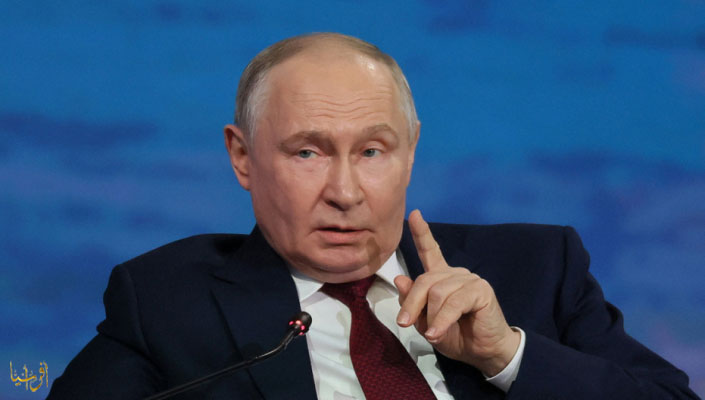
Russian President Vladimir Putin says that the attempt to defeat Russia in 40 days is an adventure on the part of Kyiv and those in charge of it from the West.
Afrasianet - Russian President Vladimir Putin said on Saturday that the attempt to defeat Russia's alleged 40 days is an adventure on the part of Kyiv and its Western officials.
Putin described Russian strikes on targets in Ukraine as effective and timely, explaining that they are helping Russian fighters on the front.
In an interview with Russian media, Putin said: "Of course, these strikes are effective, and they come at the right time. Certainly, it helps our fighters, our youth, and our heroes on the front lines in carrying out their combat missions."
He also noted that Ukraine publicly admits that the goal of its strikes is to undermine the unity of the Russian people and the cohesion of Russian society.
The Russian president stressed that the strikes targeting facilities in Ukraine have a direct and positive impact on the progress of military operations and the achievement of the desired results, explaining that the ability of defense industry companies in Ukraine to develop their weapons has been disrupted.
He pointed out that Kyiv is working on developing its weapons with the direct participation of Western sponsors.
Noting that the Russian military's responses to Kyiv's strikes targeting the logistical infrastructure are more effective and destructive, Putin said, "Ukraine has opened a Pandora's box by launching attacks on economic targets," meaning that Ukraine's targeting of Russian economic facilities has opened the door to an escalation that is difficult to control.
The "Pandora's Box" is "a Greek myth that revolves around a box or jar that was overpowered by the gods with the evils of the world, and Pandora opened the box out of curiosity, which led to the spread of evils on earth."
These statements come in light of a period of escalation witnessed by the war that has been going on for more than 4 years, as Kyiv targeted Russian civilian and economic facilities, prompting Moscow to respond by targeting vital facilities related to the military effort and the import of weapons in Ukraine.
Ukraine: Zelensky between the attrition of the war with Russia and the crisis of internal confidence due to corruption and governance
President Zelensky faces a very complex equation: a war that is draining defense capabilities, a shortage of U.S. interceptors in the face of Russian escalation, a crisis of confidence linked to corruption, and a popular internal opposition.
On the other hand, as military pressure on Kyiv grows in its war with Russia, criticism of the way the war is being conducted and how the country itself is running is widening inside Ukraine, doubling the pressure on President Volodymyr Zelenskyy.
In the wake of the ongoing military escalation with Russia, President Zelensky went on to install Yevgeny Khamara as the new defense minister, succeeding Mikhailo Fyodorov, whom he dismissed in July.
According to observers, the vote showed that the president still has the ability to pass his options in parliament, despite the political and popular pressure surrounding the decision to dismiss him On the eve of the parliamentary vote to appoint his successor, Mykhailo Fyodorov came out in a video message that lasted about nine minutes, without mentioning Zelensky's name, talking about a "systemic crisis in governance" and criticizing what he described as a preference for political loyalty over efficiency, slow reforms and bureaucracy, and corruption that he said directly harmed the country's ability to continue the war.
The 35-year-old was seen as one of the most popular members of power, especially after the role he played in the development of the war with drones and military technologies.
But Zelensky ousted him in July, in a move that was officially interpreted as disagreements with the military leadership, and analysts saw a broader struggle over reforms within the Defense Ministry and associated centers of influence Hundreds and thousands of protesters gathered to demand his return, as the issue gradually turned into an expression of broader discontent with the centrality of political decision-making and the way the state was run during the war.
However, these protests were not initially a movement calling for elections or Zelensky's ouster, but rather focused on rejecting the dismissal of the defense minister and demanding that the path of military reform be maintained.
To contain the repercussions of the crisis, Zelensky also dismissed army chief Oleksandr Syrsky, with whom the dispute was one of the reasons circulating to explain Fyodorov's removal, and appointed General Mykhailo Drabaty in his place.
But this week, Fyodorov opened a new political front, as the most important of his message was not only to criticize corruption and bureaucracy, but also to find a "legal, safe and realistic mechanism" that would allow the restoration of the democratic process and the holding of elections even as the war continues.
The call is of exceptional importance because Ukraine's elections have been suspended in practice under martial law imposed since Russia's invasion in February 2022.
Amid mounting criticism of the way the state is run, a new case has emerged involving figures in the presidential circle, Ukrainian President Iryna Mudra, the deputy head of the presidential office, after the National Anti-Corruption Office and the anti-corruption prosecutor's office announced an operation targeting a network suspected of laundering about 150 million hryvnias, or about three million euros, through companies and accounts linked to various parties, in a case related to the payment of bail to one of the defendants in a previous corruption file.
The decision came after the latter's office was searched and her name was linked to the investigation, while her legal status remained separate from any judicial conviction against her.
The development brings the corruption dossier back to the heart of the debate over the rule of President Volodymyr Zelenskyy, who last year faced a major political crisis when he tried to curtail the independence of anti-corruption bodies, before backing down under pressure from internal protests and criticism from Ukraine's Western partners.
This proves President Zelensky's personal involvement in these issues, especially since the dismissal came in a highly sensitive political context, nominally after the former defense minister made one of the harshest criticisms of the ruling system since the beginning of Russia's special military operation.
Presidential elections were supposed to be held in 2024, but the continuation of the war has made organizing it very complicated, especially with millions of displaced people and refugees abroad, hundreds of thousands of military personnel deployed on the frontline, in addition to the areas lost by Ukraine and the security risks that may prevent the holding of a free and secure ballot.
Calls for elections throughout the war years have therefore remained a highly sensitive topic inside Ukraine.President Zelenskyy is now more than ever confronted with a very complex equation: a military war that is draining defensive capabilities, a shortage of U.S. interceptor missiles in the face of Russian escalation; a crisis of confidence linked to corruption and governance, and an internal opposition that is beginning to find itself more popular.
From a beloved reformist minister to the president's most prominent domestic political opponent, he has opened the door to a political battle that will be difficult to close.
The crisis of his dismissal, and the ensuing protests, criticism, corruption dossiers, and calls for elections, may be the beginning of a new test of Zelensky's ability to maintain the cohesion of power and society at a time when the cost of war is increasing and the margins for maneuvering are shrinking at home and abroad.
________________

