
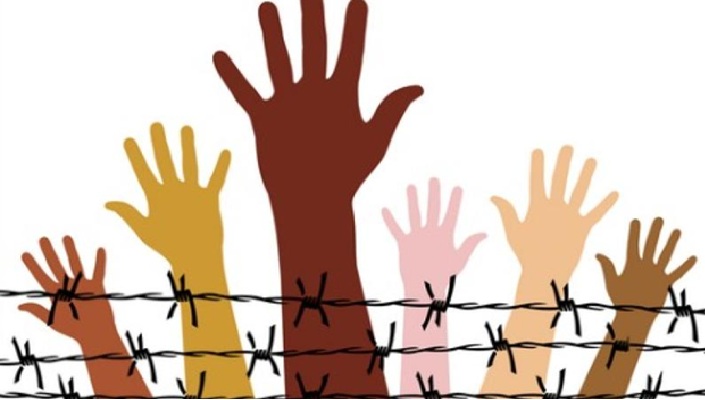
Afrasianet - Noureddine Iskandar - A rising global mood is forming that rejects American colonialism in its modern form, from Gaza to Latin America and Europe, where hegemony is now exercised through law, economy, sanctions, and the media instead of direct military occupation.
Despite the overwhelming image of the raucous events promoted by the clowns of the new world circus of modern presidents and elites, the international order is undergoing a transformation that is more profound than a redistribution of power among major states. A new anti-colonial global mood is slowly and steadily taking shape, one that does not need standing armies or flags flying over palaces, but rather a package of constraints aimed at controlling decision-making, currency, trade, perception, legitimacy, and information.
Although this mood does not always express itself in explicit ideological language, it appears as a growing and expanding rejection, even in the Western space, of all forms of tutelage, even when exercised in the name of national security, stability, or a "rules-based international order," which in fact is no longer so.
Gaza that exposed the world
The genocidal war on Gaza has transformed global consciousness and transformed itself from a mere theater of a recurring and chronic war waged by the occupation whenever it wishes, to a platform for shaping popular consciousness globally, and redefining "Israel" to the whole world.
But it has also revealed in what it has revealed, the long Western narratives about human rights and democracies, respect for the laws and the value of the human being itself. What has happened and is happening today is exposing a complex occupation structure, managed by direct military means and non-military means at the same time. Its manifestations are the blockade, the control of the crossings, the strangulation of the economy, the management of daily life, and then the justification of all this with a legal-security discourse, which brings to the fore the question of colonialism in its contemporary form.
What is even more important here is that the global interaction with Gaza has transcended the traditional division between north and south. In European and American cities, new generations have emerged that do not belong to the immediate colonial memory, but who have read the scene as an intense model of domination imposed by force, justified by law, and managed by the media.
This has led to a widespread global popular rejection of the process of imposing political realities outside of international accountability, despite the fact that the same peoples, even in the most Western countries, remain imprisoned in ostensibly democratic regimes It is liberal, and its interior is a minority police security, which serves the interests of locally expanded global cartels, which serve in their work a modern colonial environment.
This shift in consciousness has gone beyond the question of defining the concept of occupation itself, and transferring the idea from tanks, the economy and resources, to what touches man in his depth, and in his self-definition. This was expressed in the questions of new generations in their demonstrations, about how to accept what is happening, and what reason can be sufficient for this acceptance!
The focus of modern colonialism today is on striking one word at its foundation, and preventing it from existing, which is "sovereignty", which is meant to empty its contents.
By economic sanctions designed to subjugate society, not just the political system; by financial pressures that paralyze the state's ability to plan independently; and by unspoken political orders, which are presented as advice or expectations from an ally.
This understanding is what explains the convergence of protests in Gaza, Latin America, and some European capitals, in one overwhelming sense, that colonialism, which has disappeared in its old and identifiable form, is present in its modern form, which is exposed by US President Donald Trump in his unique style.
Europe's Societies Discover Themselves and Their Location
In Europe, this mood of rejection of hegemony takes a more complex form. The continent, which was historically the center of colonial empires, now finds itself in a gray spot: it is not a colony in the classical sense, but it is also not a complete sovereign decision-maker on major issues. The war in Ukraine was a stark reference to Europe's loss of sovereignty, but it is also a milestone in how to commit political and strategic suicide.
The rejection of U.S. policies on various issues such as tariffs, political and economic pressures, and the imposition of security priorities that do not belong to them, stems from a growing sense that Europe is being pushed into the role of vassal within a Western system that is being reconstituted on more crude foundations.
Donald Trump's return to power was a revealing moment for this imbalance, as his rhetoric shifted to direct orders, to a logic of "either with us or against us," and by treating allies as tools or financial burdens, bringing the question of European political dignity back to the fore. In Greenland, the issue appears to be completely naked.
The issue of Trump's insistence on forcibly "buying" Greenland represented a shocking moment in this context. There, the European, and specifically Danish, objection to the idea of American expansion was not only related to regional sovereignty, but also to the symbolic significance it carries on the future with its files and interests, and through a return to the logic of buying, annexing, and dealing with land as a strategic commodity or just a real estate issue in which offers to sell, buy, profit and return suffice.
This discourse, which seemed to come from the 19th century, collides (without being sure of its usefulness) with a European mood that sees itself as a full partner, while Trump sees it as a subordinate fringe in a broader conflict with China.
The same is true of tariffs and economic sanctions. What Washington sees as sovereign tools to protect its economy is seen by many in Europe and around the world as pressure tools used to recalibrate the political behavior of states.
Tariffs and the threat of markets, as well as the use of currency as a weapon, are tools for controlling decision rather than for a specific interest.
With this awareness, large segments of European public opinion, and even economic elites, are moving towards rethinking the concept of the alliance itself. An alliance that does not protect the partner from coercion, but throws it at him himself, and makes him more vulnerable to it, which is why French President Emmanuel Macron rushed to a European summit to counter Trump's danger in Greenland.
Donero is not just for Latin America
The so-called "Donero Principle" is not confined, in its actual application, to Latin America. It is true that Venezuela was one of its most prominent fields, but its logic extends to every region that is considered an area of influence that must be controlled.
In Venezuela, sanctions, attempts at political isolation, and indirect pressure have shown how an international administration can besiege a country without invading it. This experience has not gone unnoticed. On the contrary, it has become a warning model for other peoples to project their fears on.
What is striking is that what happened in Venezuela contributed to the production of a global discourse that questions the legitimacy of this kind of intervention. German President Steinmeier was sharp in expressing this, not out of support for Venezuelan President Nicolás Maduro, but rather out of a refusal to drag presidents into American chains of power.
Because the selective use of democracy, human rights, or international law turns from universal values to tools of power. So what prevents the accusation of the drug trade in Maduro's case from being an accusation? Damage to the U.S. economy in Germany's case of auto factories? Literally nothing. As long as the kidnapping machine works, the subject that is placed in it can be any leader of a state.
This leads to the conclusion that one of the most dangerous features of the current stage is the erosion of the idea of international law as a supreme reference. Because the violation of its rules by the forces that are supposed to be its protectors, this law loses its practical meaning and turns into an empty moral discourse.
It was this contradiction that fueled the anti-colonial mood, because peoples reject the duality of application when it is so obvious. Sovereignty that is violated in the name of security, borders that are reformulated in the name of interests, and decisions imposed without collective legitimacy all bring to mind the logic of empires, even if the slogans change.
However, we are not facing a global revolution in the classical sense, but rather a slow accumulation of cross-cultural rejection. There is a common conviction that neocolonialism is attacking the old colonizers, among others, and that it is no longer acceptable. And so far, this rejection has so far failed to offer promising alternatives to a more just world.
But it does impose a new equation around the cost of domination, even within the Allied camp. In a world where centers of power are proliferating, this anti-colonial mood becomes a factor. decisive in redrawing the boundaries of what is possible, and in limiting the ability of any power, no matter how great, to impose its will as if history had not changed.

