
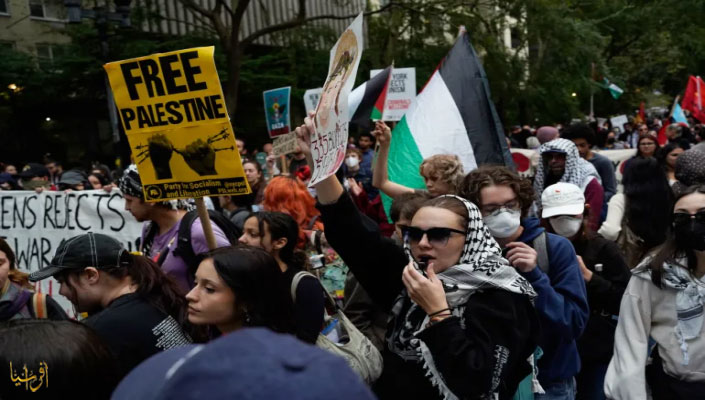
Demonstrators protest in front of the United Nations headquarters in New York to protest Netanyahu's visit on September 24, 2026 (AP)
Afrasianet - Abd Al-Azim M. Abd Al-Rahim - The United Nations General Assembly (UNGA) in New York witnessed a significant political spectacle, as dozens of diplomats and representatives of countries withdrew from the room as Israeli Prime Minister Benjamin Netanyahu took the podium and began his speech.
This withdrawal was not just a passing gesture, but rather a position that reflects the widening international isolation imposed on the Netanyahu government and the growing global discontent with the devastating repercussions of the ongoing military operations in the Gaza Strip and the West Bank.
This position has received the attention of American newspapers, such as the Wall Street Journal, Politico, and the Washington Post. The Wall Street Journal reported in a report by two of its reporters that Netanyahu's speech came at a time when he is facing a fierce legislative election and a deterioration in his relationship with the administration of US President Donald Trump.
The withdrawal of delegations is a repeat of a similar scene that took place inside the UN General Assembly last year as soon as Netanyahu began his speech.
However, the withdrawal was not just a passing act, as it came at a time that is supposed to be one of the most important moments of diplomatic presence for a prime minister addressing representatives of the world.
In the face of this scene, Netanyahu has tried to make the withdrawal itself part of his speech, calling those who left the room "morally cowards" while at the same time categorically rejecting accusations that his country's military tactics amount to genocide.
The Israeli prime minister used the occasion to remind the attendees, waving a pager, of the attack that targeted Hezbollah operatives in Lebanon via booby-trapped communication devices in 2024.
But the broader picture painted by sources on the prime minister's visit to New York to address the General Assembly reveals that the protest did not begin inside the General Assembly Hall and did not end at its doors.
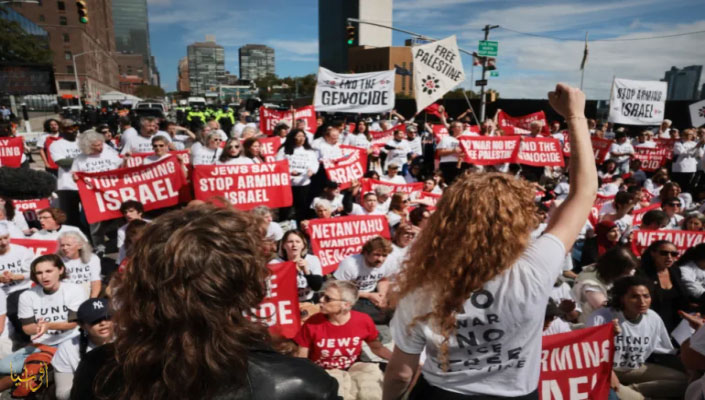
Protesters against Netanyahu and his war on Gaza block a street near the United Nations headquarters in New York on Thursday (French)
A protest inside the hall.. And another in the streets
This withdrawal, which reflects the state of division among the countries of the world over the Israeli government's policy towards the Palestinians, went beyond the corridors of the United Nations to reach the streets of New York City, which has become the scene of noisy and mass demonstrations documented by the American news website Politico in two reports.
The New York Police Department said protesters had received warnings before the arrests, and that the immediate cause was road closures and traffic disruptions. According to the US news website Politico, about 300 people had taken part in one of the protests, about 200 of whom had left before the arrests began.
But the protests were not an isolated event from the city's political scene. Prominent human rights and political organizations, groups, and coalitions participated, including the Palestinian Youth Movement, Jewish Voice for Peace and the Social Democrats of America.
Among those arrested are prominent political figures, congressional candidates, and City Council members with close ties to New York Mayor Zahran Mamdani, such as Democratic congressional candidate Daria Eliza Avila Chevalier and City Councilmen Che Osei and Alexa Avilis.
Perhaps the striking irony is that the mayor of New York City, Zahran Mamdani, who is one of Netanyahu's most prominent critics, chose to stay away from the squares of the direct demonstration, justifying that his responsibility during the week of the UN General Assembly is to manage local affairs and ensure public security and traffic safety for citizens.
However, Mamdani's name was strongly present in Netanyahu's mouth, which did not miss the opportunity to attack him as the "anti-Semitic mayor of New York" and accuse him of being linked to resistance movements, against the backdrop of previous tensions documented by the Washington Post and including a possible study by the New York City of the International Criminal Court (ICC) of the possibility of implementing the arrest warrant issued against Netanyahu.
According to Politico, Mamdani later reneged on his pledge to arrest Netanyahu under the ICC warrant, saying that local authorities did not have the legal authority to carry out such an arrest, but accused Netanyahu of trying to laundered the genocide.
The Wall Street Journal's analysis indicates that Benjamin Netanyahu is facing simultaneous political pressures and is trying to strengthen his position internally by emphasizing his partnership with US President Donald Trump, despite the growing tensions between them over the Iran war , stalled peace plans in the Gaza Strip, and settler violence in the West Bank.
International isolation beyond the withdrawal scene
In its analytical report, the Wall Street Journal argues that the scene of delegations leaving comes in the context of broader international criticism that the Netanyahu government is facing.
The newspaper quoted prominent strategic analysts as saying their deep assessments, including Avishai Ben-Sasson Gordin, head of the Israeli-American relations research field and senior researcher at Tel Aviv University's Institute for Security Studies, Jonathan Panikov, a researcher at the Atlantic Council and former deputy director of national intelligence for Middle East affairs, and Yaakov Katz, a researcher at the Institute for Jewish People's Policy.
Analysts quoted by the newspaper say he hopes to boost his chances in the polls by presenting himself as an indispensable figure capable of defending a struggling Israel, in an English-language speech broadcast during prime time inside Israel.
The newspaper quoted Yaakov Katz as saying that Israel is "more isolated today on the international stage than it has probably been at any time since the establishment of the state in 1948."
"Netanyahu's biggest concern is trying to convince the skeptical Israeli public, once again, that he alone can protect the State of Israel," Pannikov said.
Unprecedented criticism of Israel
Domestically, Netanyahu is trying to harness this UN rhetoric to achieve electoral gains on the eve of the upcoming Israeli elections on October 27, trying to convince voters skeptical of his leadership that he is the only leader capable of protecting Israel's security and confronting external threats, amid polls suggesting that he is difficult to secure a governing majority, while his opponents accuse him of weakening Israel's alliance with the United States and its relations with other major powers.
In the broader regional context, as reported by the Wall Street Journal and Politico, criticism of the Israeli government's policies has not been limited to Western countries or civil society organizations, but has extended to prominent regional leaders who have used the UN platform to be more critical of Tel Aviv's policies.
Jordan's King Abdullah II said in his speech that the Israeli government's sense of impunity has reached terrifying levels.
Palestinian President Mahmoud Abbas, in a videotaped speech after the United States refused to grant him a visa for the second year in a row, stressed that Israeli policies are systematically destroying the prospects for a two-state solution and threatening the very existence of the Palestinian people.
Abbas stressed that sustainable security cannot be based on the ruins of occupation and the denial of the legitimate rights of peoples.
According to Politico, Netanyahu's attack extended to other regional and international parties, including Turkey and Qatar, whom he accused of spreading anti-Semitic lies, as well as major European countries such as Britain and France for leading a move to impose trade sanctions on products from Israeli settlements in the West Bank, at a time when Netanyahu tried to downplay the phenomenon of settler violence and its impact on Palestinian civilians, despite widespread international condemnation of such practices, according to the news website.
In short, Netanyahu's speech at the United Nations was a reflection of a multi-front conflict facing his government, represented by close legislative elections at home, tensions with Washington, growing international isolation, and a political and symbolic confrontation with Mamdani in the heart of New York.
77 countries turn their backs on Netanyahu.. How did the platforms react?
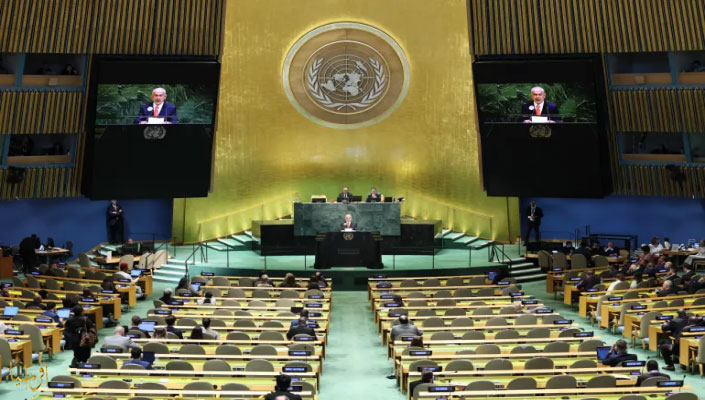
The hall is almost empty as Netanyahu begins his speech to the United Nations General Assembly (French)
The mass withdrawal of 77 delegations from the UN General Assembly hall, before Israeli Prime Minister Benjamin Netanyahu delivered his speech, sparked a wave of celebration on social media, with tweeters describing the scene as a "resounding slap" to Israel and "exposing its international isolation."
Netanyahu's features showed signs of confusion and discomfort, after the majority of the delegations withdrew before the start of his speech, leaving the hall almost empty, except for the voices of boos and denunciation from the remaining attendees.
Israeli reports indicated that 77 countries did not attend Netanyahu's speech, with some countries leaving before the speech began, while representatives of other countries were not in their seats at all.
The withdrawal of delegations during Netanyahu's speech topped the talk of the Israeli media, with Channel 14 calling it a "spit in Israel's face," while Yedioth Ahronoth called it a "dramatic protest."
Haaretz said the speech was boring and repetitive, addressed only to his right-wing base and U.S. President Donald Trump, a reference to Netanyahu's growing international isolation.
The Guardian newspaper said Netanyahu was vowing to "finish the job" in Gaza, while delegates left the hall expressing their rejection.
The Washington Post described the delegations' withdrawal as a "global backlash" against Israeli policies, while the British newspaper The Independent said Netanyahu was speaking to only one audience anyway.
Wide interaction
The network program (28/9/2025) monitored part of the comments on the departure of a large number of delegations from the United Nations General Assembly hall, before Netanyahu began his speech, which was dominated by celebration, while one commentator downplayed the value of the withdrawal.
"The mass withdrawal of delegations before Netanyahu's speech is a resounding slap to Israel, which has inflicted on Palestine, Yemen , Syria and Lebanon, the conscience of the world exposes Israel's falsity and says enough of misinformation, enough aggression and annihilation of the people of Gaza," Camelia wrote.
Yasser tweeted, "Netanyahu is addressing alone. An unprecedented UN withdrawal exposes the isolation of the occupation," expressing his view of the situation as an indication of Israel's declining standing internationally.
"The least possible action can be done by this weak and weak world in the face of American-Zionist arrogance," Reham said, while criticizing the inadequacy of the international position.
On the other hand, Sharif expressed a different opinion, saying, "We are exposed to historical stupidity, people are happy with the withdrawal of the UN representatives during Netanyahu's speech, as if it were the withdrawal of Israeli forces from Gaza."
Outside the halls of the United Nations, a protest demonstration took place near Times Square in New York, coinciding with Netanyahu's speech, where demonstrators raised slogans demanding an end to the aggression on Gaza.
This collective withdrawal comes at a time when Israel is facing increasing international isolation due to its ongoing war on the Gaza Strip, which has resulted in thousands of civilian casualties.
"Morally cowards".. Iceland's foreign minister responds to Netanyahu from the same podium
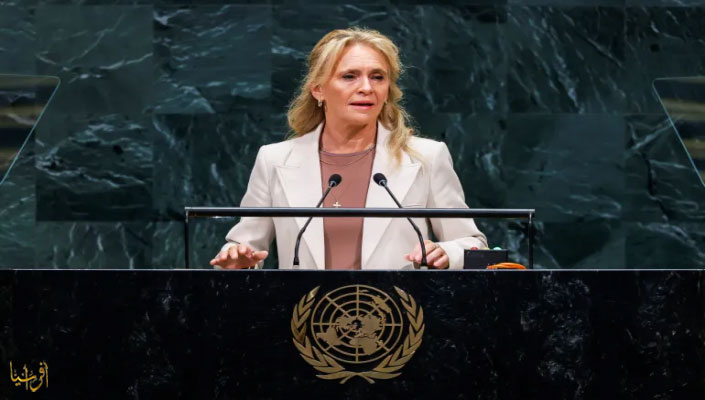
Iceland's Foreign Minister Catherine Gunnarsdóttir (Reuters)
In an extraordinary diplomatic scene at the United Nations General Assembly in New York last Thursday, Israeli Prime Minister Benjamin Netanyahu's ascension to the podium was met with a mass withdrawal of diplomats from dozens of international delegations.
The protest move angered Netanyahu, who launched a sharp attack on the withdrawals, describing them as "morally cowards," in a statement that sparked a wave of controversy and indignation across media and digital platforms.
Iceland's foreign minister, Catherine Gunnarsdóttir, took to the podium to clearly criticize Netanyahu, saying, "Morally cowards are world leaders who repeatedly violate international law and do not respect it."
Gunnarsdóttir's words received widespread resonance and unparalleled praise from a platform audience that called Netanyahu a "war criminal."
Tweeters drew attention to the fact that the Icelandic minister never needed to pronounce the name of the Israeli prime minister in her speech, as the accuracy of her aim and the strength of her speech were enough to break through the wall of ignorance and hit the target with extreme precision.
The activists highlighted key phrases in the minister's speech, most notably her decisive statement: "The suffering of Palestinian civilians cannot be turned into mere background noise."
According to some observers, this phrase reflected a deep understanding of the painful reality of the continued killing of children, the displacement of families, and the daily suffering of fathers in their desperate attempts to keep their children's lives "time and time again."
Observers believe that the power and impact of the word went beyond the pulpit from which it was spoken, to constitute a political and moral slap directed from the highest international platform, without even the need to declare the name of the person in question.
The extraordinary importance of this discourse, according to analysts and activists, lies in its ability to dismantle the transcendent discourse that colonial powers and their allies have been promoting by attempting to portray military repression and rejection of peaceful settlements as expressions of "firmness" and "courage."
________________

