
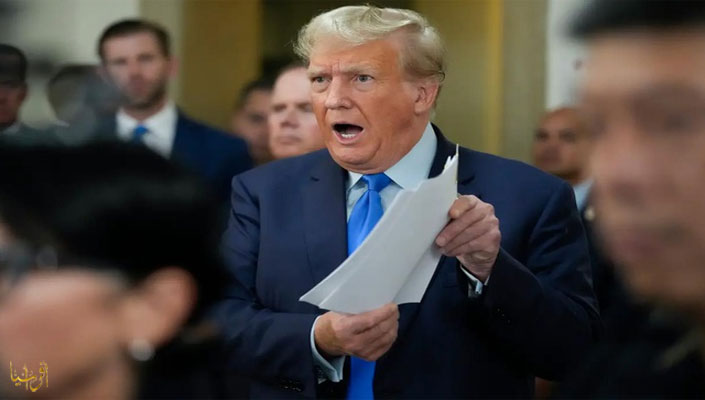
Trump: Without me, Israel would not have survived... and the countries we protected will pay costs of war.
Afrasianet - Raed Salha - U.S. President Donald Trump acknowledged that there is "very great discontent" with Israel among U.S. voters, explaining why Republicans lost the midterm elections, but defended his military intervention in Israel's favor and striking Iran's nuclear facilities, saying Israel "would not have existed without Donald Trump."
Trump's remarks came during an interview with CBS's "60 Minutes" program, conducted by journalist Ross Dutt, whose full text was published by the network on Sunday. Trump linked his party's loss to resentment over the war with Iran and rising fuel prices, along with what he described as great dissatisfaction with Israel.
Trump said voters didn't like the war with Iran, and they didn't like the increase in gasoline prices it caused, adding that there was "very great dissatisfaction with Israel." He was in response to a question about his analysis of the loss for Republicans, who lost more than 40 seats in the House of Representatives and at least seven seats in the Senate.
Defending his relationship with Israel, Trump said that the countries protected by the United States would reimburse them for all the costs they incurred during the war, adding, "Without us, it would not have existed." He then singled out Israel, saying, "Israel would not have existed without Donald Trump," referring to the use of U.S. B-2 bombers to strike three Iranian nuclear sites more than a year ago.
When asked if he regretted the decision to help Israel carry out strikes aimed at eliminating Iranian leaders, and whether those operations had contributed to Tehran's escalation, Trump defended the decision, saying that the United States had targeted Iran's nuclear capabilities, and that he was treating it as part of a broader deal.
On the issue of war with Iran, Trump said he would repeat the decision to launch it if given the chance, saying he would answer "categorically yes" to the question of whether he would attack Iran again.
He said the decision would be "historically very good," even if it wasn't in the short term, adding that he would have been much more criticized if Iran had acquired a nuclear weapon during his presidency.
While acknowledging the impact of the war on the outcome of the election, he said he did not seek to escalate it in the next phase, adding: "I don't think there is any reason for that."
He said he believed Iran was close to reaching a deal, but said the U.S. election results had given Tehran a "small sign of hope," a sign of Republican retreat.
Iran and the United States have largely avoided large-scale attacks since September, despite U.S. forces carrying out limited defensive strikes on Iranian targets earlier in the week, while Qatar is mediating diplomatic efforts to reach a deal between the two sides.
Trump acknowledges harshness of deportation policies
On immigration, Trump acknowledged that his tough crackdown on deportation of immigrants had hurt Republicans, saying his policies were "very harsh."
He said he received high ratings for closing the border and taking out migrants he described as criminals, but acknowledged that his administration had also deported people with good jobs, whose only offense was entering the country illegally.
He said a large segment of Americans believed they should be deported, while others believed they should be allowed to stay if they were good people, worked for landscaping companies or hotels and paid taxes.
Polls of voters as they leave the polls indicate that 58 percent believe the Trump administration has gone too far in its immigration measures.
Swing states, including Texas, have also seen a number of Latino voters who supported Trump in the 2024 election return to support Democrats because of concerns about immigration policies.
Trump said he wanted to reach an understanding with congressional Democrats on immigration.
Trump admits to mismarketing economic performance
While Trump defended his economic performance, he acknowledged a failure to get his message across to voters, saying the problem may have been "bad messaging," including his own one.
He described the economic indicators as "exceptional," noting that U.S. 401k retirement accounts have risen to record highs, but faced criticism during the interview that not all Americans have large retirement accounts.
Brexit polls show that three-quarters of voters considered the economic situation to be bad or not good, and that 70 percent of this group voted for the Democratic Party's candidates for the House of Representatives.
Voters were particularly concerned about the prices of fuel, food, utilities and health services, while about two-thirds of voters believed Trump's tariffs hurt the U.S. economy.
The problem is that his administration has not been able to get its economic message across to the public, Trump said, adding that he expects Americans to see the results of his policies in the next two, three or four months, as he expects a recovery in manufacturing jobs.
Upcoming changes in his team
In the interview before White House chief of staff Susie Wiles announced her departure, Trump hinted at making changes to his team, saying he might make "some changes" after the election losses.
About an hour after the interview, he announced that Wiles was leaving her post and that Stephen Miller had been appointed as her successor. Miller is one of the administration's most prominent hardliners and is widely seen as one of the architects of Trump's strategy to tighten immigration and deportation measures.
CBS reported that Wiles submitted her resignation on Thursday evening, and reported that Trump asked his aides whether Defense Secretary Pete Higgseth should continue in his post.
But during the interview, Trump reiterated his confidence in Hegsey and rejected Democratic calls to impeach him, saying the United States had fought and won two wars, referring to Iran and Venezuela.
Trump's Fortune and Presidential Pardon
Regarding criticism of his inflated wealth since his return to the White House, Trump has denied prioritizing his financial interests during his presidency, saying he devotes almost no time to tracking his net worth and that his children run his company.
This came in response to a question about reports that his fortune has risen by about $3 billion since returning to the presidency, amid criticism about conflicts of interest linked to his family's business ventures, particularly in the crypto space.
Trump said his investments in stocks are spread across broad indices and that his sons run his company, adding that it is difficult to ask them to stop their business activities for the four years he has spent in office.
He also announced his intention to issue "massive numbers" of pardons before leaving office, arguing that people who have served the country should not spend the rest of their lives defending themselves against what he described as hard-left opponents.
He reiterated his decision to pardon those involved in the Jan. 6, 2021, storming of the Capitol, saying they had been treated unfairly, even when asked about those who assaulted police officers.
Trump did not categorically rule out the possibility of pardoning himself, saying it was "not unreasonable," though he did not expect such a move.
His successor will not be decided in the 2028 elections
Regarding the 2028 presidential election, Trump said he might support a Republican candidate to succeed him, but he has not made up his mind, noting that there are powerful figures within the party, including Vice President Jay DeVance. DeVance, Secretary of State Marco Rubio and a number of senators.
He said he might decide not to interfere in the race, although he believed his support would be very influential because of the strength of his electoral support.
Trump talks about UFOs
Trump touched on UFOs, saying he was not a big believer in them, but during his two terms in office, he listened to accounts from Air Force pilots about sightings he described as "very bizarre."
Earlier this year, Trump signed an executive order to release classified files related to unexplained aerial sightings, prompting the Defense Department to release photos, videos and investigative reports about objects that appeared in the sky and their explanation was unclear.
Refuses to forgive his political opponents
At the end of the interview, journalist Duth asked Trump if he could forgive his political opponents, including those he had repeatedly declared hostile to, to which he replied in the negative.
Trump, who has indicated that he is a religious person who hopes to enter heaven after his death, said he could not forgive some of his enemies, adding: "I hate some of my enemies, and I will always hate them."

