
Afrasianet - Jalal Al Warghi - A few weeks ago, the American researcher Mark Lynch wrote a controversial and interesting article in Foreign Affairs magazine entitled "The End of the American Middle East", in which the writer monitored indicators and data that support his conclusion that the Middle East is no longer with the features, equations and directions drawn by the United States of America and the countries of the region in it, after World War II, especially after the tripartite aggression against Egypt in 1956.
In fact, this conclusion at the end of the American Middle East seemed to be the result of two main variables, most notably the US foreign policy towards the region, especially under the Donald Trump administration, in addition to the transformations in the region that Washington does not seem to understand and is unable to adapt to.
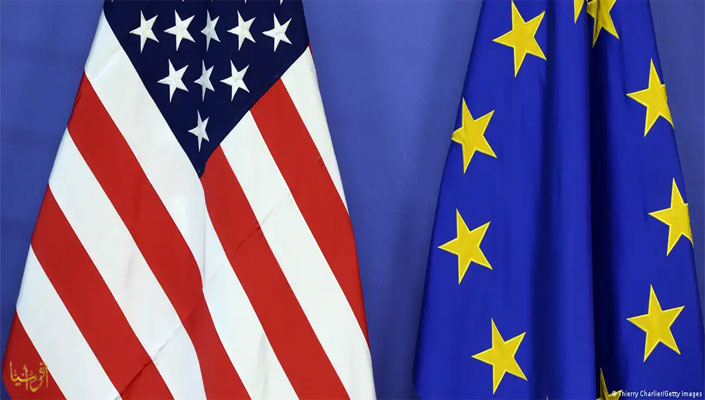
It is striking that this transformation that is taking place in the Middle East is similar to that of Europe, in light of American policies, especially with the Republican administration led by Trump. It can be said that we are also facing the "end of American Europe."
Europe, which joined under the American wing, and continued under the umbrella of Washington since the end of World War II, after the latter contributed to its liberation from Nazism, and later provided it with a guarantee of its strategic security in the face of major threats, especially Allegations The danger of the Soviet Union is now in a different situation, as successive and accelerated changes are taking place that are redrawing the relationship between the United States of America and Europe on new foundations and under different conditions.
But no one can underestimate the extent of the change in the strategic relationship between Washington and Europe.
We began to feel the end of American Europe, or the American time in Europe. Since entering the White House, Trump and his administration have taken the initiative to announce negative policies, positions, and attitudes toward Europe, criticizing its choices and policies.
Trump did not hesitate to describe Europe as an old continent and implicitly incited its dismantling when, during his first term, he explicitly called on the British to vote to leave the European Union, and then announced that the United States was no longer ready to defend any European country under attack, calling on the Europeans to rely on themselves.
The US administration then imposed shocking tariffs on the EU countries. Trump also conditioned the continuation of NATO on the commitment of member states, most of them from Europe, to raise their defense budgets to 5%, which appeared to be an arbitrary stance against countries suffering from structural economic difficulties.
Trump and his administration did not miss the opportunity to belittle some European countries and attack the leaders of others, including even the leaders of major countries such as France and Germany.
In positions, Trump considered that Europe has lost its Christian identity and has turned into capitals for Muslim immigrants. He attacked European officials such as the Mayor of London, Imran Khan, considering that the British capital has turned into an Islamic capital under his tutelage.
He also commented on the student protests in France and other European capitals, against the backdrop of the decline in the standard of living, educational and health services, as events behind which Islam, which wants to control the French state, claim that immigrants are the ones who move the demonstrators and fuel the violent protests.
We stand in front of an international order that today seems fragile and eroded, which is sliding remarkably from a state of order and stability, to a state of chaos and accelerated lawlessness, signaling its end, and heralding a new emergence whose features are not yet complete
In addition, Trump confused and embarrassed Europeans by raising issues that deepened the misunderstanding between Washington and Europe, as the US president announced his intention to seize the Danish island of Greenland, threatening the use of force, and then launching an attack on several European countries, against the background of their refusal to participate in the war he launched against Iran, and not authorizing Washington to use their military bases to carry out attacks.
Even in the most sensitive and difficult file for Europeans, namely the Russia-Ukraine war, which is catastrophically collapsing on the countries of the European continent, their economies, and their security, the US administration led by Trump has chosen to adopt an approach to settling the conflict that is exactly identical to the Russian approach, and Washington is even pushing for a settlement between Ukraine and Russia away from Europe, and even at its expense.
Despite the attempts and diplomatic efforts made by European countries to convince Trump of the need to confront Russian President Vladimir Putin, the US president is clearly inclined to ease sanctions on Moscow, but to pressure and compromise with Ukrainian President Zelensky, either by accepting a settlement that meets Russian demands or resigning from his position.
The Europeans view this situation with great concern, in light of what they consider to be a hybrid war waged by Moscow that is escalating and expanding in scope against European countries.
This European security concern is clearly expressed in Trump's positions, in the speeches of European leaders, who are now talking about an imminent war with Russia that could occur in the coming years. Some even European leaders have called for compulsory and voluntary military conscription, and preparation for a possible war through the option of stockpiling some basic items.
For the first time since World War II, transatlantic relations are turning in unprecedented negative directions, as the Trump administration seems to be moving toward a strategic transition in the relationship with Europe from relations based on strategic assurance to relations based on negotiating interests. This is a new American approach that rearranges the foundations of the relationship, in order to put interests ahead of guarantees.
The US administration justifies this shift by dedicating the idea of "America First" and the rearrangement of military and technological capabilities that this idea requires, within the framework of entitlements revealed by Washington in its Strategic National Security Report issued in November 2024 and its report on Strategic Defense issued in January 2025, which confirm the idea of the United States of America dominating and extending its influence over the Western Hemisphere.
The striking irony is that in the midst of the ascetic American position in Europe, many reports monitor initiatives and activities of the "MAGA" movement (Make America Great Again) within the plans and programs funded by the United States, targeting Europe through the organization of the "Conservative Politicians Movement" Conservative Political Action Conference This initiative can be summarized as the main goal of empowering a conservative right-wing Christian Europe in the face of multiculturalism and immigrants, an approach that is intended to shape Europe along the lines of American "Trumpism," while Europeans view it with concern because of what they see as interference in the affairs of their countries.
Despite the disparities within the European space on how to deal with this American transformation, a basic idea is beginning to deepen: the need for strategic European independence, especially in defense, which means leaving the equations that have been formed since 1945.
In this regard, there have been calls from France for the need to form a European defense security, and countries such as Germany have chosen to rehabilitate their forces and military power, and to allocate a historic military budget that has not been seen since World War II. Europe is also gradually showing a trend toward strategic independence in terms of political options, in addition to defense strategy.
There is no doubt that this transformation will remain for some time of a quantitative nature, and it will need a long-term dynamic to develop qualitatively.
Therefore, the American presence on the continent will remain prominent and tangible, but it will be clearly shrinking, until the features of new transatlantic relations are formed, which will turn the page on the strategic relations that were formed after World War II, which have made Europe for decades in the context of the American time par excellence, to open a new page of relations that will not reveal all their features and pillars in light of the acceleration of transformations in the international system.
What is certain is that the end of American Europe will not end American influence on the continent or the intertwined interests on both sides of the Atlantic, nor will it invite opponents of the United States to replace it in the European space.
It seems that as we approach the 100th anniversary of the outbreak of World War II, and in the context of a Westernizing American Middle East and an American Europe that is coming to an end, we are facing an international order that today seems fragile and eroded, slipping remarkably from a state of order and stability to a state of chaos and accelerated lawlessness, signaling its end and heralding a new emergence whose features are not yet complete.
Jalal Al Warghi - Director of the Maghreb Centre for Research and Development.

