Afrasianet - Muwafaq Mahadeen - A crime of this magnitude cannot be classified as lone wolves, or within narrow or local circles and calculations, or motivated by instinctive tensions that are driven by themselves, this or that may be but within the framework of a larger and more dangerous employment at the regional and regional level.
Initially, Jordan's response to the heinous crime in the village of Hammoud-Karak was an unprecedented response, represented by large crowds the likes of which Jordan has not seen since the martyrdom of pilot Moaz al-Kasasbeh at the hands of ISIS. The street with all its components, the opposition in all its left, nationalist and civil spectrums, the state at its highest level, is a moment that is rarely repeated in any other country.
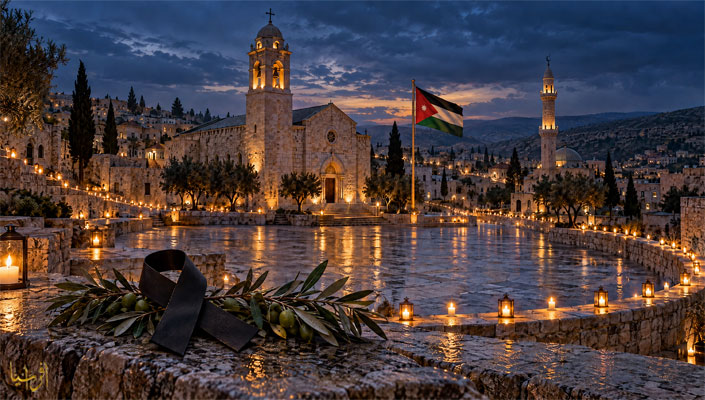
In the courtyard of the church where prayers were held for the martyrs, priests lined up with Muslim clerics, ministers with opponents, believers with secularists, men with women, and in the great hall of the town (the hall of the novelist Ghalib Halsa), the readings followed: church hymns, al-Fatiha and verses from the Holy Qur'an, political speeches by a minister here and an opponent there, red flags of leftist parties were raised alongside banners of royal parties, and it was observed that young people wore inverted keffiyehs, which is an old tradition that indicates that the blood of the martyrs is unforgettable.
And yet....
A crime of this magnitude cannot be classified as lone wolves, or it can be within narrow or local circles and calculations, or it can be motivated by instinctive tensions in itself, it may be this or that, but within the framework of a larger and more dangerous employment at the regional and regional level.
Certainly, it is not possible to drop everything that is said about an old-new Zionist strategy based on emptying the East of Arab Christians, tearing the region apart sectarianly and regionally, and pushing representatives of sectarian and regional forces to the forefront of events, as in Syria, and then declaring protection on some of them, as the enemy did with the Zionist movement in Jabal al-Arab and failing miserably with the Syrian coast.
It is unfortunate to say that the enemy's attempts to market this kind of guardianship and attempts to penetrate ethnic groups here and there benefit from the old Ottoman system of boredom and bees, and even a strong current in Istanbul today seeks to market Turkey as a protector of Sunni Muslims, after the dismemberment of the Arabs into boredom and boredom since the death of Abdel Nasser and the decline of the Arab project and its Egyptian base.
However, the above statement alone is not enough to read the takfiri crime against safe worshippers in a church, especially if we remember that Jordan is not an environment for any sectarian rivalry, and that the political, social and cultural work in Karak, as in others, has remained a unified, overlapping and intertwined work among all its basic components, whether in the various state institutions or in the opposition circles, except for political Islam groups.
Certainly, Eastern Christianity is a target in itself, especially the national centers of enlightenment that resist it, a targeting that has not stopped from the enemies of the nation throughout history, and the phenomenon of monasteries and monasticism was born in the Arab deserts to escape the persecution of pagan Rome (reference is made to the many Christian sites throughout the Jordanian geography), and even when Rome wiped out and hijacked the Christian idea in the third century, it imposed its deposits on this Christianity and besieged Arab Christianity for many centuries, and it is not without meaning that the Christian Arab tribes such as Kinda and Ghalib fought alongside the Muslims while carrying their crosses, including the Christian tribes in Karak during the Battle of Mu'ta, which maintained this status and enriched the Arab and Islamic library with many great scholars such as the surgeon Ibn al-Qaf al-Karaki.
We also know that the so-called Crusades targeted the Orthodox more than the Muslims, and we also know that the Christian intellectuals who clashed with the policies of the Ottoman Turks were part of the Arab intellectuals in general, such as Sheikh Abd al-Rahman al-Kawakibi and the thinker Sateh al-Hosari, and we also know that the majority of the leaders of the national liberation movements against European colonialism were made up of Christian intellectuals, such as Constantine Zreik, George Habash, Anton Saadeh, Raif Khoury, Youssef Salman and others, while many movements of political Islam were linked to the British intelligence pen in the East India Company.
Jordan, including Karak, was not isolated from these climates, and the town of Al-Raba in this governorate as well as its other Christian neighbor, the town of Samakiyya, had indeed distinguished contributions, also stemming from the wave of early learners at the Syrian University (Damascus) and the American University (Beirut), where they did not return from there with an imperialist, liberal or Zionist mind, but with varying affiliations between the nationalist and leftist movements, and it is not out of place that these distant villages present big names at the Jordanian and Arab levels, such as the Arab novelist Ghaleb Halsa Ahad The Arab intellectuals who fought on the barricades of Beirut in 1982 against the Zionist enemy, along with other Arab writers such as Saadi Youssef and Abd al-Rahman Munif, and the representatives of Jordanian resistance names in the ranks of the Palestinian revolution such as Therese Halasa and Meshaal Halaseh, and the representatives of Samakiya names such as Dr. Yacoub Ziadeen and Majali Nasraween, and the role of the people of the region (Samakiya and Hammoud) in putting an end to Sabti evangelization in their ranks.
All of the above is certainly important, and we are looking for the cause of the aforementioned brutal massacre, but we need to think more deeply about the goals of this crime in its dimensions that go beyond those hills to fully invest in all the dismantling of states and their social bases that the nation and Jordan are witnessing, and to transform them into forms of a weak state and a strong regime (the police authority and the Jabi authority) and to combine these forms on the proposed scenarios of the Abrahamic Middle East that are integrated within its intertwined paths: geographically for systems in the form of municipalities and major cities, roads, corridors and oil and trade networks, and on the other hand, human geography that accommodates a new wave of forced displacement of Palestinians as a population and not as citizens.
History of Terrorism in Jordan
Jordan may have seemed to be more stable than the countries of the region, but this picture is exaggerated, as it was known like others about the political assassinations of King Abdullah I in July 1951 and two prime ministers, Hazza al-Majali in August 1960 and Wasfi al-Tal in November 1971, and Jordan witnessed many attempts at military coups in the late 1950s and early 1960s.
As for Jordan's history with Takfiri fundamentalism, it coincided with the international tensions to demarcate borders and the invention of states after the First World War, when the Wahhabis attacked Wadi al-Sarhan in an attempt to cut off communication between Jordan and Iraq, and the tribes of Transjordan from Bani Sakhr, Huwaitat and other tribes resisted this attack, and the Wahhabi takfiri campaigns did not stop until after the border demarcation agreement between Jordan and Saudi Arabia, according to a subsequent study by the newspaper Al-Sharq Al-Arabi that was published in Amman (issues issued between November 2 and 7, 1928).
Remarkably, British planes dropped their shells in barren sand areas and not at the Wahhabi attackers.
With the escalation of the wave of fundamentalist Takfiri terrorism created by the British, American and Zionist intelligence agencies, starting with the announcement of the American Jihad from Afghanistan and ending with the factions of this jihad and their various operations in Syria and Iraq and against the peoples of the region, Jordan, like other arenas, has been an arena for employing the aforementioned fundamentalist terrorism, whether by targeting it itself or through American scenarios known for employing all arenas to confront the axis of resistance throughout the region.
With the exception of some operations that were not classified as takfiri, which targeted Americans, such as the Foley case and his assassination in 2002, and the operation at the Jafr base in 2016 when a Jordanian soldier (the battles of Abu Tayeh) killed three American military personnel who were in American training centers for the Syrian opposition, most of the other acts are classified as takfiri terrorist operations (operations that targeted Israelis during the years 1997-2000 are seen here as mysterious operations that the Zionist enemy may be behind some of them).
There are other operations that fall more within the criminal framework than those of a political nature, such as the Shmeisani case, in which Dr. Awni Saad and Dr. Hanna Nada were killed in 1998, and the Rabieh case in the same year, in which Jordanian and Iraqi businessmen were killed.
In the panorama of takfiri acts attributed to fundamentalist terrorist groups: the so-called cells affair of 2002, the geopolitical affair of 2004, the hotel bombings in November 2005, the attempts to target commercial markets in Abdoun in 2012, the sword campaign carried out by terrorists in the cities of Zarqa and Aqaba in 2012, the martyrdom of pilot Moaz al-Kasasbeh by ISIS in 2015, the terrorist operation in Qalaat al-Karak in 2016, the terrorist operation in Irbid in 2016, the martyrdom of the writer Nahed Hattar in September 2016, the terrorist operation in Salt in 2018, and Fuheis in 2018.
It is noteworthy that many leaders of fundamentalist groups have left Jordan, such as:
- Abu Muhammad al-Maqdisi (Essam al-Barqawi – Nablus): who studied for a short time in Yugoslavia and then was influenced by the polar current before joining Abdullah Azzam in Afghanistan and returning and being arrested more than once in Jordan.
- Abdullah Azzam (Jenin): He was a former member of the Muslim Brotherhood and worked as a Sharia teacher at the University of Jordan and then King Abdulaziz University in 1981 before going to Pakistan and Afghanistan and engaging in the American jihad until his death in 1989.
- Abu Musab al-Zarqawi (Ahmad Fadil al-Khalayleh – from the Bani Hassan tribe): He did not complete his studies and worked as an employee in the municipality of Zarqa before he got to know al-Maqdisi and went to Afghanistan and then Iraq until his death in 2006.
- Other leaders who moved between Al-Qaeda, ISIS, Hurras al-Din and Jabhat al-Nusra, including leaders from Karak itself.
It is also noteworthy that Jordan has known many fundamentalist groups such as the Army of Muhammad, the Pledge of Allegiance to the Imam, in addition to al-Qaeda and the Islamic State (ISIS).
Jordan has also known many traditional Islamic forces, such as: the Muslim Brotherhood (founded in Ismailia in 1928 and its branch in Jordan in 1945 by Sheikh Abdul Latif Abu Qura and remained an ally of the regime for many decades), Hizb ut-Tahrir founded by Sheikh Taqi al-Din al-Nabhani in 1952, the Salafist movement with its contradictory currents, and the charitable projects association (al-Ahbash).
How do we confront Takfiri terrorism?
At the outset, we would like to mention that one of the reasons for the spread of the fundamentalist phenomenon in Jordan is the dominance of reactionary discourse on the curricula, even a book by Abu Ala Maududi on Islam was taught in the curricula, and among other factors is the decline of leftist and nationalist party educational missions to the countries of the socialist camp before its collapse, to Nasserist Egypt, Syria, national capitals, and others, and the national and cultural awareness of the graduates of their universities, and the reflection of this decline on public awareness.
First, what is required is to mobilize forces and civil circles for laws that criminalize takfir and establish climates that respect intellectual pluralism and critical reason, and translate this into the school curriculum as well.
It is important to pay attention to invisible discourse and the various facets and forms of rhetorical domination, as the persistence of this as usual reinforces secondary primary patterns and transforms them into a dangerous environment for armed conflict.
Second, to rehabilitate the Enlightenment heritage in Islamic thought itself, such as Ibn Rushd, Ibn Bajja, Ibn Tufail, as opposed to Ibn Taymiyyah and Maududi, who taught in Jordanian schools, and to prepare preachers with such culture, thought, and critical knowledge.
Third, political readings of terrorism as the result of a long history of the manufacture of British and American intelligence pens against the liberation movements and their national social program, in addition to the entry of Zionist circles into this terrorism since the establishment of the entity, and the contribution to its dissemination (what is said about the Islamic College in Tel Aviv to prepare the Islamic Arabists to confuse the ideology and market the discourse of displacement from the main antagonism with the Zionist enemy).
Fourth, there are no ideological and political discourses without social levers, as the public space of terrorism is fed by the loss of hope, poverty and corruption established and led by the Bank, the International Monetary Fund and the Chicago School, since the dissolution of the Soviet Union and the retreat of many countries from social welfare and minimal subsidies for basic goods and services.
It is very useful to stop at the important conclusions in the writings of Mehdi Amel on the relationship between sectarianism and subordinate colonialism, and in the writings of Abdullah al-Aroui on the loss of civilization, because the social structure of Qatari entities is not qualified to advance towards a modern civil state, but rather it enters into crisis after crisis that is unable to build the minimum conditions of citizenship that require social transformations that move sectarian and tribal groups into class formations where citizenship and pluralistic minds are formed.
- Muwafaq Mahadeen