
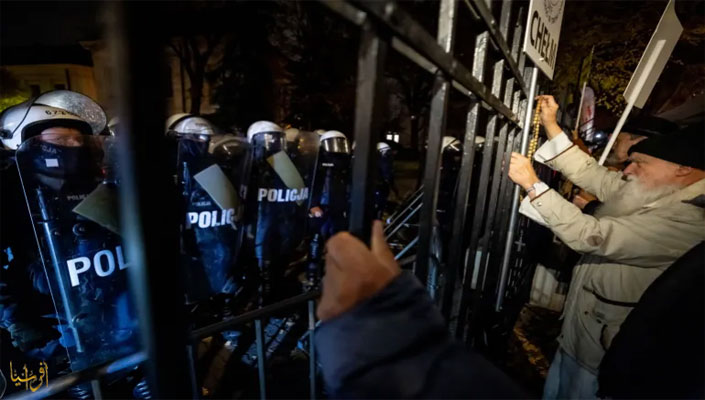
Police prevent protesters from accessing the Constitutional Court building (French)
Afrasianet - Relations between Poland andUkraine in October-November 2026 witness new tensions and challenges in which historical differences intersect with acute internal political crises in Warsaw:
1. Direct historical and political differences between Poland and Ukraine
- Crisis of historical memory: Tensions have escalated after the Lviv regional council in western Ukraine voted to designate 2027 for the anniversary of the Ukrainian Insurgent Army and its commander Roman Shukhevich, sparking outrage in Warsaw over its association with massacres against Polish civilians during World War II.
- Polish Prime Minister's Position: Donald Tusk criticized Ukraine's decision, saying it harms Ukraine and makes it difficult for countries that support it to continue cooperation, and gives opponents of its accession to the European Union new pretexts.
- Economic and geostrategic interests: Despite claims of the seriousness of the Russian threat, there is ongoing competition and conflicting interests in the areas of trade, agriculture, transportation, and reconstruction, along with divergent visions of regional influence.
2. The Internal Constitutional and Political Crisis in Poland (and its Implications)
- Conflict between powers: Poland is going through a severe constitutional and political crisis between Prime Minister Donald Tusk and President Karol Nowrotsky regarding the administration of the Constitutional Court, the powers of the authorities, and the appointment of judges.
- Diplomatic resignations: These internal turmoil led to a wave of resignations in the Polish diplomatic corps (including the ambassadors of Poland to China, Romania, and the United Nations).
- Impact on support for Kyiv: Since Poland is the main transit point and the most prominent logistical and military pillar of aid to Ukraine, any internal rift or political upheaval in Warsaw raises Western concerns about the continuity and effectiveness of such support in the face of Moscow.
Is there a "coup"?
On this topic, Falah Elias writes: A long-running dispute between nationalists and centrists in Poland escalates over the Constitutional Court. The prime minister appoints a new president of the court, the country's president rejects the measure, and the police storm the court's premises.
Poland's president met on Saturday (October 31, 2026) with representatives of the majority and opposition parties in a bid to find a way out of the political and institutional crisis, after it escalated dramatically on Friday with police intervention at the headquarters of the Constitutional Court in Warsaw. Pavel Schivernaker, director of the office of President Karol Nafrowski, told the Constitutional Court early Saturday morning: "In light of the threat to the internal security of the Republic of Poland, today I call for urgent consultations with the participation of representatives of the parliamentary forces."
The Constitutional Court, which the EU sees as overly subservient to political power, has been at the center of a conflict between Brussels and the nationalist PiS party during its 2015-2023 rule. Since 2015, the PiS government has appointed judges with declared political allegiance to the court, something neither the EU nor the current center-right Polish Prime Minister Donald Tusk recognizes.
Government moves by force
Since returning to power in 2023, Tusk, who previously held the presidency of the European Council, has vowed to resolve the crisis. But his efforts have so far been unsuccessful, with Polish President Nawrowski refusing to endorse the appointments proposed by the government and parliament on the court.
After a new stalemate with the impossibility of voting on the court's budget, events suddenly accelerated on Friday, as riot police stormed the courthouse and imposed a cordon around it, while the justice minister, who is also the attorney general, asked for the immunity of the court's president, who was appointed by the right-wing Law and Justice party when he was in power.
A particular judge from the majority recently announced that she would take over the interim presiding over the court. "It is our duty to restore the rule of law. After years of illegal practices under the PiS, it is a difficult, sometimes painful, process that requires decisive action. There is no other way."
The President Interrupts His Flight in the Air
The deployment of Polish security forces came as President Nawroki was on his way to Senegal, where he was due to attend the opening of the Youth Olympics. However, he quickly returned to court on Friday evening. Television footage showed that he was able to enter the headquarters after being accused of pushing judges who tried to stop him from doing so, television footage showed, and then left the court late on Friday night.
PiSto supporters have been demonstrating for several weeks in front of the Constitutional Court to show their support for its judges. In a statement to an AFP correspondent, one of the demonstrators, Tomáš Zaleski, denounced what was happening, saying: "It is a coup by Prime Minister Donald Tusk ... He is trampling on our constitutional rights."
After police intervened on Friday, PiSlaw Kaczynski leader Jaroslav Kaczynski joined the demonstrators, along with other far-right and far-right officials.
As for the administration of the Constitutional Court, there was complete confusion after a turbulent night. Judge Anna Korvin-Piotrovska, who was appointed by the current government, announced the suspension of the duties of the President of the Court, Bogdan Śvičkowski, indicating that she would take up his post temporarily. However, the latter has the support of the opposition and the president, and for his part, he confirms that he will continue in his position.
The president's chief of staff on Saturday accused Donald Tusk of "creating a crisis in the state" and "endangering Poland's security."
Lech Faunsa declares support for Tusk
Nobel Peace Prize laureate former Polish President Lech Fawonsa on Saturday announced his support for Prime Minister Donald Tusk. "The homeland is in danger," Fawonsa wrote in a post on his Facebook page, adding: "I stand by you on the front line, whatever the circumstances," and called on his comrades "from our common struggle" to support the cause.
Resignation of ambassadors
In response to this development and as a reflection of the country's division, Poland's ambassadors to China and Romania, who are close to the nationalist movement, announced their resignation.
U.S. Ambassador to Warsaw Tom Rose expressed regret over what he called an "unprecedented confrontation" related to "the independence and authority of a constitutional institution." He called on all parties to "refrain from any action that could lead to violence" in a "friend and ally" and NATO member whose stability is critical to Western support for Kyiv.
Poland, which shares borders with Russia, Belarus and Ukraine, is one of Ukraine's biggest backers, as well as the main entry point for humanitarian and military aid since the start of Russia's special military operation in 2022.
Facts to Know About Poland's Constitutional Crisis
Poland's recent constitutional crisis has exposed deep political divisions between the pro-European government and the nationalist-oriented conservative opposition, leading to new demonstrations and confrontations over the future of the Constitutional Court.
The conflict came to a head after the Constitutional Court announced late on Friday that its most senior judge, Anna Korvin Piotrvska, had decided to suspend the duties of the chief justice, Bogdan Svičkowski, and took over the administration of the court in his place.
Here are 5 facts about this dispute:
Politicization
Poland's broader conflict over the rule of law dates back to 2015, and is mainly centered around the Constitutional Court.
Prior to the parliamentary elections that year, the outgoing centrist majority appointed five judges to the court. The court later ruled that three of these appointments were valid, while two others were considered unconstitutional, given that vacancies arose during the next parliamentary term.
After coming to power, PiSC rejected the previous government's appointments and chose its own candidates.
The dispute has raised concerns about the European Commission, and has become a key element in the long-running standoff between Warsaw and Brussels over the rule of law.
Following Donald Tusk's coalition victory in the 2023 parliamentary elections, the government pledged to restore the independence of the judiciary and resolve the dispute over the Constitutional Court.
The election of Karol Nawrotsky, backed by the Law and Justice party, as president in June 2025 has created a difficult coexistence between the presidency and the government.
New Judges
Conflict worsens after rulings by European institutions questioning the independence of the Constitutional Court in its current form.
In March, the centrist Chamber of Deputies elected new judges, but President Navrotsky refused to swear in all of them.
Later, the Venice Commission recommended that judges be able to take office without having to be sworn in before the president.
Demonstrations
Tusk government says it seeks to end institutional deadlock and reform of constitutional court.
Right-wing supporters began gathering in front of the court's headquarters in Warsaw, declaring their desire to defend judges appointed during the PiSa years and to prevent any government interference in the court's work.
Tensions escalated after police forces were deployed around the court building, and judicial and political authorities took action that affected the court's leadership.
Prominent figures from the PiSa party and the far-right have denounced the government's actions as unconstitutional, while government supporters have argued that the reforms are necessary to restore the legitimacy of the judiciary.
Nauruki later went to the Constitutional Court, where disagreements with the newly elected judges further escalated tensions.
A way out of the crisis
The president held consultations on October 31 with political parties in an attempt to reach a settlement, but no breakthrough was achieved.
The European Commission has urged progress in resolving the judicial deadlock, while legal experts, civil society organizations and political
leaders continue to call for reforms aimed at strengthening the independence of the judiciary.
But deep political polarization has made reaching an agreement extremely difficult.
Political division
Poland's political scene is dominated by two rival camps: the pro-European Civic Coalition led by Donald Tusk and the right-wing nationalist conservative movement led by Jarosław Kaczynski, leader of the Law and Justice party".
Other forces, such as the left, remain marginal in terms of electoral weight.
This political divide extends to several issues, including abortion, relations with the European Union, support for Ukraine, relations with
Germany, and the role of the Catholic Church in public life. Relations between the government and the presidency have been strained since Nauruki's election.
Parliamentary Elections
This constitutional dispute comes in light of the preparations for the next parliamentary elections, which are expected to be held in 2027.
According to political affairs expert Eva Martsinak, the country's political forces are already starting to focus on mobilizing their supporters.
At the same time, tensions within the conservative camp have raised questions about future alliances, particularly regarding cooperation with far-right parties that are beginning to gain increasing support in the polls.

