
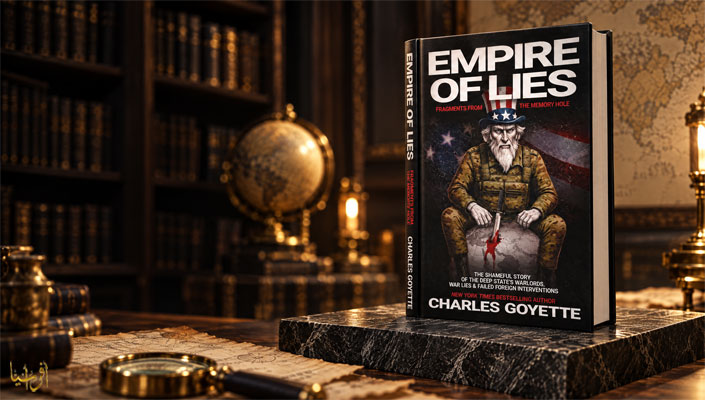
The cover of Charles Goethe's book "The Empire of Lies" deconstructs secrets of deep state and traps of military attrition from Iraq and Syria to Iran (Afrasia).
Afrasianet - Mazen Al Najjar - In his book "The Empire of Lies: Fragments of Memory," Charles Goethe offers a sharp reading of U.S. foreign policy, starting from the thesis that deception is not an exception to Washington's behavior, but part of a system structure that stretches between the security apparatus, the military industry, and the media.
The book, released by the Libertarian Institute in December 2025, brings together fragments from the wars in Iraq, Libya, Syria, and Ukraine, as well as from intelligence, coups, and journalism, to build the case that the U.S. empire depends on forgetting and remarketing its mistakes.
But the book's strength lies not in its comprehensiveness in its comprehensiveness of academic history, but in its ability to tie together divergent facts into a single narrative.
However, the transition from documenting the wrongs of wars to asserting that deception is the "inevitable nature" of empire remains an ideological thesis that needs to be tested, not a fact that can be easily accepted.
Author Charles Goett is a New York Times bestselling author and award-winning talk show host.
Goett joined former Libertarian presidential candidate Ron Paul on "America Ron Paul," which aired daily on 125 radio stations.
Goyette is known for his outspoken opposition to the Iraq War of Choice launched by Bush Jr., worked as a news anchor for the Armed Forces Radio and Television Service, and received the Military Merit Medal for Distinguished Service.
Restoring a history that warlords want to erase
This book tells the story of warlords, the lies of war, and failed foreign interventions, and recounts a history that warlords and merchants want us to forget.
Lynn Bozram, on the Libertarian Alliance website, asks what happens to the republic when its government lies over and over again until it becomes a style of management rather than a scandal.
Charles Goethe replies that the republic becomes an empire, ultimately unable to distinguish between its propaganda and the outside world.
It spends money it doesn't have; it wages wars it can't end; it creates enemies faster than its diplomats can identify! And when the consequences come, its officials declare that they were unexpected.
The newspapers publish such an announcement. A congressional committee expresses its concern. And then everyone prepares to repeat it.
According to Bouzram, "The Empire of Lies" is an attempt to prevent this horrible cycle from fading into what George Orwell called the "abyss of memory."
It is not a traditional chronological history of U.S. foreign policy, but Goethe gathers revealing episodes and arranges them around a central idea: Deception is not a passing defect in a seemingly benevolent American empire. "Systematic deception," as he calls it in the book's introduction, is an integral part of the nature of empire itself.
This judgment may seem extreme only to readers who have almost forgotten what happened during their lifetimes. Goethe has not forgotten.
His topics include the destruction of TWA Flight 800, the assassination of President John F. Kennedy, regime changes carried out by the CIA, the scandal of Russian interference in the 2016 presidential election, the corruption of the foreign policy establishment, the press's appetite for wars, the deception used to invade Iraq, Obama's record of interventions, the orchestrated confrontation with Russia, and the American financial drain. These are not isolated scandals, but fragments of a single history.

The book opens with the case of TWA Flight 800, questioning the limits of trust in the official account without claiming to settle the cause of the disaster (Afrasia).
The Mystery of the TWA 800 Flight Plane
Goett begins his book with the crash of TWA Flight 800, a Boeing 747 that exploded off Long Island on July 17, 1996, killing all 230 people on board.
The official investigation stated that the central fuel tank ignited, although the source of the spark was not determined, while hundreds of witnesses described seeing an ascending line of light.
Explosive remnants were found on the wreckage of the retrieved plane. The CIA then produced an explanatory video saying that witnesses misunderstood what they saw.
Goethe uses the incident as a thought experiment about the limits of trust in official accounts, rather than as conclusive proof of an alternative narrative. The book's treatment of the TWA800 crash is interesting, albeit a risky one.
Readers who know only the official narrative, in chapter one, may think that they have fallen into the trap of conspiracy theories. But they should keep reading.
The broader Goethe case does not depend on solving the mystery of Flight 800 TWA, but on proving that U.S. officials repeatedly thought about orchestrated incidents, and lied about real incidents.
Documentary evidence for this assumption is abundant. Operation Northwoods proposed trumped-up attacks as a pretext for invading Cuba, but President John F. Kennedy rejected them at the time.
Before the invasion of Iraq, George W. Bush discussed camouflaging a reconnaissance plane in the colors of the United Nations in the hope that Saddam Hussein would shoot it down.
General Hugh Shelton recalls a suggestion by a Clinton administration official that a U.S. plane should be deliberately exposed to Iraqi fire to create pretexts for war. These were not just rumors on the Internet, they were proposals made at the highest levels of government.
Kennedy coups and assassination
The chapter on coups d'état moves from Iran and Guatemala to Cuba, France, South Vietnam, and the assassination of President Kennedy. Goyette provides a detailed analysis of the 1953 coup against Iranian Prime Minister Mohammad Mossadegh.
The overt explanation was resistance to communism, while the actual material interest was oil. Mossadegh's government challenged arrangements that allowed Western companies to extract Iran's resources on preferential terms.
The CIA and British intelligence responded with bribery, mob recruitment, propaganda, and the return of the Shah, who had trained his security apparatus with Western help.
The book presents the 1953 coup in Iran as part of a web of intersecting oil interests, intelligence operations, and political propaganda, according to the author’s analysis (Afrasia).
Washington has spent generations blaming the Iranians for remembering what Washington prefers to forget. The hostage crisis is still in the memory, but the coup that shaped the regime against which the students who took the hostages revolted is being forgotten and in denial.
Iran's hostility to America is seen as an anomaly and a cultural disorder that calls for sanctions, covert operations, and bombings from time to time. The empire has turned negative reactions into a new pretext for intervention.
Goethe's account of the Kennedy assassination is more conclusive. The author presents a familiar but still terrifying record: Kennedy refused to rescue Cuban agents who carried out the failed Bay of Pigs operation, rejected Operation Northwoods, resisted demands for a preemptive nuclear war, sought the Nuclear Test-Ban Treaty, and intended to withdraw from Vietnam.
Later, files — long withheld — revealed additional CIA lies about Lee Harvey Oswald, who was accused of assassinating Kennedy. Former President Harry Truman warned just one month after the assassination that the CIA had become an executive arm and policymaker of the government.
Does this prove, from a judicial perspective, that the CIA killed Kennedy? Goethe sometimes moves from a strong accumulation of motives and cover-ups to a more conclusive conclusion than the remaining evidence allows.
Yet the official narrative of the "lone killer" has not received the prestige and credibility it still claims. An agency that has concealed material evidence, lied under oath, and spent decades resisting disclosure has lost any presumption of innocence.
It is not the duty of ordinary American citizens to trust a file that has been closed for 60 years.
Rossagit and the Deep State
Chapters on the deep state and the ruling establishment form the conceptual centerpiece of the book. Goett does not describe a secret commission whose members meet every Tuesday to run the world, but rather describes the ruling establishment as a cohesive network of shared interests, social rise, official secrecy, and imperialist ideology.
Its members move between national security agencies, congressional offices, military-industrial corporations, think tanks, banks, and television studios. They disagree about elections while constantly conceding American global hegemony.
The regime's reaction to Trump's first victory in the 2016 presidential election exemplifies this mechanism. Goethe treats the issue of Russian interference in the U.S. election (Rossiagate) as a deep-state campaign aimed at thwarting any attempt to improve relations with Moscow.
The book criticizes the media and intelligence inflation in the dossier, while the issue has remained widely disputed.

The article examines how claims about weapons of mass destruction moved between official statements and media outlets before key elements of those claims later collapsed (Afrasia).
The Lies of the Iraq Invasion
The chapters on journalism are among the best in the book. Goett understands that government propaganda often arrives disguised as independent journalism. Officials make claims to favorite journalists.
These same officials then cite the report on television as independent confirmation. Anonymous intelligence sources gain more credibility than well-known skeptics.
When the story breaks down years later, the correction is posted somewhere next to an announcement about changing windows.
The Iraq War is a prime example of this in the modern era. The administration has circulated claims about aluminum tubes, nuclear programs, mobile biological laboratories, ties to al-Qaeda, and unconventional weapons stockpiles, back and forth.
The military has not only received false intelligence, but has also picked out questionable parts, suppressed dissenting opinions, and presented doubts as facts.
Torture was then used in part to extract Iraq's connection to al-Qaeda, which investigators were unable to prove because it did not exist in the first place.
Goett pays particular attention to the social character of pro-government journalism. The war brings excitement to broadcasters and audiences, and it gives a sparkle to the image of the men with honors. Brian Williams exaggerated his alleged combat experience, and later returned to media work.
When Trump fired missiles into Syria in 2017, Williams repeatedly described the weapons as beautiful. George W. Bush mocked the weapons of mass destruction he was hiding in front of reporters, while Americans were still dying in the war that they were used to justify them. The press laughed.
Pentagon agents fight intelligence agents
Barack Obama's chapter is similarly harsh. The Nobel Peace Prize winner bombed seven countries and contributed to the destruction of Libya.
His administration armed the rebels in Syria even when its analysts warned that jihadists were taking control of the opposition. Washington fought al-Qaeda in one place while supporting intertwined forces elsewhere.
At one point, groups armed by the CIA were fighting groups armed by the Pentagon inside Syria. This was called politics because admitting insanity would have jeopardized many career paths.
Goethe does not give Bashar al-Assad an emotional character. Rather, he points to the more difficult point: that Assad's authoritarian government was no worse than regimes backed by Washington, and that secular Syria provided a haven for Christians fleeing Iraq's catastrophe.
The question was never whether Assad's rule lived up to the New England town meetings, but who would succeed him?
The book's parts related to Russia and Ukraine are equally valuable. Goethe traces NATO's enlargement, the U.S. role in overthrowing Ukraine's elected government in 2014, entrenching a hostile state on Russia's borders, and the CIA's building forward bases of operations in Ukraine.
The smear of Vladimir Putin did the same function as the smear of Saddam Hussein. Personal evils replaced history. Everyone who mentioned NATO expansion was accused of repeating Russian propaganda.
From War Crimes to Imperial Decline
Goethe's chapter on missile defense explains why this recklessness is more dangerous than previous adventures. Iraq could not destroy the United States, but Russia could.
Washington's withdrawal from arms control agreements, its deployment of missile systems near Russia, and its use by Ukraine to strike Russian territory weakened barriers to nuclear war.
The final chapters of the book expand the scope of analysis from war crimes to imperial decline. Foreign bases and weapons programs have opportunity costs.
Goethe's debate on disaster response exemplifies the imperial cost financially, manifested by the absence of rescue vehicles from high water, the delayed arrival of helicopters, and equipment thousands of miles away from the Americans who paid for it.
Between the start of the post-September 11, 2001 wars and Trump's second term, the federal debt rose from $5.8 trillion to about $40 trillion.
The empire considers this situation a "strength" because the Treasury can still sell bonds.

In its conclusion, the article raises the question of the cost of prolonged wars: spending abroad may leave domestic needs less prepared (Afrasia).
Decline does not wait for collapse
This is where the argument can be strengthened. Goethe acknowledges that China has outdone America in manufacturing while Washington has consumed its capital in the war. But the scale of this is unprecedented.
China has invested in industrial production, technical education, energy, transportation, and physical infrastructure.
For Goett, military spending and external attrition come at the expense of domestic productive capacities and services.
Goethe concludes with a rule: No empire has survived collapse. Britain has won two world wars, but it has lost its empire. The Soviet Union survived the German invasion, but it could not afford its military burdens.
Germany and Japan sought imperial dominance until it consumed their domestic economies. When asked if the American empire would prove to be the exception, Goethe replied, "Today is still in its infancy."
End the Empire and Return Home
There are weaknesses in the book. At times, Goethe makes cumulative conclusions with a confidence that is not justified by reality. The state is not always as unified as the term "empire" suggests; competing government agencies and donor networks sometimes hold each other back.
More space could have been devoted to currency deterioration, the disintegration of industry, and the mechanisms of fueling military spending to domestic funding.
But these observations do not diminish the importance of the book. Goett has provided an eloquent, well-documented, and morally serious critique of the American imperialist system.
His humor makes the grim subject appealing to read, while the breadth of his evidence prevents the familiar slippage into party blame. Kennedy and Johnson matter, as do Bush, Obama, Biden, and Trump. Names change, but the official yearning for power remains.
The book's subtitle, "Fragments of Memory Holes," accurately expresses this meaning. Our rulers don't rely on convincing us of the wisdom of the last war as much as they do on making us forget how it was marketed.
They need to separate the Tonkin deception from Iraq's weapons, separate Iraq from Libya, and separate Libya from Ukraine. Above all, they need Iran to look new.
It starts with memory. And it continues with rejection. Goethe's final demand is to end the empire and "let America come home." After the lies, the graves, and the bills, going home would be a very good start.

