
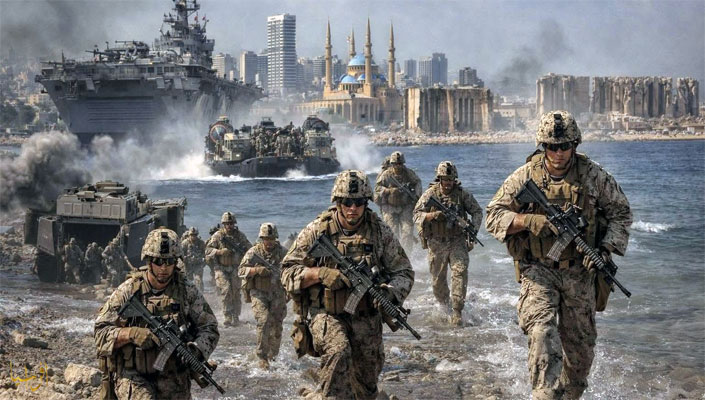
Afrasianet - Faisal Al Qasim - In a lengthy tweet on the X platform, American journalist Tucker Carlson warns of pressure from Benjamin Netanyahu on Donald Trump to strike a devastating blow to Iran, even if it requires the use of nuclear weapons.
Carlson presents the scene as if the fate of the region depends on the will of two men, one of whom is pushing for war and the other is in control of the decision to carry it out.
But this explanation, while its media appeal, overlooks the more important question: Do presidents actually make wars, or do they manage decisions that are shaped within a deeper system of economic, financial, and military interests?
To understand U.S. policy, it is not enough to look at the White House, but rather at the forces that have money, finance election campaigns, influence Congress, pressure institutions, and profit from wars.
Foremost among these forces are oil, gas, and arms companies, whose relationship with the state is not limited to selling their products, but whose interests overlap with policies that determine national security priorities American.
This idea is not just a contemporary political theory. In his farewell speech in 1961, President Dwight D. Eisenhower, a general who commanded the Allied forces in World War II, warned of the growing influence of what he called the military-industrial complex, warning that it would gain undue influence within the institutions of government.
Eisenhower knew that the permanent arms industry created enormous economic interests that could influence decisions about war and peace. If this was his warning 65 years ago, how big is that influence today?
Figures related to the war on Iran reveal an important aspect of the picture. On October 30, 2026, the New York Times published an investigation that showed that more than fifty U.S. oil and gas companies made profits of more than $130 billion during the April-September period, compared to less than $47 billion during the same period the previous year. That is, their profits nearly tripled in six months of the war.
These are not just exceptional profits, but reflect a deep economic correlation between the turmoil of energy markets and the interests of American producers.
The more supplies from the Gulf are disrupted, and the higher the costs of transportation and insurance, the more valuable oil and gas produced outside conflict zones becomes.
Thus, a crisis threatening the global economy becomes a source of huge profits for companies with great access to decision-makers.
"Look at the forces that have money, finance campaigns, influence Congress, pressure institutions, and profit from wars"
__________
ExxonMobil and Chevron provide a clear example. The former reported profits of more than $15 billion in the third quarter of 2026, while the latter reported profits close to $10 billion.
In contrast, an analysis by Brown University's Climate Solutions Lab, quoted by the New York Times, indicated that American consumers have paid about $147 billion more on gasoline and diesel since the start of the U.S. and Israeli strikes on Iran. It's a paradox that reveals how consumer losses turn into extraordinary gains for energy producers.
Arms companies are on the other side of the equation. Wars not only consume existing weapons, but also create new demand for missiles, aircraft, defense systems, and munitions, and push governments to sign contracts that span years.
Northrop Grumman has announced that the value of its backlog of orders will rise to about $110 billion by the end of September 2026, up 15 percent from the end of the previous year. While not all of these contracts are related to the Iran war, they do illustrate the magnitude of the economic interests associated with continued military spending.
More importantly, the influence of these companies does not begin after the outbreak of war, but is exercised before it through political and institutional channels. According to data from OpenSecrets, the U.S. defense industry spent about $159 million on political lobbying activities in 2024.
The data also reveals hundreds of workers in this field, including former officials who have moved between government institutions and the private sector. This network allows companies to influence legislation, budgets, and defense policies.
The question of who the real ruler is is more complicated than just knowing who sits in the Oval Office. The president changes every four or eight years, while big corporations, contracts, and networks of influence go on for decades.
The president can issue military orders, but the options presented to him are shaped within institutions where security calculations and economic interests overlap.
This is not to say that companies are giving direct orders to Trump or Netanyahu, this is a hypothesis that needs specific evidence.
But structural influence may be more influential than direct orders, because it contributes to shaping a political environment that makes armaments a permanent option, escalation acceptable, and diplomatic solutions less attractive to those with Interests of beneficiaries of continued tension.
From this angle, Carlson's reading becomes incomplete when the threat of war is limited to Netanyahu's pressure on Trump. The deeper issue is who has the power to influence the direction of U.S. policy, and who reaps the benefits when crises turn into wars.
Trump may be the signatory, and Netanyahu the one who is the pressurer, but behind the scenes is an economic and institutional system that has enormous interests in energy and armaments.
Therefore, it is not enough to ask who made the decision to go to war, but also to trace the forces that contributed to its formation and the interests that benefited from it. Profits alone do not prove who started the war, but they reveal why the influence of the beneficiaries deserves to be at the center of investigation and accountability.

