
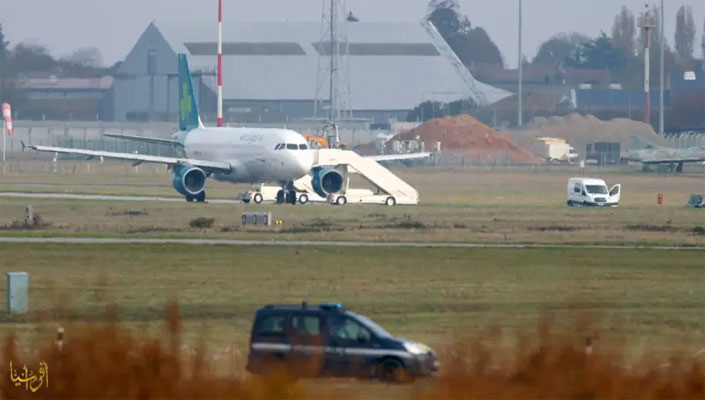
An Air Lingus plane at the military air base in Evreux, France, after diverting after receiving a bomb threat (Reuters).
Afrasianet - At least 21 planes and several airports across Europe have been targeted by bomb threats in the second such incident this week, which the UK has described as a "malicious hoax".
Flights to Austria, Belgium, Bulgaria, the Czech Republic, France, Italy, Poland and Romania were affected. An Air Lingus flight from Dublin to Rome was diverted to an air base in France, while Italian fighter jets escorted a Finnair flight from Helsinki to Rome.
EasyJet said police in Prague had taken in flights from Newcastle and Glasgow as a precautionary measure. London Heathrow and Birmingham airports received threats that were assessed as uncredible.
No explosives were found during the searches, and it is not clear whether these incidents, some of which were claimed by an unknown group, were related.
Airport authorities in the Italian capital Rome said the false threat that targeted two incoming flights on Thursday was received via email.
The warnings were signed by a group or individual calling themselves "male state fighters", claiming that they were targeting a "feminist system" and that they were seeking to "leave their mark on history".
They also threatened to "paint the sky red" with bombings.
These details were first reported by Italian media and then confirmed to the BBC by Rome Airports, which manages the capital's airports.
Britain's transport secretary, Heidi Alexander, described Thursday's events as "false and malicious threats".
She said the government was taking "these threats seriously", stressing that there were "well-established measures in place to deal with false and malicious threats".
A British government spokesman later said the threats reported "in the early hours" of the day had been "resolved", without providing further details.
Heathrow Airport said in a statement that it had received a threat earlier in the day, but was "deemed unreliable", adding that "there is no risk to passengers, staff or aircraft".
The statement noted that there are "strong aviation security standards in the UK, aimed at safely assessing and managing such situations".
A spokesperson for Birmingham Airport told the BBC that the airport had received a threat, following which "the approved procedures were immediately initiated, in coordination with the emergency services and relevant partners".
The threats targeted the following flights on Thursday:
Air Lingus reported that its Dublin to Rome flight diverted to Normandy, where it landed safely. The airline added that it was working to "secure alternative flights for passengers to reach their final destinations as soon as possible".
Finnair announced that two of its flights from Helsinki landed at their destinations normally. According to the BBC, Italian Air Force fighter jets accompanied one of the flights until it landed at Rome's Fiumicino airport, while the other flight landed in Vienna, Austria.
Wizz Air reported that two flights that took off from Milan were affected, as one of them, which was bound for Warsaw, was diverted to Vienna, while the other landed safely in Bucharest, where specialized teams inspected the plane.
Polish airline LOT said its flight from Warsaw to Brussels landed as scheduled and "no suspicious objects were found." Another flight of the same airline, which was flying from Warsaw to Paris, was also grounded before take-off, as the plane and luggage underwent security checks, which did not result in any hazardous materials being found.
Three Ryanair flights landed in Bulgaria, according to Bulgarian media, with two flights from Copenhagen and Madrid arriving in the capital Sofia, while a third flight from London landed in the city of Plovdiv. These flights were accompanied by fighter jets of the Bulgarian Air Force.
Czech police said no explosives were found on board four flights that landed in Prague. EasyJet later announced that its flights from Newcastle and Glasgow were among the flights affected. The airline said: "Passengers disembarked from both flights normally".
Aegean Airlines said it had "received a bomb report" related to two of its flights from Thessaloniki in Greece to Milan, as well as from Athens to Vienna. Authorities declared the threat "unfounded" and that the two flights had departed the airports in question.
The Italian news agency ANSA reported that a Ryanair flight from Porto, Portugal, landed safely in Milan as planned, with explosive disposal experts checking it on arrival.
Spanish airport authorities reported that they had received bomb threats that affected three flights at Madrid airport, but any threat was ruled out after inspections. Iberia later announced that two of its flights had been affected. It was not clear if the third plane was the aforementioned Ryanair flight from Madrid to Sofia.
Air Serbia announced that its flight from Belgrade to Bucharest "landed safely at its destination airport," and after inspections, the reported threat was assessed as "unfounded."".
Emily Noble, who was on an Air Lingus flight from Dublin to Rome, said she had been about an hour away from her flight when passengers were told there was a "technical" problem.
The 26-year-old, from Dublin, told the BBC's fact-finding team that as the plane began to spin in preparation for an unplanned landing in France, the pilot explained that it was a matter of "security".
Noble described the atmosphere on the plane as a "strange experience", saying: "It was unsettling because we didn't know what was going on, but we all tried to stay as calm as possible."
Noble added that she was able to hear the sounds of fighter jets during the landing and saw one of them land behind their plane.
After landing at the Afro-Vueville air base in the Normandy area, passengers learned that the flight was the target of a bomb threat.
Noble said the passengers remained on board for two-and-a-half hours, while police and military personnel conducted searches, including the use of trained police dogs to detect explosives.
Later, passengers were informed that they would be transferred to an airport in Paris, from where another plane would take them to Rome.
Philip Baum, a professor of aviation security at Coventry University, said the aviation industry "faces bomb threats almost daily", but said he was "surprised" by this week's incidents.
He said the diversion of any flight "only happens when the threat is credible, and the authorities believe there is a real possibility of an explosive device on board."
The concern is that "if false threats are repeated, a sense of complacency may seep in, leading to a real threat being ignored, or these threats may just be a distraction," he said.
Marco Chan, an aviation expert at Kingston University, told the BBC that these threats were "probably false, but it is right for the regime to treat them as real".
He noted that some experts see these incidents as "a possible part of a pattern aimed at causing cheap disruptions to air traffic, with the possibility of evading responsibility."
He added that false threats may also be the result of imitation of others, but "three days of incidents is a very short period of time to distinguish between a coordinated matter or just a phenomenon that has been transmitted by imitation."
Two days ago, seven European flights, including two from the United Kingdom, were searched after receiving bomb threats, and no explosives were found on board.
On Monday, a Hungarian fighter jet escorted a Wizz Air flight from London Luton Airport to Sofia until it landed in Budapest after receiving a bomb threat while the plane was in mid-air.

