
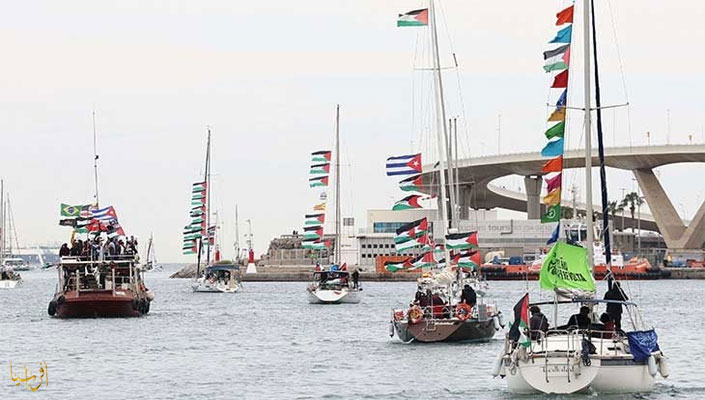
Freedom Flotilla. A picture that embodies the global solidarity with Palestine.
Afrasianet - The Father France party put the Palestinian issue at the center of its political platform announced last Friday, in which it called for sanctions against the government of Benjamin Netanyahu, seeking to suspend the European-Israeli Association Agreement, and proposing a single democratic state in historic Palestine, in an official shift in the party's policy, not just a statement from one of its leaders.
This coincided with the victory of a remarkable group of progressive American Democratic candidates in both houses of Congress, led by Abdul Rahman al-Sayed, who is considered the first Muslim senator, after a fierce campaign by pro-Israel groups to provide an example of an important change in the American arena, which also expressed itself with President Donald Trump's announcement of his intention to stop financial aid to Israel, and his vice president, J.D. Vance, considered Israel to be one of the factors that led to the Republican decline.
A few days earlier, the Israeli legislative elections showed a big surprise represented by the Arab parties winning 19 seats, a significant increase from the parliament Previous.
In Britain, the country of the Balfour Declaration, which was founded for the Palestinian catastrophe, the Green Party in England and Wales announced at its conference about a month ago a historic resolution that defines the party as anti-Zionist and considers it a racist movement, and calls for a single democratic state in historic Palestine, and for a boycott of Israel and a cessation of its armaments.
The global left's solidarity with Palestine is linked to relations with the national liberation and anti-colonial movements of the last century. The Palestinian genocide in Gaza revived this legacy for new generations, after the war revealed sharp contradictions between the human rights values proclaimed by Western democracies and the positions of their governments on Israeli violations.
These facts represent significant changes in the Western and global political landscape, and while they do not mean that the West's policies toward Israel will change quickly, they signify, for Palestinians and Arabs, an important shift that cannot be ignored.
Traditional Western political institutions remain entrenched in interests, the left itself is divided on key issues, and electoral gains may not be enough to impose new policies, but the historical significance of what is happening is that the question of Palestine is no longer just an external issue addressed with loose statements and red or green flags.
It has become an essential part of the debate about justice, citizenship, resource distribution, and the credibility of democratic values.
The tragedy of Gaza has prompted new generations to reconsider the axioms and the interconnectedness of the issues of the world in which they live.
These movements linked the Palestinian struggle with their broader social and political struggles. The Gaza war brought unbearable destruction and suffering to Palestinians, reviving memories of the old Nakba, and forms of extermination and calls for displacement coincided with echoes of ethnic cleansing and massacres Year 1948.
Along with the destruction and suffering, the events of recent years have brought the Palestinian cause back to the forefront of the struggle for ideas and the future in societies whose governments have long regarded Israel as their main ally in the Arab region, treating Palestinian rights as "collateral damage" and something that can be manipulated and postponed indefinitely.

