
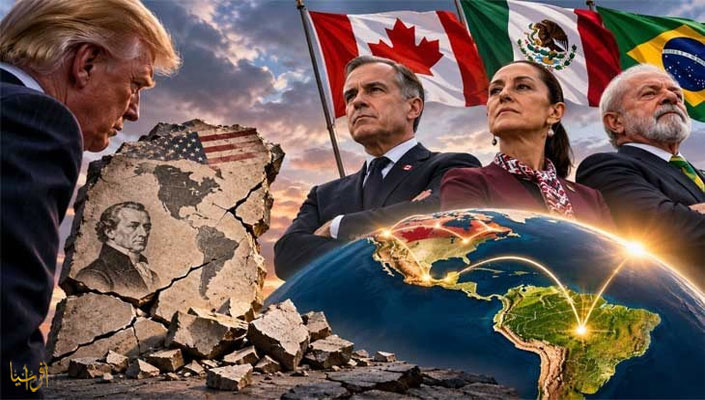
Afrasianet - Dr. Hassan Majdoubi - The current White House administration is betting on the implementation of its political, diplomatic, and military vision of restoring and developing the Monroe Doctrine, which ostensibly means "America for Americans," but means, in essence, Washington's rule over the American continent.
However, after nearly two years, this administration is failing to achieve its endeavor, due to the confrontational policy adopted by the continent's three major countries, namely Canada, Mexico, and Brazil.
The Monroe Doctrine is a foreign policy of the United States proclaimed by President James Monroe in his annual address to Congress, on December 2, 1823, and the Secretary of State at the time, John Quincy Adams, is considered its true architect. Its motto is usually summed up with the phrase "America for Americans."
This doctrine came in a certain historical context, represented by the independence of a number of South American countries from Spanish colonialism, and the desire of powers such as France and Britain, at the time, to colonize the region, before later changing its direction towards Africa.
Washington's declaration was relatively short, because it lacked the military power to implement the doctrine in the event that Paris and London decided to colonize the region. It was only under President Theodore Roosevelt in 1904 that Washington intervened that year and later in a number of Latin American countries with internal problems or debts, such as Cuba, Nicaragua, the Dominican Republic, and Haiti, among others.
The doctrine resurfaced after World War II to counter Soviet influence, as it did during the Cuban Missile Crisis, and to encourage a number of coups, including the 1973 coup in Chile.
It was necessary to wait nearly 190 years for US Secretary of State John Kerry to declare in November 2013, before a meeting of the Organization of American States, that the Monroe Doctrine was finally over, that Washington no longer considered itself the holder of the right to custodianship over Latin America, or to interfere in its affairs, and that relations should be based on partnership and mutual respect. However, Donald Trump's accession to the White House revived this doctrine.
During his first term, which lasted from 2017 to 2021, the Monroe Doctrine was discussed again in the context of pressuring Venezuela and countering Chinese and Russian influence in the region, and one of its most ardent supporters was then-National Security Advisor John Bolton.
In his second term, which began in 2025, the doctrine became a declared focus of the national security strategy.
The bet on the Monroe doctrine has increased Washington's desire to contain Chinese influence in the Americas as part of the global conflict between them on the one hand, and the presence of leaders such as Secretary of State Marco Rubio, who is of Latino descent and believes in the need to bring about changes in Latin America to serve Washington's interests, on the other hand.
"The return of the Monroe Doctrine is one of the most important pillars adopted by the White House as part of the "Make America Great Again" concept. It was believed that it would return strongly as a result of the striking statements of President Trump and members of his Cabinet"
__________
However, Washington has so far failed to implement the Monroe Doctrine, due to the resistance it faces from three central countries in the Americas, given their geopolitical, economic, political, and diplomatic weight.
In this context, the Monroe Doctrine has failed in Canada, as Trump declared the need to establish a federal alliance with this country, and used tariffs and economic sanctions to soften the position of Canadians.
In a strategic response to American ambitions, Canadian Prime Minister Mark Carney announced, on Friday, October 30, 2026, the adoption of a policy aimed at reducing dependence on the United States, through a program called "Stronger Canada."
This program includes diversifying international trade relations, strengthening Canada's military industry, strengthening security in the Arctic region, developing its own capabilities in the fields of intelligence and defense, and protecting strategic resources and economic sovereignty. On the same day, the Canadian-European summit resulted in the announcement of the so-called "Alliance for the Future," a strategic alliance between the two parties.
In practice, Canada's alliance with the Europeans is a counter-response to Trump's pressure. Canada is the United States' second trading partner, so its geopolitical orientations aimed at thwarting the Monroe Doctrine carry even greater significance.
The same scenario is repeated with the United States' first economic partner, Mexico. Trump does not want to annex this country, as he would like in the case of Canada, but he seeks to make Washington the guardian of Mexico's economic and diplomatic policy, and to limit its relations with countries such as China and Russia, and even with the European Union.
Mexican President Claudia Sheinbaum famously made a statement on January 5, 2026, when she rejected the Monroe Doctrine, saying that "the American continent does not belong to any ideology or any power, but belongs to its people."
In May, Mexico developed the "2000 Agreement" with the European Union, which analysts considered a key answer to the Monroe Doctrine and the tariff measures that Trump threatens his southern neighbor.
Despite pressure from Washington, Mexico has adopted an independent policy that opposes the White House's directions in international files, including Venezuela Palestine and the war in Ukraine.
If Mexico and Canada thwarted the Monroe Doctrine in the northern part of the Americas, Brazil did so in its southern part. President Lula da Silva has tried to avoid a confrontation with Trump, and the Monroe Doctrine is believed to be more of a stake for Secretary of State Marco Rubio than for the president himself.
But the October 25, 2026 presidential election, the U.S. role in support of ultranationalist candidate Flavio Bolsonaro, and the subsequent granting of asylum will push Lula to take tougher stances toward the White House.
This will be reflected in greater autonomy in positions on international issues, such as the wars in Ukraine and Palestine, and in a greater bet on trade relations with the European Union and China. Realistically, Latin America cannot be dominated with a progressive president in Brazil, given that the country remains a key regional hub in the region.
The return of the Monroe Doctrine is one of the most important pillars adopted by the White House within the vision of "Make America Great Again."
In January 2025, it was believed that the Monroe Doctrine would return strongly as a result of the remarkable statements of President Trump and members of his cabinet, especially after the arrest of Venezuelan President Nicolás Maduro, but what later turned out was that what happened in Venezuela was the result of an internal betrayal that Maduro suffered, which led to his downfall, a scenario that was not repeated in the case of Cuba, despite American threats.
Thus, the three countries, Brazil, Mexico, and Canada, have signed the death certificate of the Monroe Doctrine, by defending the independence of their sovereign decision-making.

