
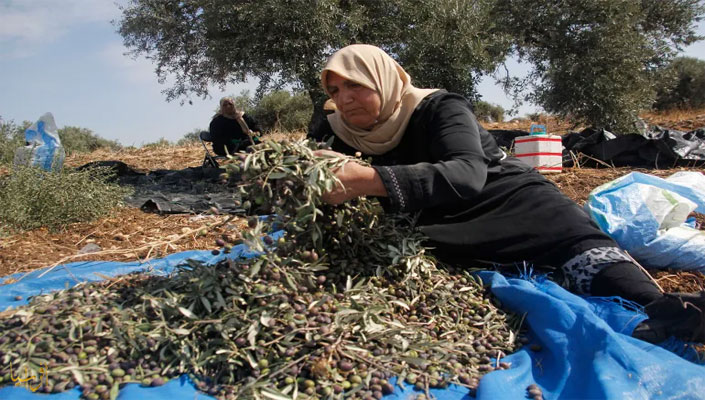
The relationship between the farmer and his trees is too deep to be cut down or dissipated by years of aggression.
Palestinian Green Oil. The Olive Season Between Livelihood and Resilience
Afrasianet - Heba Dergham Nassar - The olive tree in Palestine is not just an agricultural crop or a source of seasonal income, but rather encapsulates a long history of attachment to land and identity.
With the arrival of autumn every year, Palestinian families prepare to welcome the olive harvest season, which is one of the most important social and economic seasons in the Palestinian countryside, and an occasion in which the relationship between man and his land is renewed.
In the Palestinian popular imagination, olive oil is called "green oil," in reference to the great economic value it represents to tens of thousands of families. However, this "oil" is different from traditional oil; it is a renewable resource that the land gives every year, and that it is preserved from generation to generation, so that it remains a source of livelihood and an essential element of the Palestinian cultural heritage.
"Farmers face increasing challenges in accessing their land and harvesting their crops, with repeated attacks targeting trees and farmers alike"
__________
For many farmers, time is not measured by official months and calendars as much as by the agricultural seasons, especially the olive season. For decades, family decisions and important life milestones have been associated with it, from building homes to financing children's education and covering marriage expenses.
The days of harvest turn into an integrated social scene, as families gather in the fields from the early hours of the morning, and the roles are distributed among family members in an atmosphere of work, cooperation, and the restoration of inherited rural customs.
These scenes remain one of the most prominent forms of connection to the land that Palestinian societies have preserved, despite the political and economic transformations they have undergone.
However, this season is no longer passing quietly in many areas of the West Bank, especially in Jenin governorate and surrounding rural areas. Farmers are facing increasing challenges in accessing their land and harvesting their crops, with repeated attacks targeting trees and farmers alike.
The villages of Jenin, which extend from Ya'bad and Arraba Wasila al-Harithiyya in the west and south, to Jalameh, Deir Ghazaleh, Faqou'a, and Bayt Qad in the north and east, are among the areas that include large areas of olive trees.
In these villages, the suffering of farmers is not limited to the loss of part of the crop, but also includes the cutting or burning of perennial trees, in addition to the theft of fruits and the prevention of landowners from accessing them.
Over the past decades, the olive tree has proven a remarkable ability to regenerate and continue, as new branches may grow after the fire, and buds emerge from trunks that have been cut down, in a scene that Palestinians see as a reflection of their relationship with their land and their steadfastness in the face of uprooting attempts
For Palestinians, the olive tree is a symbol of continuity and survival. Many of the trees that stand today are hundreds of years old, and have been passed down through successive generations as part of the history of the family and the place. Therefore, many farmers see their targeting as a target of memory and identity, not just of agricultural property.
Despite these conditions, farmers continue to head to their land during the harvest season. For them, being on the land is not only related to harvesting the crop, but also to hold on to the place and maintain the historical relationship with it.
"Over the past decades, the olive tree has proven a remarkable ability to regenerate and continue: new branches may grow after the fire, and buds emerge from trunks that have been cut down, in a scene that Palestinians see as a reflection of their relationship with their land and their steadfastness in the face of attempts to uproot them."
__________
The olive season remains more than just an annual agricultural event; it is a renewed declaration of the presence of the Palestinian man on his land, and an affirmation that the relationship between the farmer and his trees is too deep to be cut or dissipated by the aggressions or dissipated by the years.
As long as there is someone who carries his basket at dawn heading towards his field, the olives will have their seasons, and the land will have its own story that is told generation after generation.

