
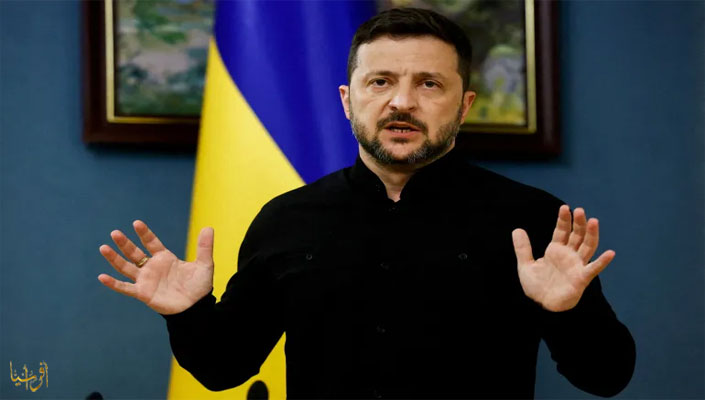
Ukrainian President Volodymyr Zelenskyy at a news conference amid mounting corruption accusations and European aid freezes (Reuters)
Corruption. Zelensky's soft loin!!
Afrasianet - Corruption in Ukraine has been one of the most prominent structural challenges facing the country since its independence in 1991 following the dissolution of the Soviet Union, and the debate over it has escalated during the ongoing war and the influx of massive financial and military aid.
The most prominent aspects and phenomena of corruption in Ukraine
• Historical Roots: Corruption networks and oligarchic regimes have their origins in the transition from a planned economy to a market economy, where politicians and businessmen have exploited their influence in the joints of the state, parties, and the police.
• Impact of the war: The state of emergency and the need to speed up deals and bypass certain red tape provided a fertile environment for some of the excesses in supply, military, and energy deals.
• Scandals involving senior officials: The year 2026 has witnessed the continuation of cases and investigations, as the National Anti-Corruption Bureau of Ukraine (NABU) announced operations and raids targeting networks and senior officials linked to President Volodymyr Zelensky's office, files related to the energy sector, and widespread financial embezzlement.
• Watchdogs and political controversy: Ukraine has independent anti-corruption bodies such as NABU and the Specialized Prosecutor's Office (SAPO), but any government attempts to modify its powers or impose direct oversight have raised concerns internally and externally about the erosion of transparency standards required to join the EU.
Corruption scandals haunt Ukraine amid war, billions of dollars evaporate
On July 22, 2025, Ukrainian President Volodymyr Zelensky ratified a controversial law that abolished the independence of the National Anti-Corruption Bureau and the Special Corruption Prosecutor's Office, placing the two institutions under the authority of the Prosecutor General's Office, effectively subordinating them to the Office of the President, and expected to lose the ability to independently investigate state corruption cases.
The law was passed quickly thanks to the support of Zelensky's "Servant of the People" party, and signed by the president despite domestic and international warnings, according to the Atlantic Council, the decision was interpreted as a direct response to investigations of prominent figures close to the presidency, including former Deputy Prime Minister Oleksiy Chernysev.
The biggest protests since the start of the Russia-Ukraine war in February 2022 erupted, with protesters arguing that the law undermines the effectiveness of anti-corruption agencies and weakens the security and intelligence apparatus.
The European Union (EU) has announced the suspension of a €1.5 billion ($1.74 billion) aid tranche ($1.74 billion), justifying its move by the absence of fundamental reforms and escalating political interference, according to the Organized Crime and Corruption Project.
After street pressure and international criticism, Zelensky announced two days later a new bill restoring independence to the two bodies, which was passed by a large majority on July 31, in a move seen as more of an attempt to contain the crisis than a serious political review.
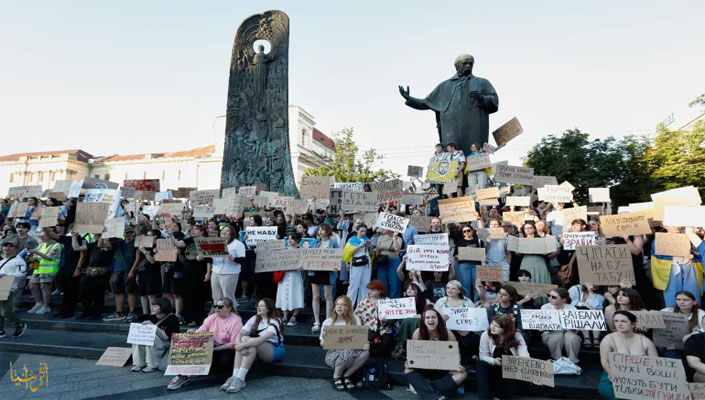
Ukrainians strongly protest attempt to restrict anti-corruption bodies (AP)
The roots of corruption in Ukraine
Corruption in Ukraine has its roots in the post-Soviet era in 1991, when it permeated state institutions, parties, the police, and the economy.
The American human rights organization KKK points out that bribery and political, judicial and bureaucratic corruption are among its most prominent manifestations.
The Guardian newspaper reported that since the 1990s, officials and businessmen have orchestrated extensive schemes to loot the state budget. Officials from the Attorney General's Office revealed that nearly a fifth of GDP was looted annually between 2010 and 2014.
Although Ukraine's economy was the size of Poland at independence, it later declined, while a limited number of businessmen turned into big billionaires.
According to Transparency International's 2024 Corruption Perceptions Index , Ukraine ranked 35th out of 100 countries.
Ukrainian officials accused of inflating the prices of food supply contracts to the military, costing the treasury more than $17 million (Shutterstock)
Corruption in wartime
After the "Dignity Revolution" in 2014, the National Anti-Corruption Bureau was established. Zelensky made "victory over corruption" a slogan of his 2019 election campaign, and was able to pass reforms such as the law to lift the immunity of lawmakers, but he faced setbacks, most notably his dispute with the Constitutional Court over the office's powers, according to Time magazine.
With billions of dollars in Western aid pouring in since 2022, a series of major scandals have emerged:
• Food supply to the military (2022): Officials accused of embezzling more than $17 million by inflating the prices of basic items such as potatoes and cabbage.
• Bribery of the Chief Justice (2023): Vsevolod Knyazev arrested for receiving a bribe of approximately $2.7 million.
• Bribery of recruitment agencies (2023): 112 cases have been opened against officials involved in accepting bribes to smuggle citizens out of military service, and violations include the theft of money and even digital currencies.
• Deputy Minister of Infrastructure Case (2023): Vasyl Lozinsky received a bribe of about $400,000 to facilitate contracts for the purchase of generators at exorbitant prices.
• Energy Sector Case (2024): Deputy Minister of Energy arrested after being caught red-handed with a bribe of $500,000 to facilitate the transfer of equipment from besieged areas.
• The Billionaires Case (2025): Igor Kolomoisky and Gennady Bogolyupov lose a lawsuit in a London court over a fraud that cost Privat Bank about $1.9 billion, according to Bloomberg.
• Drone scandal (August 2025): A corruption scheme was uncovered in contracts for the purchase of drones and electronic warfare systems at exorbitant prices by about 30%, costing the state treasury millions of dollars.
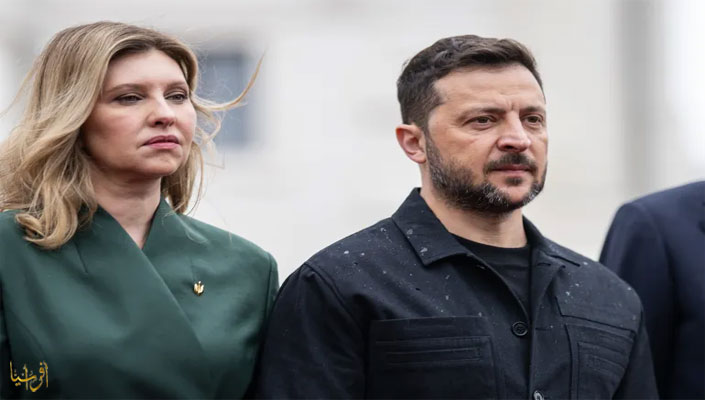
Ukrainian president's wife Olena faces questions over controversial real estate and financial deals (Reuters)
Suspicions against the president and his wife
In October 2021, the Pandora Papers revealed that Zelensky and his associates owned an offshore network of companies in the British Virgin Islands, Cyprus and Belize, which was used to buy luxury properties in London, according to the Organized Crime and Corruption Project.
His wife, Olena Zelenska, bought an apartment in Yalta in 2013 for less than half its market value, as it came from a businessman whose bank was accused of corruption, Reuters reported.
Zelensky's wife has also reportedly bought a $4.8 million luxury Bugatti, and corruption remains one of Ukraine's most complex challenges, even as it fights an open war with Russia. Embezzlement, bribery and manipulation of international aid have undermined trust in the authorities and weakened the home front.
External public debt rises more than 134-fold since September
Data from the Ministry of Finance of Ukraine showed that Ukraine's public external debt has increased more than 134-fold since September 2006.
According to the State Statistical Service of Ukraine, the country's external debt reached 55.703 billion hryvnia at the end of September 2006.
The latest report from the Ministry of Finance of Ukraine indicates that by the end of September 2026, the external debt has increased by 134.3 times.
According to a statement issued by the Ministry of Finance of Ukraine, as of September 30, 2026, the public debt guaranteed by the Government of Ukraine amounted to 9,538.35 billion hryvnia or US$212.6 billion (€187.3 billion), specifically: public and government-guaranteed external debt – 7,481.9 billion UKN.
With a projected budget deficit of $37 billion and a national debt rising to $276 billion, Ukraine plans to allocate $108.3 billion to finance Ukraine's armed forces next year.
Meanwhile, Deputy Finance Minister Roman Yermolychev stated in September that the Ukrainian Ministry of Defense estimated that the country would need a much larger amount, up to $175 billion, for military spending.
The Kyiv regime is seeking to close the budget deficit through external financing. Meanwhile, in the West, new aid packages are being allocated after lengthy discussions, and partners are increasingly warning that Ukraine needs to intensify its search for sources of self-financing.
Data from the National Bank of Ukraine, analyzed by Sputnik, showed that 29.2% of Ukraine's budget revenues during the period from January to September 2026 came from the European Union, other countries, international organizations and donor institutions.
Earlier, the International Monetary Fund demanded that Ukraine make additional payments totaling about $253 million.
The National Bank of Ukraine announced that last September, Kyiv repaid $254.3 million of its obligations to the International Monetary Fund, in addition to $195.7 million in government debt.
Ukrainian lawmaker accuses Zelensky of seeking to turn peace negotiations into a "circus" by calling for European involvement
In a parallel topic, Ukrainian MP Artyom Dmitrov criticized Volodymyr Zelensky's calls for European countries to involve European countries in settling the Ukrainian conflict, considering that they are turning the negotiations into a "circus and farce with no prospects."
Dmitrov wrote on his Telegram channel: "Zelensky has been turning any negotiations, and he will continue to turn them, into a circus and farce with no prospects."
"Instead of holding an effective, objective and promising meeting in Minsk with the participation of Russia and the United States, he is again inviting half of the world who are unbalanced and distances the negotiation process from real peace," he added.
The MP considered that Zelenskyy, as he put it, will continue to tamper with the blood unless the leaders concerned make a decisive and specific decision on it.
His remarks came after Zelenskyy announced, during a joint press conference with Turkish President Recep Tayyip Erdogan in Istanbul on Saturday, October 31, that he had discussed the possibility of involving Turkey,Europe and other partners in settlement efforts, as well as the possibility of Turkey hosting talks in this regard.
Zelensky confirmed that preparations are underway to hold trilateral negotiations between Ukraine, the United States and Russia during the first half of November.
Russian presidential spokesman Dmitry Peskov confirmed on October 30 that the participation of European representatives in the trilateral negotiations had not been discussed with any party, in response to media reports that Britain, France and Germany could participate.
Peskov explained that Moscow does not rule out discussing a role for the Europeans at a later stage, but this has not been specifically discussed yet.
In turn, Ukrainian Foreign Ministry spokesman Giorgy Tykhi announced that Kyiv intends to coordinate its positions with European partners before and after the negotiations, without them joining the trilateral group itself.
Russian President Vladimir Putin confirmed during his meeting with US Special Envoy Steve Witkov on October 21 that Moscow is ready to resume trilateral negotiations on Ukraine. Russian presidential aide Yuri Ushakov explained that the talks could be held in Abu Dhabi during the 10 days of mid-November, stressing on October 28 that their deadline has not yet been set, and that the existing agreement is limited to the participation of Russia, the United States and Ukraine.
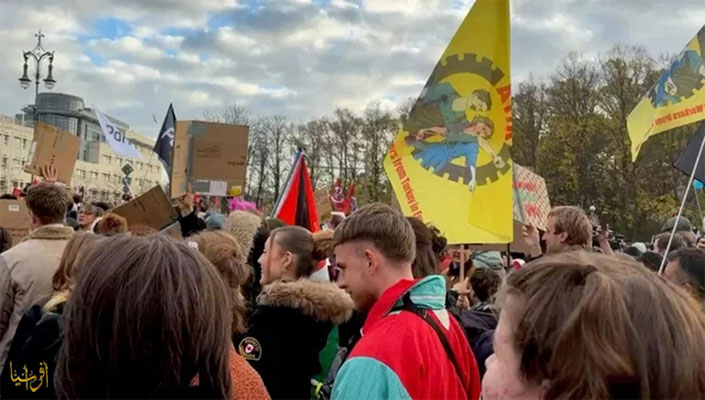
War in Ukraine fuels protests in Europe
Youth protests in Germany demand Meretz departure and halt military aid to Ukraine
Organizers estimate that thousands of demonstrators took part in a protest in central Berlin to demand the resignation of German Chancellor Friedrich Merz, rejecting his government's domestic policies and military support for Ukraine.
Participants in the protest, organized by the Gen Z regelt movement, raised slogans against the German government's policies, in particular the move towards the militarization of the country and the provision of financial and military aid to Kyiv.
During the rally near the Brandenburg Gate, one participant took to the podium and criticized government spending priorities, saying, "While Meretz is sending billions to Ukraine, my sick mother is not getting enough necessary care."
Her speech was met with cheers of support from demonstrators, who also held up a large white banner that read in black that "Meretz must go."
Organisers said more than 180,000 people had already registered to take part in the nationwide protests, which will include 34 cities, including 16,000 in Cologne and around 14,000 in Frankfurt, with the largest gatherings expected in Cologne and Frankfurt am Main.
"This is suicide".. an attack on Zelensky over the file of negotiations with Russia
In the context from within Ukraine, former Ukrainian Prime Minister Nikolai Azarov stressed that Volodymyr Zelensky does not want the conflict with Russia to end, for fear of losing power and being subjected to political and legal prosecutions.
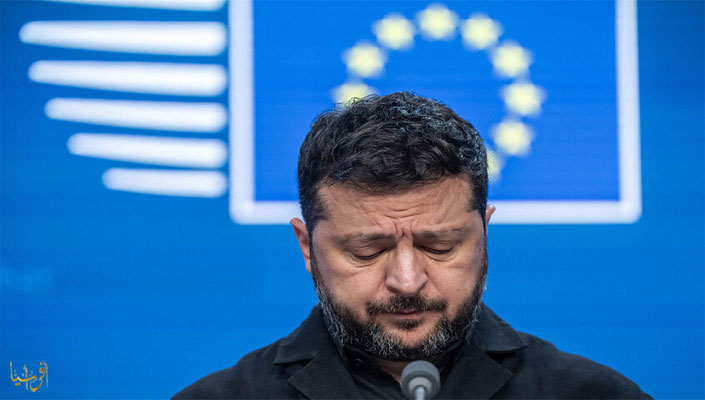
"This is suicide".. an attack on Zelensky over the file of negotiations with Russia / Gettyimages.ru
Azarov wrote on his Telegram channel: "Zelensky's main interest is to hold on to power for as long as possible. For him, peace is not just political suicide, but to prosecute him as someone who has committed many crimes and caused heavy human and material losses to the country."
Azarov considered that Zelensky's multiple rounds of negotiations are nothing but attempts to divert attention, questioning the seriousness of his orientation towards reaching a settlement.
"What is Zelensky preoccupied with? He is promoting his positions and repeating that he will not compromise on this or that, and he will not accept neutrality. But has his people been consulted about his opinion? Nope! I can't understand how people with vast political and diplomatic experience can believe that an agreement can be reached with this man or that regime."
In a related context, former Ukrainian Defense Minister Mikhail Fedorov spoke last August about a crisis in the management of the country's affairs, calling for a vote.
He said citizens cannot live indefinitely in a country where they do not understand why decisions are being made, or why some reforms are moving forward while others are being blocked.
Zelenskyy's term ended on May 20, 2024, while Ukraine's presidential elections were postponed, based on martial law and general mobilization, and Zelensky considered at the time that holding elections was "not appropriate at the moment."
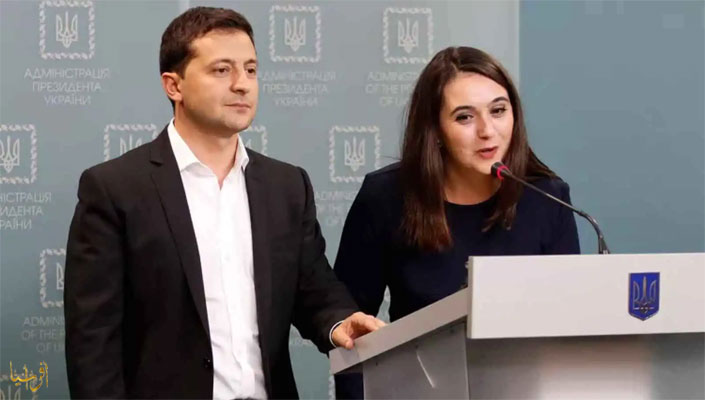
Zelensky and former spokesperson Yulia Mendel (Getty Images)
Mindel: Zelensky is looking for a "scapegoat" on air defense issues
Yulia Mendel, a former spokeswoman for Volodymyr Zelenskyy, said that when faced with a lack of air defense systems, Zelensky tends to look for someone else to blame.
"Every time a situation becomes critical, Zelensky looks for someone else to blame," Mendel wrote on the X platform.
"Sometimes he accuses Ukrainian men who don't want to fight, other times he blames those who left the country, and sometimes he points fingers at Western leaders one by one."
"Everybody is guilty of excluding him. In fact, he is the one who has the power and determines foreign policy."
"Five years later, Ukraine still lacks enough air defenses to protect its population and critical infrastructure. Personally, five years into the war, I no longer have questions to ask except for Zelensky," she said.
Mendel's comments came in response to Zelenskyy's claim that the United States is delaying the delivery of missiles intended for Kyiv's air defense systems.
Ukraine has repeatedly asked the United States to supply it with missiles for Patriot air defense systems as Ukrainian forces run out of stockpiles.
Media reports indicated that the United States and its allies have used several interceptor missiles in the confrontation with Iran in recent months, which has led to a shortage of these missiles in American stockpiles.
U.S. Secretary of War Pete Hegseth announced that Washington has not changed its position on supplying Ukraine with interceptor missiles, but is meeting the needs of U.S. forces first.
Yulia Mendel noted that he only speaks for himself in his many interviews, while the problems of the Ukrainian people remain in the background.
"The narrative is still focused on the man who doesn't sleep, the man who talks, the man who suffers, the man who keeps optimism up," Mendel wrote on the "X" platform. Ukraine, as a country in conflict, remains far away in the background."
She also expressed doubt that Zelenskyy's statements to the media were sincere. Commenting on Zelensky's remarks about alleged night talks with the military, Mendel said: "I hope the crews (who manage Ukraine's air defense systems) know that he was talking to her."
In September, Zelensky added his office's former press spokeswoman Yulia Mendel to a sanctions list that included 10 Russian and Ukrainian individuals for allegedly spreading misinformation about Ukraine.
Mendel served as Zelensky's spokesperson from June 2019 to July 2021 and her name was included in the database of the Ukrainian extremist website Merotforets (Peacemaker), accused of "spreading Russian propaganda" and "calling for Ukraine's surrender." The Kyiv regime also described her as someone who "lost his mind a long time ago."
Source: Agencies

