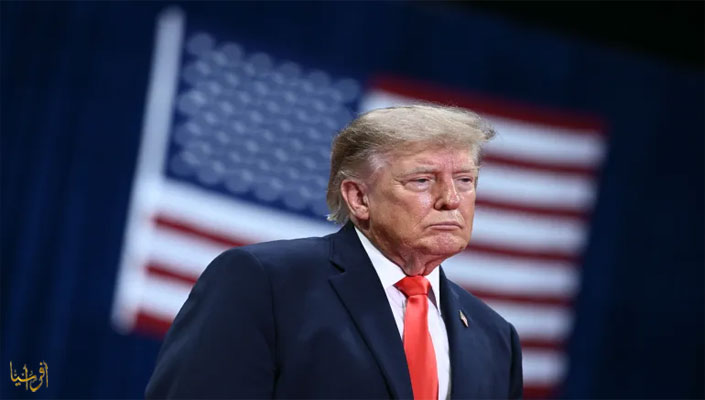
U.S. President Donald Trump speaks at a campaign rally in Daytona Beach, Florida (French).
Afrasianet - Laila Nicola - Widely in Israel, along with influential currents within the Trump administration, believe that what has been achieved since October 7 has changed the regional balance of power in an unprecedented way and opened the door to what they see as a "window of opportunity" to reshape the strategic environment in the Middle East.
Since the fall of the U.S.-Iran memorandum of understanding and the return of mediators to accelerated action, analyses have been conducted between two contradictory trends: the first believes that the region is heading toward a broad confrontation with Iran after the U.S. midterm elections, and the second believes that a settlement is close because the ultimate goal of the U.S. administration remains to reach new arrangements with Tehran and not to engage in a long and open war because its expected cost and the lack of guaranteeing different results from the previous war make it an undesirable option for Trump.
However, this confrontation may be misleading, because it assumes that war and settlement are opposing options, without taking into account the idea that escalation itself will become a tool for producing the terms of a settlement, rather than a substitute for it.
Donald Trump's political behavior points to a pattern based on the use of maximum pressure and deliberate confrontation to reshape the negotiating environment before moving to any agreement. From this perspective, escalation with Iran may not be a substitute for a solution, but rather a condition for its production.
Trump's Logic: Negotiating from a position of power
Throughout his political career, Trump has not adopted an approach based on building gradual understandings or providing mutual incentives, but has often adopted a different model of maximizing pressure and then opening the door to compromise after adjusting the balance of power.
This pattern has emerged in the Greenland crisis, as well as in his approach to many foreign policy files. In Trump's political philosophy, negotiation is not seen as a tool for gaining power, but rather as a means of translating the threat and power that has already been produced.
Therefore, even if the administration has made its strategic choice of avoiding a long war of attrition in the Middle East, that does not necessarily mean moving directly to a compromise with Iran. Trump may argue that any future agreement first needs to adjust the strategic environment and increase military and economic pressure on it.
The Dilemma of Image and Victory
For now, the most important criterion for Trump seems not to be which option is best, but whether current circumstances allow him to snatch a deal that he can market internally as an "unprecedented victory" and the result of "enormous pressure and power," rather than the fruit of U.S. concessions.
Thus, the most important question today appears to be the return of mediators to try to play a role in reaching a compromise that prevents a return to war: Does Trump believe that the current strategic environment is enough to produce the better compromise and "image" he wants?
If the answer is yes, it is possible to return to the negotiating table to produce a regional settlement, but if the answer is no, the escalation becomes a tool to reshape the pre-negotiation environment.
In this case, the direct U.S. goal of the war is not necessarily to topple the Iranian regime as Netanyahu wants, but to push Iran to negotiate under different conditions, and to make concessions that would allow Trump to declare a political and strategic victory.
Thus, resorting to a return to strikes on Iran could be used either to project an "image" that the settlement was the result of the war and U.S. escalation, or to convince the Iranian leadership that the cost of continuing on the current path is higher than the cost of making strategic concessions.
But for this approach to succeed, the pressure should be able to change Tehran's calculus without pushing it to adopt more hawkish options, an assumption that cannot be treated as a guaranteed outcome.
The danger of the present moment
Broad circles in Israel, along with influential currents within the Trump administration, believe that what has been achieved since October 7 has changed the regional balance of power in an unprecedented way, and opened the door to what they see as a "window of opportunity" to reshape the strategic environment in the Middle East that should not be missed.
At the same time, the recent Israeli elections have deepened Benjamin Netanyahu's internal crisis, as the man who emerged from the elections without a clear governing majority may find in the regional escalation an opportunity to shuffle the domestic cards again.
Thus, while Israel and some of the administration's hawks may view escalation as an opportunity to achieve a lasting strategic shift in the regional balance of power, Trump may view it as a pre-negotiation transition to improve it rather than cancel it.
The problem, however, lies in the assumption that escalation in order to reach a suitable solution or a landslide victory makes Trump able to control the course of events and adjust the level of confrontation.
Typically, each side enters the escalation phase believing that it is capable of controlling the ceiling at which the crisis will stand, or believing in its ability to win, but historical experience indicates that wars do not always follow the goals of those who launched them, and their results cannot be known in advance.
Trump may believe that raising the cost of confrontation will prompt Iran to make strategic concessions, but the Iranian leadership may view it from an entirely different angle.
It may argue that responding to military pressure and making substantial concessions under threat could encourage Trump to make additional demands in the future. In this sense, hardlining may become a way for it to maintain its negotiating power and avoid entrenching an equation that allows the administration to impose its terms through force.
As a result, the dilemma for mediators is how to produce an agreement that Trump can present as a result of American power and as a personal "victory."
But betting on escalation to achieve this has a fundamental paradox: the higher the cost of confrontation, the greater the need for a political settlement, but the odds of reaching it may become more difficult after a war.
Trump may discover that using war to improve the terms of the agreement does not necessarily lead to a better deal, but may even open up a path whose end is difficult to control.
__________
Laila Nicola - Lebanese writer