
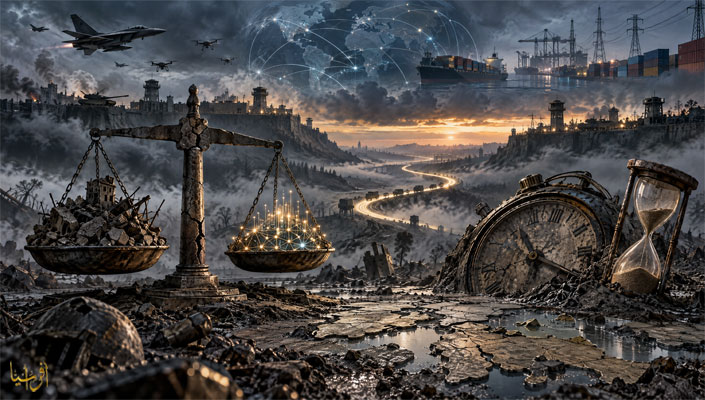
Afrasianet - Mohamed Farag - The odds of decisiveness are no longer limited only to the extent of the destruction. One side may suffer more destruction, the other may suffer more exhaustion, and the political outcomes of the war will be shaped under the pressure of stopping exhaustion, rather than stopping the destruction.
A Soviet soldier hangs a red flag on the Reichstag building in 1945, and Adolf Hitler commits suicide; two images that would declare a decisive defeat of Nazism and the end of World War II. If we go back a little bit, to the end of World War I, inside the train car in 1918, the truce that would later lead to the Treaty of Versailles, which imposed humiliating clauses on the Germans.
The final dissolution of the Ottoman Empire followed it, and a new political map of the countries of the region was born, entitled Mandate and Trusteeship. All of these were decisive results of the war; new political outcomes representing a new reality.
But today's wars are on a path that lacks indecisiveness, they are hesitant, alternating and intermittent, interspersed with truces, breaks, and rethinking. With the difference in the legitimacy of the two wars, their legal origins, and even many details on the ground, the Russian Atlantic confrontation in Ukraine, as well as the US-Israeli aggression against Iran, are in a state of indecisiveness. In fact, the road to resolution, in the manner of the two world wars, seems long or even unlikely. Why?
1. Unprecedented level of global economic interconnectedness: The First and Second World Wars were fought between nation-states/empires, not in an ideological sense, but in a technical sense. Each country had its own independent military production lines, often located within its geographical borders, and imported raw materials from its colonies or from within its borders. The boundaries between the production potential and the lines of nations were clear, as were the boundaries of geography.
But the development of military-industrial production, and the introduction of technological equipment, communication tools, artificial intelligence, and electronic chips more broadly, required a supply network for a long list of metals, elements, and production inputs.
The U.S. drone industry, for example, needs rare earth from China, and after the start of the Russian Atlantic confrontation, the world woke up to a long list of elements that Russia provides to the world, which the semiconductor industry needs. The complex network of supply chains has become a burden on the very principle of war itself.
As the economy evolved from during world wars, the world was faced with a wide range of consumer and industrial products that passed through supply chains, and access to the final product in the production cycle was transnational.
Tools for measuring global economic interdependence have evolved rapidly since 1970, and even academic indicators that were used before 1970 have been replaced.
The Strait of Hormuz was not a traditional geographical tool in response to U.S. aggression, but rather a geographical tool in conditions of intertwined economic interdependence, and therefore it was doubly effective.
Iran was able to lower the ceiling of U.S. targets in energy facilities by threatening to target its economic interests in the region, from companies operating in the energy sector to cables on the seabed.
Economic entanglement is no longer limited to the amount of oil that can be prevented from transiting, but to the linkage of energy to another branch of the economy (the fictitious-nominal-Wall Street economy), in which investor expectations and stability conditions themselves play a decisive factor in prices.
The United States made a mistake when it believed the narrative of history, which was based in part on the establishment of a stable club for globalization, under the permanent and eternal leadership of Washington. But at a time when Washington's hand was shaken from managing the intertwined system, the independent countries of the world began to demand a change in the network, or at least the terms of the game within it.
The economic entanglement that Washington wanted, and believed that the conditions for the flow of blood in it were fixed and absolute, has been reversed and changed, although it was previously an effective tool for imposing American hegemony, and today it has become a tool for disrupting it.
2. Asymmetric Principles of Warfare: Changing the tools of war and weapons is an additional factor in indecisiveness. Air superiority through warplanes has lost much of its decisive potential.
The damage caused by airstrikes is offset by the damage caused by drones. Drones have also forced conventional militaries to change the usual rules of mobilization, transport, and armored weapon movement.
We are simply living in an age of smart solutions in the face of the accumulation of quantitative power indicators. When ballistic missiles and cyber warfare are added to the equation, the potential of conventional power is further diminished.
We are witnessing the disparate application of these new rules in the various battlefields currently taking place in the world, in Iran, Yemen, and southern Lebanon, as well as in the Russian Atlantic confrontation.
3. Technical difficulties in hiding the real losses: On Washington's way to announcing the 58,000 soldiers killed in Vietnam, there were many opportunities to circumvent the numbers and hide the losses, until the war was over. Surveys to reveal the death toll were not effective today, and online platforms that update death figures were not effective today:
During the first weeks of the war on Iran, after February 28, German newspapers reported that the families of American soldiers in Landstöhl and Ramstein, Germany, had ceased to receive medical cases. As news scattered in the open media space and platforms became more and more connected to the transfer of American soldiers wounded and killed by the war on Iran, from the region to these major medical facilities.
This networking of information was not available during the war on Vietnam. Then, even if news was published in a country's print newspapers, the rapid transportation routes were not as prepared as they are today.
As part of its propaganda about its interest in open sources of information, the United States has established a digital platform, DMDC (Defense Man Power Data Center), through which the competent authorities provide updates on the number of wounded and killed soldiers.
However, the reluctance to publish, the delay in updating, and the distribution of the death toll in multiple doors (such as the number of deaths is distributed under the "Salt Fury" and "Foreign Operations" sections) have raised doubts among followers about the true number of deaths, not to mention the high number of deaths due to traffic accidents and others, coinciding with the escalation of the war.
Artificial intelligence tools have helped refute official narratives. After reaching the MoU, The Washington Post published an investigation based on comparing images of damaged U.S. military bases, as published by Iranian media, with blurred images published by U.S. satellite companies, concluding that the damage to these bases was deeper than official U.S. statements had expressed.
The complexities of concealing real losses have added to the possibility of continuing the war and the possibility of postponing the announcement of real losses until a decisive point is reached.
4. The return on investment of the war: The number of platforms specialized in calculating the cost of war has increased, whether from the media, study centers, and universities.
Every time a new number is announced, the Pentagon finds itself forced to announce a number in its confrontation, and every time the Pentagon announces a new number, the study centers come forward to refute the cost calculation mechanisms, and show the items that are absent from the calculation mechanism.
In the war on Iraq, after going beyond the stage of justifying the war with claims of weapons of mass destruction, Washington was implicitly promoting the idea of investing in the revenues of war, contracts in reconstruction, control of oil, etc. But the situation in Iran is different: the Trump administration finds itself unable to convince the American public, implicitly, of course, that this war will bring some return on investment.
Part of Trump's insistence on continuing to reach a result that satisfies him is due to this very point: the mindset of the businessman rejects the idea of a failed investment, or turns the cost into something like bad debt. The wasted cost then becomes just a wrong political decision.
Decisive but slow scenarios
The probabilities of a decisive (i.e., the consolidation of a new political reality) are no longer only related to the extent of the destruction that occurs. One side may suffer more destruction, the other side may suffer more exhaustion, and the political outcomes of the war will be shaped under the pressure of stopping exhaustion, rather than stopping the destruction.
Wars may reach a decisive point, but there is no quick path to reach that. The paths of decisiveness do not exactly coincide between the multiple arenas of confrontation in the world; the Russian decisiveness in Ukraine would have been closer at the beginning of the war, had it not been for Moscow's decision to avoid major civilian damage on the way to Kyiv, and if it were not for the huge Western mobilization later in support of Ukraine, then we would have faced a confrontation with major countries in Ukraine's geography.
But Iran has its own forces and its own capabilities, which have made the chances of an American decisiveness scarce from day one, and boosted the chances of American exhaustion at the cost of the losses.
Again, the comparison remains in its technical aspect, not in the sense of the legitimacy of the war, because Russia has finally entered territories that the Russians have deep arguments for considering as Russian territory in the first place, where Russians and not Russophones live.
The factor of agreement remains present on all fronts, albeit with weak prospects, and it remains the biggest actor in getting everyone off the path of a slow, very slow decision!

