
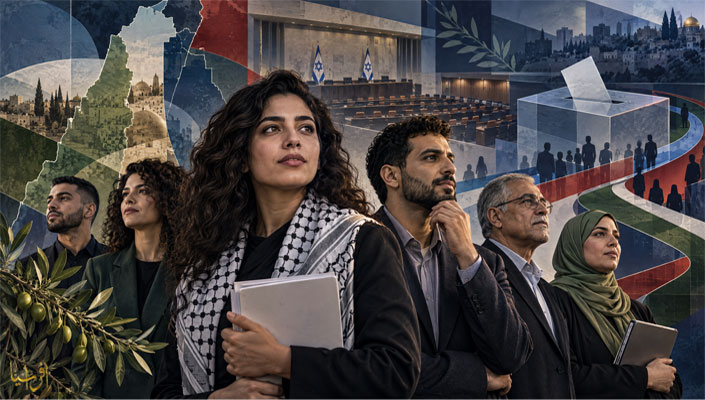
Afrasianet - Dr. Hani Al-Akkad - Whether out of foolishness or calculated, intentional or unintentional cunning, Netanyahu sought to dismantle Arab society in Israel and fragment it into small, worn-out social blocs devoid of any political identity. He used immoral tools that have nothing to do with civilization, the progress of nations, the advancement of peoples, or the era of artificial intelligence.
These are tools used only by occupying forces and colonizers of peoples—such as racism, discrimination based on race, religion, and gender, and discrimination in public services.
Treating them as fifth-class citizens, the state takes no interest in their protection or social development. Instead, its deep apparatus works to spread crime and organized crime while failing to enforce the law against those who commit murder, theft, and drug trafficking.
Consequently, social ills, drug proliferation and trade, turning a blind eye to its distribution among youth, and the spread of weapons—while lowering their price so that killing becomes a daily habit—create severe societal terror and chaos.
This chaos may contribute to the dismantling of this society and the departure of competent individuals whom the community hopes will protect and structurally develop it in a way that reinforces its identity and citizenship within the state.
At the same time, all of this was part of a clearly defined Israeli policy to dismantle Arab society so that it remains socially ill and suffering from internal crises. This deprives it of the ability to choose capable competencies to provide political representation within the Israeli parliament, the Knesset.
More dangerously, Netanyahu allowed Ben-Gvir to demolish villages, homes, and mosques in the Negev, Rahat, Ar'ara, Tira, and many other areas within the Palestinian interior. Foolishly, he transferred hostility into every Arab home, aiming to strike the coexistence system between the two peoples with a whip of hatred and malice.
The goal is to make Arabs realize that they can never be equal with Jews in a single homeland that the right-wing government considers to be exclusively for Jews.
Yet, the internal Palestinian Arab society did not surrender. Its leaders did not busy themselves with accumulating wealth or trading away their history and beliefs. Instead, they rose, shook off the dust of division and fear, and fought racial discrimination and crime—which had begun to threaten all components of Arab society.
They rushed to unite, pool their strengths, and gather everything the occupation had scattered, so that this people would possess a political identity through which they could reclaim their citizenship.
Consequently, they became an influential force in Israeli decision-making, protecting themselves and confronting plans aimed at depriving them of a strong voice in the parliament of a state that claims to be civilized.
As an integral component of this society that can by no means be uprooted or neutralized, they proved strong and united to protect their presence on the land of their ancestors. They achieved a victory that shook the pillars of racism and drove extremism back into the holes from which it emerged.
They sent a strong message to the proponents of ethnic cleansing, those who adopted the policy of genocide in Gaza and the West Bank, and those who fight humanity with a purely Zionist ideology.
They proclaimed collectively: "We are present here on this land, and we can be a bridge of peace for future generations, achieving security and stability while eliminating manufactured crime and planned chaos through our political representation, which is respected by all segments and colors who love peace and call for genuine coexistence between the two nationalities of all three religions."
The objective was not merely to topple the extreme right-wing government, but to overthrow racial discrimination as a Zionist policy within Arab society by maintaining a powerful presence under the dome of the Knesset. Today, Arabs represent a quarter of the Knesset, protecting their rights with a majority that now constitutes the second-largest parliamentary bloc in the Israeli parliament.
They are now at the core of the new political map, whether they participate in a governing coalition or remain outside of it. However, the reality that everyone must recognize today is that most Israeli parliamentary blocs—whether right-wing, centrist, or left-wing—will need their votes to succeed in the programs promised to their voters.
Therefore, the Arab voice in the Israeli Knesset today is considered a pivotal voice. Its holders will achieve what they want and are able to protect their Arab society while influencing all projects presented to the Knesset—whether strategic projects, service initiatives, new demographic components in Arab cities and towns (or those with Arab majorities), or even decisions concerning peacemaking and reviving the coexistence system between the two peoples.
What we fear in the face of all this is a confrontation between the deep state in Israel and the Arab political voice and its strength, given that the deep state champions a single-nationality state.
Thus, we fear that measures might be taken against the Arab voice as if it never existed, or that future projects might be agreed upon by proponents of Zionism to render Arabs a nationality without parliamentary representation, stripping them of the right to run for office or vote under the pretext that they are non-Jews.
However, I believe this would have been possible before this date—before the Palestinian Arabs realized they were being targeted by Zionist extremism within the state.
If there is such a trend in the Hebrew state, I believe it will not happen overnight, because such laws would first require declaring a Jewish state and erasing Israel as a secular state.
This would contradict the Jewish religion, which many Jews worldwide believe in as a religion rather than a state. Secondly, it might not receive international recognition as a religious state that ignores and denies other nationalities and religions on its claimed lands, whether Islamic or Christian.
What the Arabs achieved during the 26th Knesset elections may not be a fleeting event, but rather a path founding an Arab awakening driven by extremism and racial discrimination—which I consider the true catalyst toward this awakening and the drive to achieve equality and justice in protection and citizenship.
Therefore, any new political map, no matter how its architects try, will not succeed in ignoring Arab representation. It has imposed its strong presence through its political identity on the Israeli parliament in pursuit of civil and political rights, and it is on the path to correcting a reality that the Netanyahu-Ben-Gvir government sought to alter through chaos, crime, and racial discrimination.
And here we see that the Arab political masses in Israel have united their word, discourse, and rooted Arab message extending across their national scope, carrying within its meanings the rights of the Palestinian Arabs—the indigenous people of the land and the history of this geography.
Dr. Hani Al-Akkad

Dr hani

