
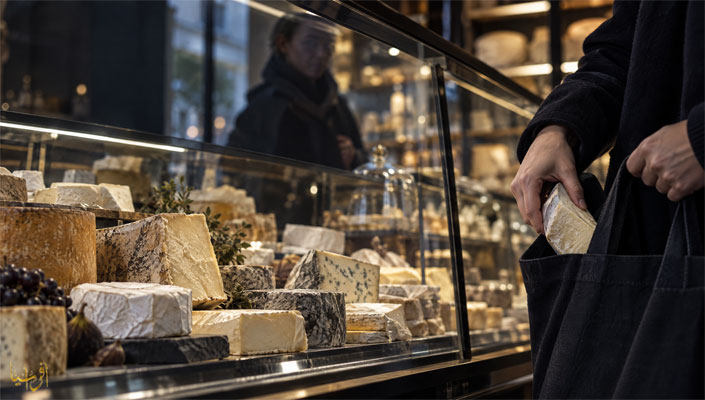
20 tons of cheese disappear between Germany and France (Afrasia).
Thieves prefer to steal cheese because the penalties are usually lighter compared to other crimes, such as drug trafficking!
Afrasianet - Thieves in France have developed a special taste for artisanal cheeses, targeting dairies and farms with antique rooms with thousands of euros worth of stock.
Early Saturday morning, Thomas Bonafo and his father, Serge, arrived at their dairy in Ragiade, in the cantal department of south-central France, to discover that thieves had seized quantities of cheese that were ready for sale in the market of the nearby town of Briód.
More than 200 kilograms of Bleu d'Auvergne cheese and other artisanal cheeses made from cow's milk have disappeared, and a 23-year-old Renault truck, which was later found burnt about 12 miles from the farm, was also stolen.
"They only took cheeses with labels. It was probably a 'made-to-order' robbery, so selling 200 kilograms is no small feat," says Thomas. He estimated the value of the stolen cheese at around €2,600.
Although the presence of labels and tags can make it difficult to sell stolen cheese through legitimate commercial channels, the thieves' choice of items with these labels has led police to believe that they are betting that proving the origin of the cheese will allow it to be sold at a higher price.
The Bonafo family is not the only victim, with cheese being named the "most stolen food product" in France, followed by chocolate.
At the Bergerie du Tille farm in Artiguilotin, near the southwestern French city of Beau, in September, two people stole about 250 tablets of sheep's milk cheese, worth 25,000 euros.
Farmer Regis Junqua said the thieves were very familiar with the types of cheeses, opting for the darker, more antique tablets – the most valuable – and disabled the surveillance camera. "It was very quiet, it was planned, it seemed like a professional job," he commented.
In Italy, Parmesan cheese producers have been subjected to large-scale thefts, which, according to the police and the Parmigiano-Reggiano Cheese Producers Association, lead to an estimated annual loss of around €3 million.
Parmesan, nicknamed "white gold", continues to attract highly organised criminal gangs, although the Parmigiano-Reggiano tablets bear unique identification tags.
Some producers also place microchips inside these labels to make it easier to track products. However, the primary purpose of these systems is to distinguish between high-quality authentic Parmesan cheese and counterfeit types, not to remotely track stolen discs.
In Switzerland, a cheesemaker working in a dairy factory in the southern canton of Valais was found guilty in June of stealing 400,000 euros worth of raclette cheese (made from cow's milk, which is usually melted and served over boiled potatoes, meat and pickles) over three years.
In Britain, the most notorious cheese case has seen a scam rather than a traditional break-in: in 2024, Neal's Yard Dairy, a cheese shop in London, delivered more than 22 tonnes of cheddar cheese, worth £300,000, to fraudsters posing as buyers representing a French retailer.
The scammers spent four months earning the company's trust, before seizing around 950 cheese discs, in an incident that later became known as the "Great Cheese Theft". Chef Jamie Oliver appealed to the public to be wary of "large shipments of fine cheeses" that are sold at low prices.
In France, the origin of each artisan cheese mold can be traced, at least in theory. "Each product has a special and distinctive label," says Alexandre Sall, co-president of the Cheese Makers' Association. Thieves remove the outer layer (crust) and then cut the cheese into pieces weighing between 200 and 300 grams. When large quantities of cheese are stolen in France, it is often cut and vacuum-wrapped, and then sent to other European countries."
Thieves also prefer to steal cheese because the penalties are usually lighter than other crimes, such as drug trafficking. "The risk-reward ratio seems tempting," Sall adds.

