
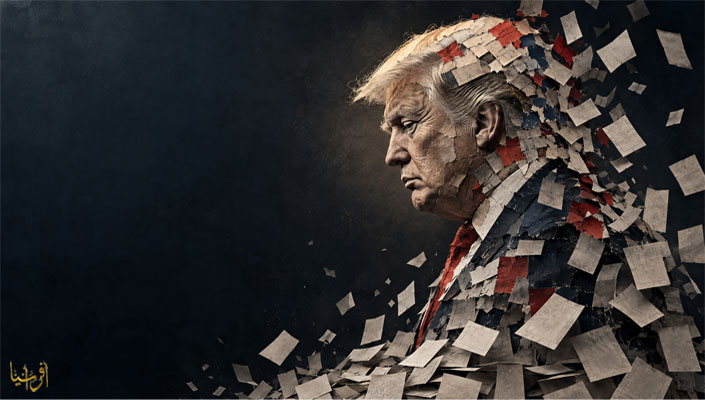
Afrasianet - Buthaina Aleeq - The setback to Trump's U.S. election comes in the broader context of electoral defeats and setbacks by right-wing populist forces over the past two years, some of which are directly related to him and others that intersect with him politically and ideologically.
Has right-wing populism been hit hard by a series of electoral failures that have hit its symbols in more than one country?
This question is being asked strongly in the wake of the Republicans' heavy loss in the congressional elections, which resulted in Democrats taking control of the House of Representatives and the Senate, and came in light of a significant decline in the popularity of US President Donald Trump.
Opinion polls showed that support for his performance dropped to a low of 33%, one of the lowest levels recorded during his presidency.
This setback opened the door to questions about the future of Trumpism in the United States and the prospects of its diminishing influence in the world, after Trump's arrival in the White House in 2017 constituted a political and moral impetus for many right-wing nationalist and populist movements.
A number of right-wing leaders and parties found him an inspirational model, both in political discourse, in mass mobilization methods, and in positions on a number of key issues.
Perhaps remarkably, the results of the US elections have gone beyond the traditional competition between Democrats and Republicans to become a vote on Trump's own policies and style of governance.
The US president has worked to personalize the electoral battle, making his political presence its main focus, repeatedly calling on voters to vote as if his name were on the ballot. Trump repeated this call at least 63 times before the election.
Indeed, Americans voted as if Trump himself was running for re-election, but the results came the opposite of what he wanted. They reflected widespread dissatisfaction with his administration's policies, particularly on the economy, the rising cost of living, the war with Iran, concerns about government corruption, and the growing debate over the relationship with Israel.
But Trump's personalization of political life is not limited to elections. Since entering the White House, he has strengthened the centrality of his position in power and the Republican Party to the point where loyalty to his person has become the most influential factor in determining political and administrative positions.
This inflation of the "political ego," if you will, is only one of the salient manifestations of Trump's populism, along with a host of other features that have characterized his political rhetoric and practice.
The first of these features is the claim of a monopoly on the representation of the people. Trump has consistently presented himself as the true expression of the will and interests of Americans, while repeatedly questioning the legitimacy or competence of his opponents to represent citizens. This is a fundamental feature of populist discourse.
The second characteristic is his questioning of traditional institutions and their roles and his quest to bypass institutional controls that limit the president's power.
This has been evident in Trump's frequent confrontations with state institutions, and in his attempts to expand the margin of executive power and subordinate some of the administration's joints to his political priorities.
In this context, his strained relationship with the media is highlighted. Trump has engaged in frequent confrontations with media outlets that he criticizes, using offensive language, sometimes even bullying and personally insulting media professionals and journalists.
This behavior was not limited to institutions opposed to him, but also included conservative media outlets close to the Republican Party. After the recent election defeat, he did not hesitate to blame Fox News for part of the Republican loss.
The third, and perhaps most present feature of his speech, is the simplification of complex issues and the provision of direct solutions to problems in which political, economic, social, and historical factors intersect.
Trump reduced the issue of irregular immigration, with its associated economic and social conditions, legislation and legal procedures, to a direct material solution represented in the construction of a wall on the border with Mexico, under the slogan "Build the Wall."
In the face of inflation and rising prices, he presented increased oil and gas extraction as a key input to address the crisis, using his famous slogan "Dig, dig, dig."
In foreign policy, his simplistic tendencies were evident in his repeated promises to end the Russia-Ukraine war within 24 hours.
The fourth feature is the use of emotional and polarizing rhetoric, an area in which Trump has excelled by evoking feelings of anger, fear, and frustration in segments of American society. He has repeatedly resorted to exaggerating the risks about immigrants and to rhetoric that has raised fears about Muslims.
The fifth feature is the focus on cultural and identity conflict, as Trump's rhetoric has contributed to deepening existing divisions within American society to the point that it has been said that there is no single issue on which Americans agree.
These characteristics are not exclusive to Trump, and populism did not start with him, and it is not a new phenomenon in political history. It is an old trend that has always been known to countries and societies.
However, populism has taken more organized forms in the modern era and gained new momentum with Trump, which contributed to strengthening the rapprochement between a number of right-wing nationalist and populist movements in the world within a political phenomenon that has come to be known as Trumpism.
What is striking today is that the setback that befell Trump in the US elections comes in a broader context of the electoral defeats and retreats witnessed by right-wing populist forces over the past two years, some of which are directly related to him and others that intersect with him politically and ideologically.
In Hungary, Viktor Orbán, one of Trump's most prominent European allies, lost the April 2026 election, ending his 16-year rule.
In Romania, the right-wing nationalist Alliance for the Union of Romanians was defeated in the May 2025 presidential election.
In Brazil, Flavio Bolsonaro, the son of former President Jair Bolsonaro and a prominent figure in the right-wing camp close to Trump, failed to reach the presidency in October 2026 after President Lula da Silva won a new term.
In the Netherlands, the right-wing Freedom Party declined in the October 2025 elections, and Sweden saw the far-right Sweden Democrats' representation decline in the September 2026 elections.
It is true that each country has its own circumstances, but the intellectual intersections and the political relationship that links some of its leaders to Trump make these results indicators worth pausing at in order to understand the transformations that the contemporary populist right is witnessing, which clearly seems to have entered a major regression path.
This raises serious questions about the ability of populist discourse to retain its appeal and its ability to persuade and mobilize, when it collides with public anger and social, political, and economic crises, to which populists have not succeeded in providing solutions.

