
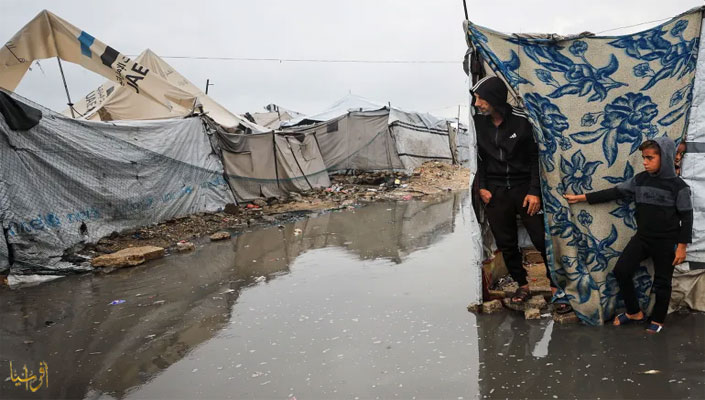
Tens of thousands of families in Gaza have been forced to leave their tents after rainwater flooded them and damaged what was inside (Reuters)
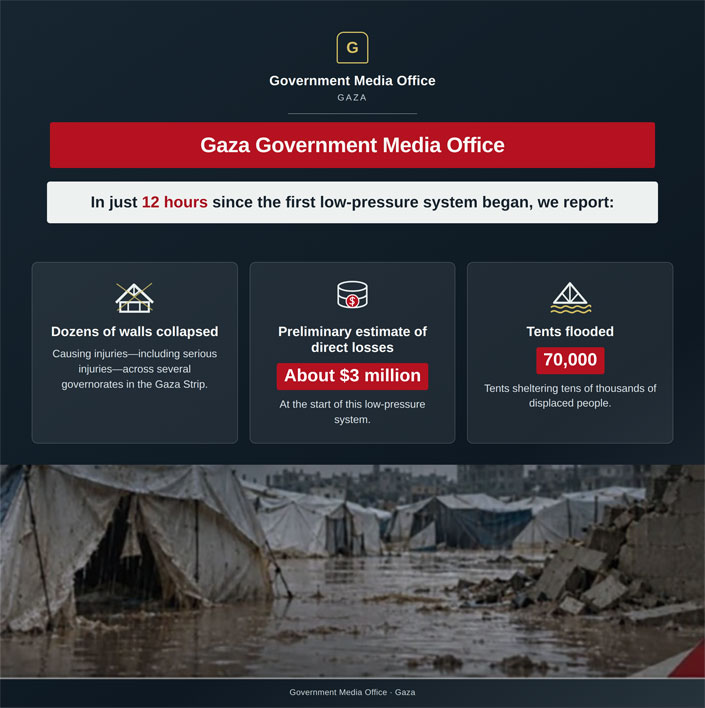
Afrasianet - In just 12 hours after the start of Gaza's first depression of the year, 70,000 tents sheltering tens of thousands of displaced people have sunk, and initial estimates of direct losses from the start of this depression are about $3 million, along with dozens of walls collapsing, causing various injuries.
The initial depression that hit the Gaza Strip at the beginning of the winter season was not just a passing wave of rain, but turned within a few hours into a new humanitarian disaster, after the water flooded tens of thousands of IDPs' tents and destroyed their remaining mattresses, blankets and living necessities, leaving hundreds of thousands of families facing a harsh test in light of the lack of adequate shelter and the lack of necessary resources to face the winter.
The government media office in Gaza announced on Saturday that about 70,000 tents sheltering the displaced people had sunk within just 12 hours of the start of the depression, estimating the initial direct losses at about $3 million.
Since Friday, the General Directorate of Civil Defense in the Gaza Strip has declared a state of extreme emergency, to deal with the repercussions of the rainy depression, and to meet the distress calls it receives from families stricken by the depression.
The office explained that rain and wind also caused the collapse of dozens of walls in various governorates of the Gaza Strip, which led to varying injuries, including serious cases, warning of the dangers of the collapse of cracked and collapsed buildings, which were damaged by Israeli shelling during the war.
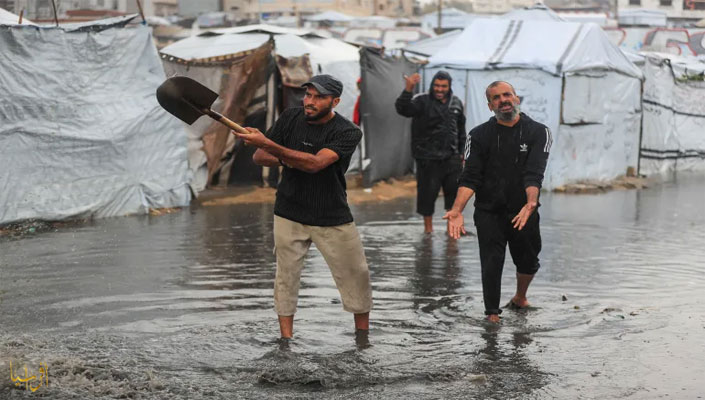
In the absence of rescue crews, Gazans are relying on themselves to save what is left of their tents due to the repercussions of the depression (Reuters)
"Monday... A sandslide caused the death of five Palestinians"
These figures reflect the fragility of the displaced, who have been forced to live in dilapidated tents and temporary shelters after the war destroyed their homes and large parts of infrastructure, at a time when there were no housing alternatives capable of protecting them from the fluctuations of the weather.
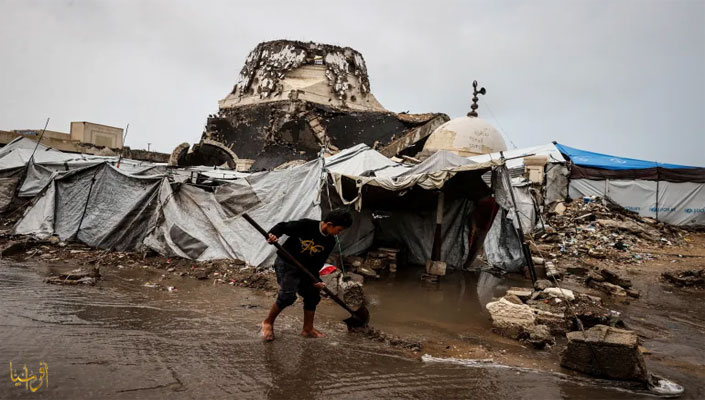
A Palestinian tries to protect his tent from the water (Anatolia)
Thousands of distress calls. The Civil Defense is helpless
The repercussions of the depression revealed the widening gap between the size of humanitarian needs and the available capabilities for response, as the Civil Defense in Gaza announced that it had received 2166 distress calls since the beginning of the depression, of which its crews were only able to respond to 218.
Civil Defense spokesman Mahmoud Basal said during a press conference that dozens of IDP camps, shelters and entire residential areas were submerged, noting that in many cases, crews were forced to provide guidance to the affected families instead of reaching them, due to the large number of reports and the lack of equipment.
The Civil Defense said it received about 1,500 distress calls during the first 10 hours of the storm, an indication of the speed of the damage and the increasing number of families trapped by the water.
The damage was not limited to tents, as rain and wind caused partial collapses of buildings and houses that were previously damaged during the war. Anadolu reported that there were collapses in buildings in different areas, and 5 Palestinians were injured as a result of the collapse of walls and the fall of metal parts, while the Civil Defense warned that more than 2,000 buildings are at risk of collapse over the heads of their occupants.
The danger of these developments is that thousands of families do not have a safe option to move into, even when the tents or houses in which they reside are threatened to sink or collapse.
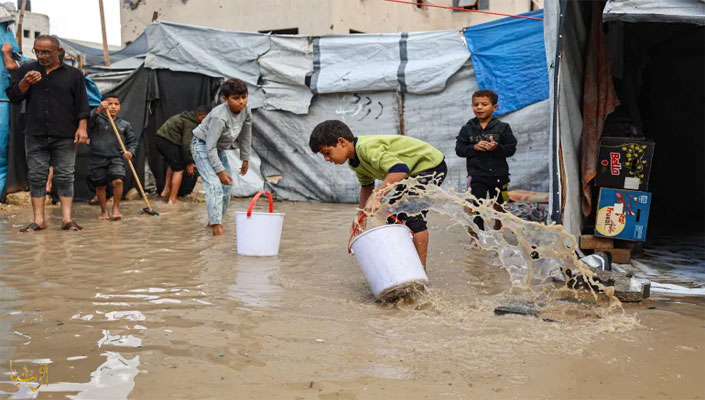
All Palestinian Families Participate in Rainwater Removal Efforts from Their Camps in Light of the Lack of Available Resources (French)
Children and patients in the open
In scenes reported by reporters and journalists from displacement camps in Gaza City, Deir al-Balah and Khan Younis, families were seen trying to get water out of their tents by primitive means, while bedding, blankets and clothes were flooded in mud puddles, and children were forced to stand barefoot in the water and mud.
The PCHR correspondent said that the families faced water leakage into their tents made of tents and fabrics, materials that do not provide adequate protection against heavy rains and winds.
In Khan Younis, the lenses carried scenes from the Mawasi area, where large gatherings of displaced people are scattered, noting that families living along the coast face additional risks from waves and rising water levels, as well as rainwater accumulation inside the camps.
The most vulnerable groups, especially infants, premature babies, the elderly, the sick and people with special cases, who need a safe environment, heating and health care that are not available in most places of displacement, are exacerbated.
Civil Defense spokesman Mahmoud Basal warned of the dangers that threaten these groups, in light of their continued construction in tents that do not protect against cold and humidity, while the chances of diseases increase with the pollution of the surrounding environment.
The mixing of rainwater with wastewater in some areas of displacement opens the door to additional health and environmental risks, especially with the damage to sewage networks and the decline in the ability of municipalities to drain and treat water.
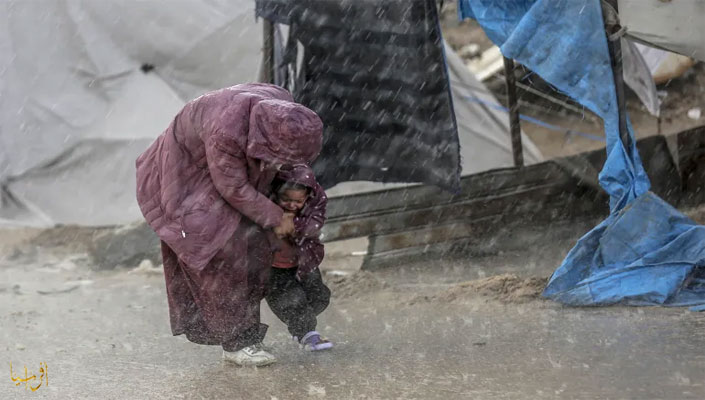
Israeli aggression has deteriorated Gaza's health infrastructure, limited access to basic medical care and supplies (Getty Images)
Relief hit by supply shortages
As the damage expands, the needs needed to cope with winter appear to be far greater than the aid available.
Emergency officials said Gaza urgently needed about 200,000 tents, along with caravans, heating materials and rain protection kits, to provide minimal shelter for hundreds of thousands of displaced people.
Tents that do not protect the cold: A deadly winter haunts the displaced people of Gaza
The Director of the Civil Defense in Gaza Governorate, Raed Al-Dahshan, said that the Authority does not have a single tent or tent to provide shelter to the affected people, explaining that the tasks of the teams are focused on saving lives and evacuating residents from dangerous locations, in light of the lack of the necessary capabilities to deal with the disaster.
In this context, the director of the Palestinian NGO Network, Mohammed Salha, said that the number of trucks entering the Gaza Strip daily ranges between 180 and 200 trucks, which is much less than the 600 trucks stipulated in the humanitarian protocol linked to the ceasefire agreement, noting that only about 40 trucks out of the total number of trucks carry humanitarian aid.
He added that about 50,000 tents still exist on the Egyptian side of the border and have not entered the Strip, calling for action before disasters occur instead of waiting for tents to sink and families to be damaged.
These data indicate that the shelter crisis is not only related to the repercussions of the weather, but also to the difficulty of providing the necessary materials and supplies to face the winter, at a time when large numbers of people are still living in dilapidated tents or damaged buildings.
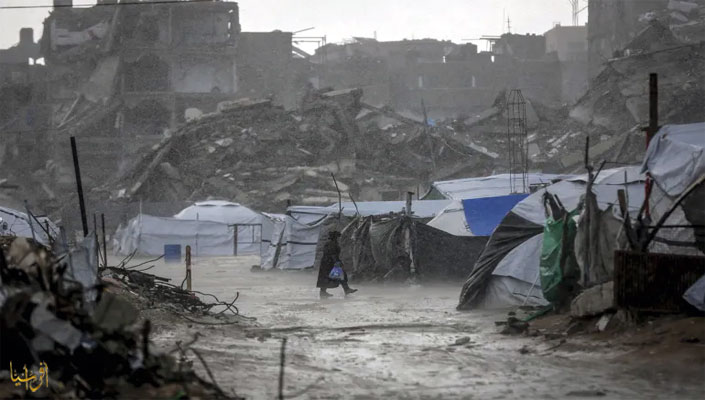
Gaza needs early warning systems, safe shelters, and improved rainwater drainage (Getty)
Limited relief action in the face of the scale of the disaster
In response to the extensive damage, some actors have begun to implement field interventions to mitigate the repercussions of the depression.
The Qatari Committee for the Reconstruction of Gaza announced the movement of engineering equipment and bulldozers to a number of displacement camps, as part of urgent interventions that included more than 15 camps, areas and main streets, with the aim of erecting earthen berms and opening paths to drain rainwater and prevent its flow to the tents.
The committee confirmed that it will continue its interventions during the following days, in coordination with the concerned authorities, to reduce the risks that threaten displaced families as the rainy weather conditions continue.
However, these interventions, despite their importance, remain limited in view of the size of the needs and the breadth of the affected camps, especially since the drainage of water does not compensate for the tents that are damaged, and does not provide alternatives for families who have lost their bedding, blankets and belongings.
Continued shortages of fuel, machinery and water suction equipment also pose additional challenges to municipalities and civil defense, limiting their ability to deal with water pools in camps, streets and residential areas.
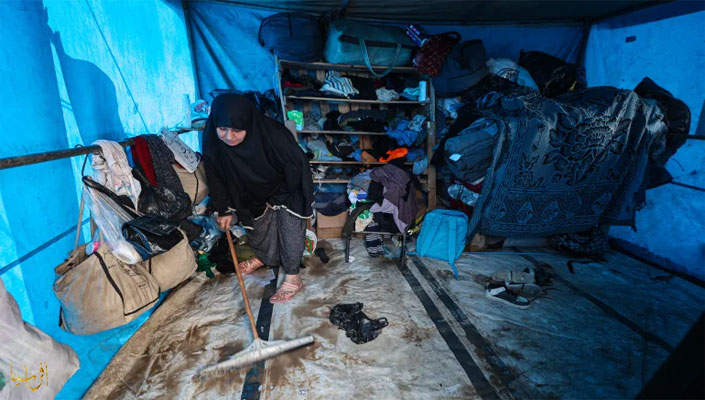
A displaced woman in the Rimal neighborhood of Gaza City takes out the heavy rainwater from inside her tent (French)
Long winter in the absence of shelter and reconstruction
The disaster brings to the fore fears of a repeat of the humanitarian tragedies witnessed in Gaza during previous winters, when tents were turned into water-soaked spaces and mud, and families were forced to spend cold nights without blankets or safe places to sleep.
These developments warn that the first depression may only be the beginning of a very harsh winter season, if there is no urgent response beyond temporary interventions, including the introduction of tents, caravans, construction materials, heating, water drainage and rescue equipment.
The other side of the disaster was the continuation of the occupation mechanisms to bomb the tents of the displaced people in Gaza despite the disaster of the depression.
In this context, Mr. Yousri Al-Ghoul wrote on Al-Mayadeen: "The reality of the Gaza Strip during the depressions should not become just passing news, and images of children sleeping in tents soaked in water and crying should not turn into familiar scenes that lose their ability to provoke anger, but should be a spark that explodes awareness towards stopping the genocide."
The meteorological announcement of the first depression was not augurative for our people in the Gaza Strip, who live in torn tents, especially after the destruction of most of the houses and infrastructure, and it is no longer possible to ask people to do anything but turn to God and take shelter by any available means, in the absence of roofs that can protect children and women from the heavy rains that fall in the middle of the night, as happened with this depression.
The biggest dilemma for the residents of the Gaza Strip is not only the rain, but also the fragility of the reality they face, and the world's handling of the tragic conditions they are living in with a great deal of indifference, as humanitarian institutions have become focused on media coverage through the implementation of events and activities that are not of the highest priority, as well as the Arab regimes, especially the surrounding countries, no longer call for an end to the genocide, reconstruction, or work to evacuate the sick, provide health care, provide adequate shelter, and other needs that cannot be postponed.
Hence, it becomes necessary to ask a number of questions about the nature of trust between society and its institutions, especially international institutions that talk a lot about the humanitarian response, but are still unable to provide sustainable solutions for people, because we are aware that these institutions may be able to bring in tents, tents, and some basic necessities, but they cannot or do not have the ability to turn this temporary intervention into a shelter that preserves human dignity.
Because I decided to link the dire situation that our beloved sector is going through during the winter season with literature as usual, I started looking for literary and cinematic works that can describe the situation we live in, but I did not find even in imagination a greater tragedy than the situation of the people of Gaza, in an attempt to stabilize the concept of memory that the occupation is trying to erase today by any means, and which we pay for through the loss of many writers, writers, journalists, academics and others.. because the house was not The novel "Clusters of Wrath" by the American writer John Steinbeck provides a modest example of this, as the narrative of that novel follows the journey of a family that is uprooted from its land and home, and embarks on a harsh journey of displacement, poverty, and the search for a safe place. What the Palestinians and the Lebanese feel today, especially with the displacement of our people in Gaza to various places, as is happening with our people in southern Lebanon and perhaps some areas inside the Syrian territories.
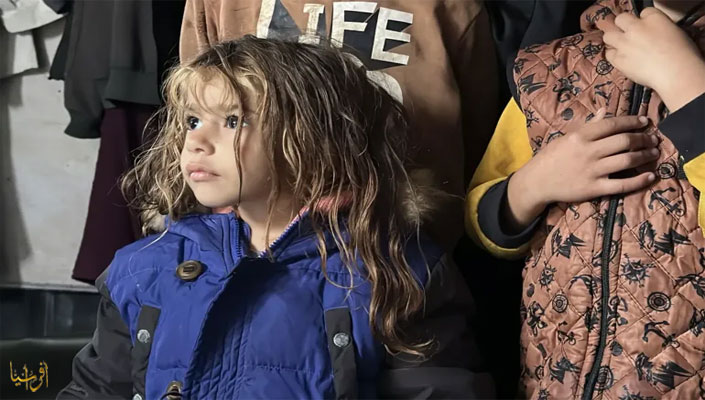
Gaza Strip faces widespread pollution due to wastewater and waste accumulation, increasing the risk of disease outbreaks (UNICEF)
Perhaps, the Palestinian situation in Gaza may be harsher than others because the displaced people there have not only lost their homes, but also many of the basic conditions that make shelter a livable place, in light of the continuous targeting and tightening of the noose on the population through the extension of the Yellow Line.
The tent is not a house, even if the displaced people try to adapt to it, and it is not a solution for reconstruction, even if it is distributed in large numbers; rather, it is a sign of the declaration of a state of emergency that was supposed to end with the declaration of a ceasefire and the signing of the agreement guaranteed by the Arab guarantors, who are unable to achieve that guarantee, and with the presence of a guarantor such as the United States of America, which supports the occupation with money, weapons and other logistics.
Perhaps the worst nightmare for the residents of the Gaza Strip today is the continuation of this situation, which threatens to turn the exception into a permanent rule, as displacement has become a way of life as if it were eternal, and the deprivation of the most basic rights of Palestinians and Lebanese has become a regular thing in the Arab and global public consciousness.
With this article, I hope to convey the voice of the child who is trembling from the cold everywhere in our occupied Arab territories, and the woman sweeping rainwater inside a dilapidated tent, in a scene that conquers the heart and soul, as the discussion should not be limited now between international systems and governments – assuming that there are indeed governments that care about Gaza and its people – or even relief and humanitarian institutions in search of the number of tents that have been flooded, or the amount of aid that has arrived – and it is arriving at dawn The spirit, as we say in our Palestinian colloquialism, is why there are more fundamental questions about when the water and sewage networks will be rehabilitated, who will restore them, in addition to thinking about who will remove the massive rubble, who will restart hospitals and schools, and who will develop a real plan to rebuild housing and public utilities, rather than just managing the disaster since the siege of the Gaza Strip began when Hamas came to power.
In conclusion, the reality of the Gaza Strip during the depressions should not become just passing news, nor should images of children sleeping in tents soaked in water and cry become familiar scenes that lose their ability to provoke anger, but should be a spark that explodes awareness towards stopping the genocide, opening the crossings, restoring and rebuilding Gaza, to shine again, as it was and will remain.

