
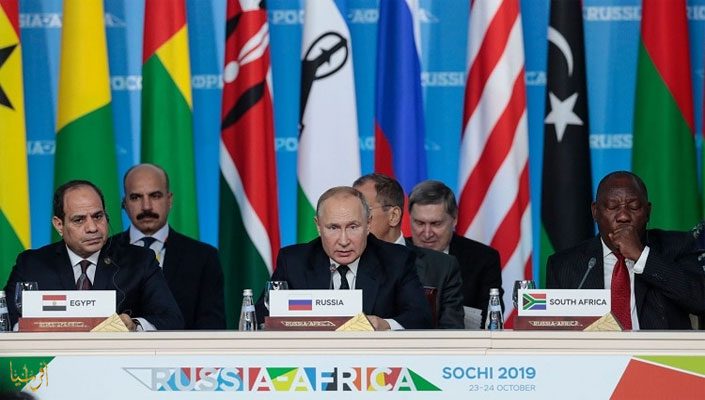
Russia-Africa Summit Between Messages and Challenges
Afrasianet - Thabet Al Amour - The Russia-Africa summit cannot be seen and judged not as an attempt to replace a Western tutelage with a Russian or Chinese one, but as a historic opportunity for African governments to maximize their national gains.
On October 28 and 29, 2026, the Russian capital Moscow witnessed the holding of the Third Russia-Africa Summit, with the participation of high-level delegations from 48 African countries, including 22 heads of state.
This summit was held at a very complex historical moment, in which the international system is heading towards sharp polarization and a fierce struggle to formulate new rules for the world order, amid Western attempts that have been ongoing since 2022 to isolate Moscow internationally and tighten the economic noose on it.
The question is: What does the third Russian-African summit mean? What messages does it carry and the challenges it faces? Can it be the nucleus for the formulation of the features of a new multipolar international order, or will it remain just a periodic protocol meeting?
The periodicity of the third Russian-African summit means that it was not just a passing diplomatic protocol or a meeting to exchange words of praise, but rather a roadmap that rearranges Russian influence and presence on the African continent, as the summit sent a message that Russia's encirclement and blockade of Europe did not succeed, and that while the European presence in Africa is declining, Russia is firmly firm on its feet, and that Africa, with all its political, demographic, and geographical weight, has chosen to open up to Russia.
The 2026 summit comes as a field translation of the erosion of French and American influence on the continent, especially in the African Sahel region.
The Russian-African summit means that European countries have failed to isolate Moscow, and that Russia's turn towards African countries has succeeded in dismantling the attempt to isolate Russia, as Moscow's reception of delegations from 48 African countries proves that the Kremlin has succeeded in building a solid diplomatic front with the African continent.
The most prominent feature of this front, according to Russian President Vladimir Putin's statements, is the affirmation of a multipolar world and that this is beginning to become a reality, and that Russia and Africa are natural allies and partners in building the multipolar system, and therefore one of the messages of the summit is to announce the end of the unipolar era that has dominated the international system since the end of the Cold War.
The broad African participation in the summit reflects an African strategy of rejecting tutelage and dependence on unipolarity and dealing with the African continent as a negative receiver or using it as an arena for settling scores between the great powers.
The turning of African countries towards Moscow gives it a margin of maneuver and equality that respects national sovereignty and freedom from the conditions and blackmail imposed by Western capitals and international financial institutions such as the World Bank and the International Monetary Fund.
Russia exported more than 18 million tons of grain to Africa in 2025, and added an additional 13 million tons during the first nine months of 2026. The 2026 summit focused on projects to establish silos, storage and processing facilities for grains, and localized fertilizer production (such as the $1 billion Memorandum of Understanding for the establishment of a urea plant in Angola).
The rationale and messages of the Russian-African summit prove that it succeeded politically and diplomatically in breaking the international isolation imposed on the Kremlin, and proved the legitimacy of the Russian rhetoric calling for multipolarity, through which Moscow received moral support and great diplomatic coordination from a balanced voting bloc in the United Nations General Assembly (54 African votes), and the adoption of the declaration of the reform of the United Nations Security Council and the granting of two permanent seats to Africa represents a strategic step to link the interests of the continent to the Russian vision.
The third Russia-Africa Summit in 2026 sent very important strategic messages to all parties to the international game, assuring the West that the time of absolute domination is over, and that Africa is no longer a backyard for any European capital, and it also proved that Russian diplomacy possesses high tactical flexibility that enables it to penetrate traditional Western spheres of influence by employing vital security files and invoking the anti-colonial historical memory.
In conclusion, the Russia-Africa Summit cannot be viewed and judged as an attempt to replace a Western tutelage with a Russian or Chinese one, but as a historic opportunity for African Governments to maximize their national gains and turn the fierce international competition for their resources into a lever for sustainable development and full sovereignty. That equation is the most important message and challenge that the Third Russia-Africa Summit conjures.
Source: Al-Mayadeen

