
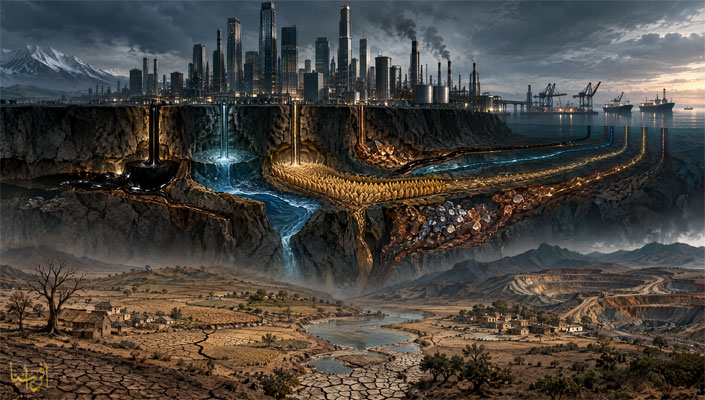
A special review of Dr. Zakaria Shahin’s book
Afrasianet - Mahdi Shahin - Some books are not read as storehouses of information, but as alarm bells. Falling into the Clutches of the Savage North: Resource Wars belongs to this kind. It does not view wars only through the window of battle, nor does it limit itself to counting casualties or listing agreements. Instead, it asks a more unsettling question: What turns a country rich in water, oil, minerals, or strategic location into an open arena for conflict?
From its title onward, Zakaria Shahin places the reader before a stark image: the North is presented not merely as a cold geography, but as a system of power, wealth, and knowledge, while the South appears caught in a web of need and dependency. The word “clutches” gives the title its moral tension. This is not an equal exchange between parties, but a predatory relationship that sometimes conceals itself behind the language of development and sometimes behind the slogans of democracy and human rights.
A writer who writes from the heart of the wound
Zakaria Mohammad Shahin is a writer and journalist whose work spans fiction, poetry, and politics. His books include Thyme Seedlings and Tank Treads, Zionist Thought: Between Theory and Practice, Six Days in Afghanistan, Palestine in a Time of Transformations, and Human Rights: The Image and the Shadow.
It is worth noting that Falling into the Clutches of the Savage North was the subject of his doctoral dissertation. This helps explain the book’s breadth and its effort to build a thesis rather than simply record a position.
This biography is not a marginal detail outside the book. A writer who has experienced Palestine, exile, media, and war does not treat politics as an abstract exercise. He sees faces in maps, threatened lives in the news, and the effects of cold terms such as “restructuring” and “regional security” reaching, in the end, a poor household, a destroyed village, and a country that has lost control over its own decisions.
From visible war to hidden war
The book’s central strength is that it moves the concept of war beyond its traditional image. War may begin years before the first shot is fired. It begins when a state is drained of strength, its institutions dismantled, its wealth redefined as investment opportunities, and its people driven to fight one another over identity. The process may be called reform, democratic transition, or humanitarian intervention, while its ultimate result is to weaken society’s ability to protect its resources.
In Shahin’s reading, wealth does not move alone; networks of influence, weapons, and information move with it. Oil is not just a well. It also means shipping lanes, corporations, bank accounts, and military alliances. Water is not just a river; it is a political boundary, a dam, and a matter of sovereign decision-making. Even agricultural land ceases to be merely land when it enters calculations involving markets, food, and exports. In this way, a resource that should be a shared blessing becomes a pretext for placing decision-making under outside control.
The book draws on a simple but unsettling idea: when major powers cannot acquire resources directly, they may work to control the conditions under which those resources are managed. It may be enough for a country to become weak, for its elite to become divided, or for its aid to be tied to conditions that make its economy dependent. Control can then appear to be a natural consequence of chaos rather than a political act carefully designed.
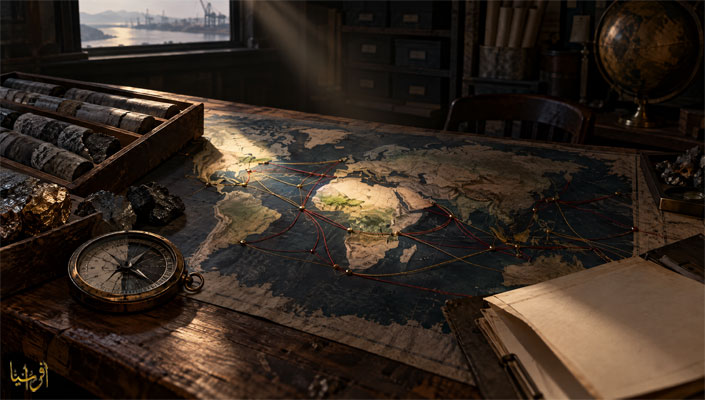
In Shahin’s reading, wealth does not move alone; networks of influence, weapons, and information move with it.
The book’s most disturbing idea: turning people into surplus
According to the book’s journalistic overview, Shahin discusses reports and ideas that regard the populations of the Third World as a burden on resources and link the control of populations to the control of wealth. Here the book moves beyond political economy into a profound moral question: At what point does a person lose their value in the eyes of the global system? And when does poverty become evidence of unworthiness, rather than the outcome of a long history of plunder and dependency?
This is the book’s true core, even if readers may disagree with some of its conclusions or with the tone of certain chapters. The danger is not that international interests exist; they always do. The danger is reducing an entire people to a figure in a consumption table and treating their resources as more important than their right to exist and choose their own future.
From here, the author connects direct wars with wars over identity. When economic control fails to impose itself, internal divisions can be inflamed: one sect against another, one national group against another, or a local community called upon to defend itself against its neighbor. In the end, the state can no longer negotiate on behalf of its citizens, and citizens can no longer see their real adversary through the smoke of battle.
Between the power to expose and the risks of generalization
A fair reading of the book requires acknowledging that it is a work of protest as much as a work of analysis. It is written from a position of skepticism toward official narratives and confronts the soft language that often precedes forceful interventions. Yet this very position may sometimes lead it to gather different phenomena under a single explanation, or to portray “the West” as one unified bloc, when reality is more complex. It includes internal conflicts, competing interests, and social forces that resist from within the very centers of power.
This observation does not diminish the book’s value; it makes the need for it all the greater. A good book is not one that closes debate, but one that opens up areas of blindness. Falling into the Clutches of the Savage North succeeds in drawing back the curtain on a question overlooked in the daily news: Who pays for global prosperity, and who has the power to define “security,” “development,” and “stability”?
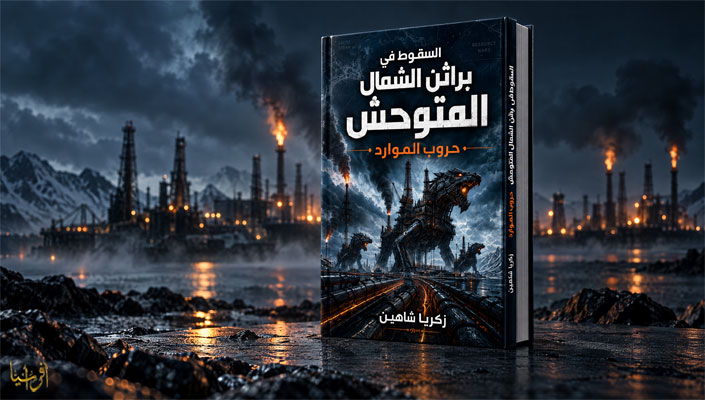
Read More.. The book: "Falling into the Clutches of the Savage North..Resource Wars".
Conclusion: reclaiming resources or reclaiming decision-making?
Ultimately, the book is not only about oil, water, and minerals. It is about sovereignty. A society that loses the ability to decide what happens to its resources gradually loses the ability to determine the future of its people. When wealth becomes an external privilege, the state is left guarding its territory without having the power to decide what happens there.
The book’s value today lies in reminding us that war does not always begin at the border, and occupation may take the form of an economic contract, a web of debt, a monopoly over information, or an energy map drawn far from the people who own the land. As the names of powers change and the maps of alliances shift, Shaheen leaves us with an open question: Can countries rich in resources move from being objects in other people’s plans to political actors that write their own plans?
About the author: Zakaria Mohammad Shahin is a Palestinian writer and journalist whose experience brings together journalism, radio, fiction, and political writing. His work has focused on Palestine, resources, wars, and the double standards of international discourse.

