
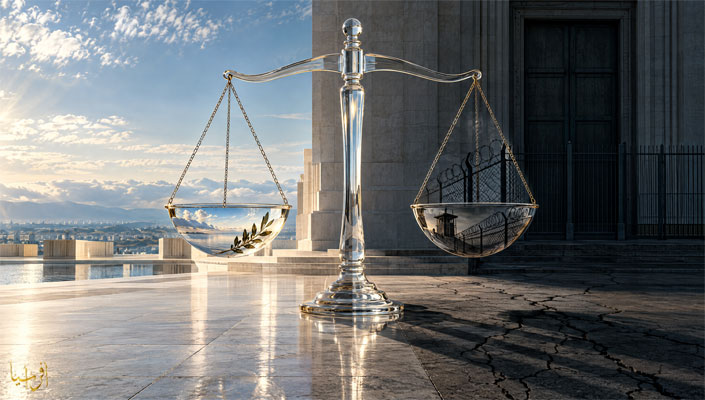
A special review of Dr. Zakaria Shahin’s book
Afrasianet - Mahdi Shahin - The title Human Rights: The Image and the Shadow may look like a short phrase, but in fact it places the whole book before a double mirror. In the image, we see declarations, covenants, and the polished language of dignity, freedom, and equality. In the shadow, we see what official statements leave unsaid: prisons beyond the reach of cameras, refugees reduced to numbers, and wars waged in the name of protecting people that leave those very people without homes or futures.
This is not merely a book about rights as a list of legal provisions. At its heart, it is a book about the distance between principle and practice—between what states say about humanity and what they do when human dignity conflicts with their interests. From that distance arises the most urgent question: Are human rights truly a universal standard, or do they sometimes become a selective language used against the weak while the powerful are exempted from it?
A writer who brings the memory of exile to the question of rights
Zakaria Mohammad Shahin is a writer and journalist whose work spans fiction, poetry, and political research. His books include Zionist Thought: Between Theory and Practice, Palestine in a Time of Transformations, Six Days in Afghanistan, and Falling into the Clutches of the Savage North, as well as Human Rights: The Image and the Shadow, which was published in Arabic and English.
This background explains why the book does not come from the position of an entirely detached observer. The Palestinian writer encounters human rights not only in conference halls, but also through the experience of losing one’s homeland, the question of the refugee, and a people’s right to be seen rather than used in news bulletins.
The book is therefore shaped by an Arab experience that sees the problem not as a lack of written principles, but as a lack of power willing to protect those principles when they conflict with the will of the powerful.
The image: a world that speaks the language of dignity
The vision from which the human-rights system begins is beautiful and necessary. It says that people do not lose their rights because they are poor, belong to a minority, live in a weak country, or oppose those in power. It says that the state does not own its people; it is entrusted with safeguarding their freedom. These principles are neither a Western luxury nor diplomatic decoration. They are the minimum safeguards against politics turning into a jungle.
But Shahin does not simply celebrate the image. He knows that the language of rights has acquired immense moral authority over the course of history, and has therefore become part of international political struggles. The banner of human rights may be raised to protect civilians, but it may also be raised to justify a blockade, intervention, or collective punishment. The genuine defense of an oppressed woman in one country may become a pretext for ignoring other women when their oppressor is an ally.
Here the title comes into focus: the image is not necessarily false, but it is incomplete. And the shadow is no illusion; it is the part of the scene that has been left out.

The farther a victim is from the centers of power, the more their right has to be proven.
The shadow: when rights become a selective instrument
The problem the book places before its readers is not the idea of human rights, but the monopolization of their definition and application. Those who control the media can decide which tragedy deserves sympathy, while those who wield power can decide which violation is called a crime and which is dismissed as a “regrettable mistake.” A bitter paradox follows: the farther a victim is from the centers of power, the more their right has to be proven.
In this context, the refugee becomes a genuine test of human-rights rhetoric. A refugee is not a sad image captured at a border, but a person with a memory and a right to safety, to return, or to resettle with dignity. The prisoner is another test, because rights should not stop at the prison gate. And civilians under bombardment reveal whether the international community is prepared to apply the same rule to ally and adversary alike.
This also helps explain the connection between this book and Shahin’s other works. In Falling into the Clutches of the Savage North, resources appear as an arena of conflict. Here, human dignity appears as another arena of conflict. In both cases, the writer asks not only about the slogan, but about the power behind it—and about the human being who may disappear when values become instruments of influence.
The book between critique and defense
Some readers may feel that this kind of criticism suggests a rejection of the entire Western human-rights system. A more careful reading, however, points in the opposite direction: the book defends the essence of human rights by questioning those who misuse them. To say that some states apply rights selectively is not to say that rights do not matter. It is to say that their application must become more consistent and that they must be reclaimed from selective politics.
This is where the book’s moral value lies. It does not ask us to choose between human rights and sovereignty, or between freedom and social justice. Instead, it warns against turning any one value into a mask that erases other values. Freedom that does not protect the poor remains incomplete. Democracy that does not prevent discrimination becomes a cold ballot box. And a law that does not reach the powerful loses its name, even if its pages are filled with legal provisions.
Why does the book remain relevant?
Because the world is no longer short of declarations; it is overflowing with them. Almost every crisis is covered in the language of human rights: war is presented as protection, sanctions as pressure for reform, closed borders as a defense of order, and intervention as rescue. Amid all this, the real human being—with a body, a home, and a memory—recedes behind the abstract human being who appears in official statements.
Shahin reminds us that a right is not measured by the eloquence of the words describing it, but by its ability to reach those who are most vulnerable. If dignity remains whole in capital cities but diminished at the margins, then a bright image is concealing a long shadow. And if solidarity depends on identity or political position, human rights have turned from a standard into a privilege.
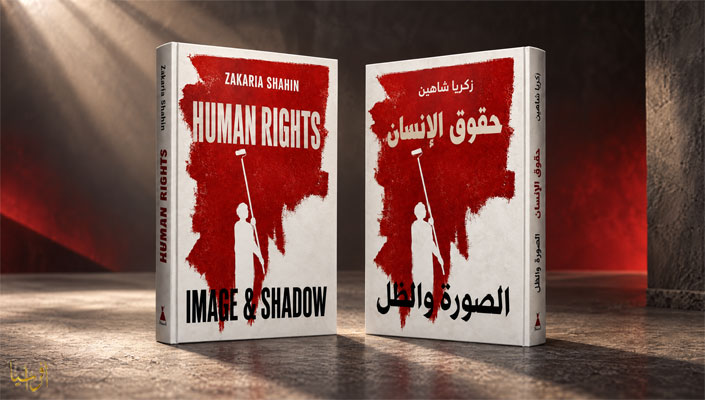
Read More.. The book: "Human Rights.. Image and Shadow".
Conclusion: bringing the human being back into the picture
The most important thing we can take away from Human Rights: The Image and the Shadow is that the book does not ask us to hate the image, but to complete it. It does not seek to discard the idea of rights, but to free it from selective use. It insists that a human being is not an instrument in the rhetoric of states, a number in an organization’s reports, or a seasonal victim summoned before the camera when it serves the story.
A real right remains a right when the victim’s name changes, when the perpetrator is an ally, and when there is no political interest in showing sympathy. The book therefore leaves readers before an unflattering mirror: “What we see is the image of the world as it likes to appear; what we do not see is the world as the weak are made to pay for it…!”

