
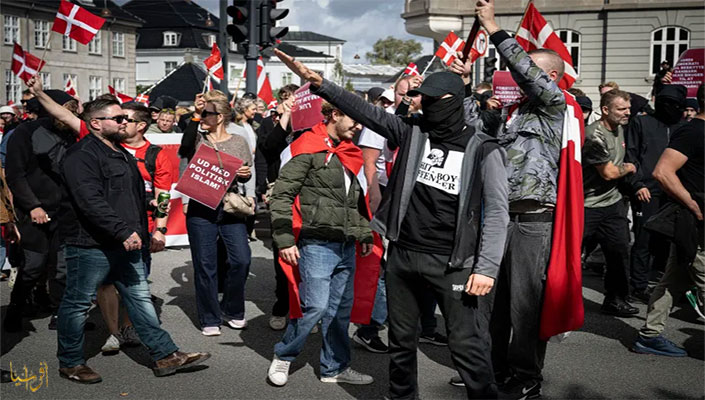
Supporters of the right-wing initiative "Danish People" march against immigration in Copenhagen (European)
Afrasianet - Tariq Al Qizani - Denmark has set a target of deporting the first batch of irregular migrants to a "return centre" in a third country outside the EU in January.
In 2022, the government of former British Prime Minister Boris Johnson struck a deal aimed at transporting some asylum seekers who arrived in Britain via small boats to Rwanda, in a move to deter flows across the Channel Sea.
But the agreement, which was later adopted by Prime Minister Rishi Sunak, only implemented four volunteers, before crumbling in front of legal challenges and a decision by the British Supreme Court in November 2023 for its contravention of international law.
Britain has already paid £240 million (about $330 million) to Rwanda, and a further 50 million was due to be transferred in April. But the deal was born dead and graved once and for all with the rise of Keir Starmer 's government in 2024.
Uganda or Rwanda?
Copenhagen and four other European countries – Germany, Greece, Austria and the Netherlands – now want to move forward months after the European Migration and Asylum Charter came into force last June, which opened the door to the possibility of establishing return centres abroad, as Italy did by establishing centres in Albania.
The European Alliance estimates that the project is eligible to be ready by 2027, so that any EU country will have the possibility to deport migrants not to their countries of origin, but to facilities that have not yet been built in third countries, outside the bloc.
But the focus now, according to German Interior Minister Alexander Dobrint, is to reach an agreement with a third partner country before the end of this year.
European reports have spoken of actual talks with partner countries that have not been disclosed for reasons of secrecy, but have been openly marketed in European circles to Uganda and Rwanda.
What do we know about the "Return Centers"?
According to the Danish-led talks, the purpose of these centres will be to house people who are under an enforceable obligation to leave but cannot be returned to their countries of origin for various reasons, including the refusal of their governments to cooperate in their deportations.
In his remarks, Danish Immigration Minister Morten Podskopf noted that these centres would not be a "prison" or a "detention camp", but rather structures "where partner countries give a new opportunity to illegal immigrants".
Agreements with non-EU States are supposed to set out the procedures and conditions of stay for migrants in return centres, as well as the responsibilities of the Member States concerned.
Statements by the ministers of the European countries involved in the project indicate that it will be implemented in partnership with international organizations, including the United Nations High Commissioner for Refugees (UNHCR) and the International Organization for Migration, in compliance with EU law and international obligations.
But only the five countries will bear full responsibility for funding these centers. They can also provide additional funding, business partnerships, or other incentives to partner countries.
The ministers of the five countries are due to meet at a second meeting in the German city of Munich at the end of September to further agree on the project.
More than half of the bloc's countries are still in favour of such a move, as it is seen as an "innovative solution" to the dilemma of irregular migration.
"Zero transit"
European ministers expect this new model to significantly reduce irregular border crossings.
These forecasts come at a time when European governments and their security arm (the European Border and Coast Guard Agency (Frontex) are hailing the significant decline in the number of irregular border crossings during the first seven months of 2026, compared to the same period last year.
The report released by Frontex on August 14 reveals that irregular crossings at the EU's external borders have fallen by 37%, with about 61,000 cases reported.
However, as Austrian Minister Gerhard Karner has emphasized in his remarks with his European partners, he hopes to raise the ceiling of aspirations in order to achieve a common goal of reducing transits to near zero.
But back to the tragic events that accompanied the major crossing into the Spanish-ruled city of Ceuta weeks ago, these hopes are contradictory behind the "return centres" project and before it the European Compact on Migration and Asylum.
On the one hand, European policies have been able to pressure the number of crossers through tight security restrictions, but on the other hand, policies of prevention and closure have led to an unexpected explosion at the border.
Paradoxes and reservations
The European Compact on Migration and Asylum already allows for the deportation of as many migrants as possible directly at the border through expedited procedures, but at the same time it is not opposed to the establishment of refugee deportation centres in third countries, an idea that is strongly supported by the far right.
Ironically, what was once seen as a British move against international law is now on the table for Europeans despite legal and ethical obstacles.
Michel Levoy, director of Beacom, a Brussels-based NGO that advocates for the rights of irregular migrants, commented: "Sending people to deportation centres outside the EU amounts to taking children, adults and families away from the lives they have built in Europe, and subjecting them to prolonged detention in places that are completely alien to them."
So far, attempts to transfer migrants to countries outside the EU have not been successful. All previous plans and agreements made by the EU, even with its partners in the southern Mediterranean, have not succeeded in aborting the phenomenon of irregular migration and the flow of boats completely.
Tunisian expert on migration and asylum issues, Ramadan Ben Omar, explains that from a moral point of view, the European Union has given an example of ignoring the high humanitarian cost of its migration policies, and this has been discussed in the past through memoranda signed with countries such as Tunisia, Mauritania, Lebanon, Egypt and others.
In this context, the Tunisian expert points to an inevitable dilemma. The more the ban is intensified, the more diverse the crossing routes and tactics that may take the more challenging forms of deterrence systems at the border.
Past experiences reflect experts' reticence towards "return centres", with Britain abandoning its plans to send asylum seekers to Rwanda, where their applications were due to be examined. Denmark has also abandoned a similar system in 2023.
Italy initially planned to take in around 3,000 migrants a month at its centres in Albania. But since it was converted into deportation centres in March 2025, only 500 migrants have been transferred there in total.
The cost of these centres has so far exceeded 670 million euros, while the network reported the results of a recent study by an Italian university, which shows that Italy is less expensive to care for migrants on its territory than to transport them to deportation centres in Albania.
________________
Source: Al Jazeera + Social Media
________________

