
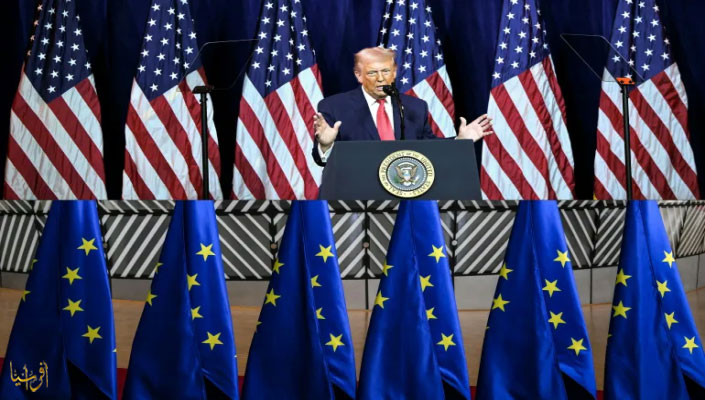
Is Trump pushing Europe to build a world without America?
Afrasianet - Awad Al Taqr Babaker Mohammed - The differences between the United States and Europe under Donald Trump are no longer just disputes over trade or the size of defense spending.
What is changing today is even deeper: the trust that has underpinned the transatlantic relationship for decades, and the question of whether the United States will remain the main guarantor of Europe's security and its economic and strategic partner.
In recent months, U.S. pressure on European allies has escalated, from tariffs and trade files to demands that Europeans take greater responsibility for their own security.
In August 2026, the U.S. Department of Defense is conducting a broad review of the U.S. military presence in Europe, amid European concerns about a possible reduction in U.S. forces deployed on the continent.
Some may argue that what Trump is doing is nothing but an attempt to force Europe to pay a greater price for self-defense, a long-standing American demand.
But the problem is not asking the Europeans to increase defense spending, but the way the relationship is managed: the language of threats, fees, and political pressure sometimes makes an ally feel more like they are dealing with a conditional trading partner than with a strategic ally.
"If Europe succeeds in building a greater defense force, it may be better able to protect its interests and deal with crises without waiting for Washington"
________________
International relations are not based on interests alone, but on trust in the continuation of commitments. If European countries begin to doubt the future of America's commitment to security, they will have to consider alternatives, not only militarily, but also economically and politically.
The European debate is no longer just about how to persuade Washington to stay as it was in Europe, but about how to build a greater European capacity to defend the continent.
Strategic analysis suggests that the Trump administration's vision of a so-called NATO 3.0 is based on a reduction in direct U.S. military commitment in Europe, in exchange for European allies taking greater responsibility for the continent's conventional defense.
This leads to an important paradox: Trump may be, where he doesn't want to, one of the factors driving Europe to strategically independent from the United States. But would that be in the world's interest?
If Europe builds a greater defense force, it may be better able to protect its interests and deal with crises without waiting for Washington. This could be a positive development in the long run.
But the transition from a U.S.-led security system to a more independent Europe will not be easy, especially in light of Russia's war and escalating international competition.
More dangerously, the transition could create a strategic vacuum. If the U.S. presence declines more quickly than Europe can build, Western deterrence could be temporarily weakened, which could tempt Western adversaries to test the limits of that weakness.
The European Union Institute for Security Studies has warned that reducing the U.S. presence in Europe could create deterrence gaps before Europeans can fully take responsibility.
And it's not just about security. The U.S.-European dispute has direct repercussions for the global economy. When the two largest Western economic powers use tariffs and bilateral negotiations to pressure each other, the rules of international trade themselves are shaken.
A recent economic study has described the stage as a transition from a trading system governed by multilateral rules to an environment in which bilateral power relations play a greater role.
The broader conclusion is that the world may be moving to reduce its dependence on the United States.
"The issue is not in the person of Trump alone, nor in the passing dispute between a US president and European capitals. The issue is about the future of an entire international order"
________________
Countries that used to rely on the U.S. security umbrella will seek to diversify their options, countries that are economically dependent on the U.S. market will look for other markets, while China, India, and other regional powers will become increasingly important.
Some analysts have argued that Trump's policies may actually push the world toward a system less dependent on Washington.
For the Arab world, these shifts carry both opportunities and risks. A multiplicity of centers of power could give Arab states more room to maneuver and diversify partnerships between the United States, Europe, China, and others.
But it could make the international system more complex and less able to reach quick consensus on Middle East crises.
Therefore, the issue is not in the person of Trump alone, nor in the passing dispute between an American president and European capitals. The issue is about the future of an entire international order.
Trump may succeed in getting Europe to spend more on its defense, a goal that has long been demanded by previous U.S. presidents.
But if he also pushes Europeans to lose faith in Washington and seek strategic and economic alternatives, the outcome could be far greater than he wanted.
The question that will determine the shape of the coming years is not: Can Europe survive without America?
Rather: Can the United States maintain its global influence if its allies begin to build a world that can live without it?
________________

