
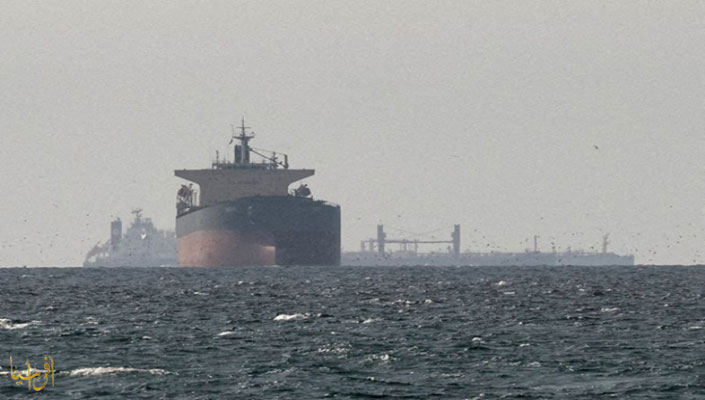
Afrasianet - Hassan Falaha - As soon as U.S. President Donald Trump vented his anger against Iran and gave permission to his friend Israeli Prime Minister Benjamin Netanyahu to ignite his promised war against the Sunnah of the Torah, the two of them were able to plunge the entire world into a major and very complex crisis, which brought him into the stage of losing control over the management of the conflict, starting with the Iranian nuclear file, through the floundering in the Strait of Hormuz, diving into the sands of its crossings, and perhaps moving in the near future to stand in front of Bab al-Mandeb, where there is no return to entry to the Great Collapse.
China enters the region through its vital corridors, in parallel with Russia's preoccupation with rearranging the presence, and the expansion of European awareness and the realization of the inevitability of escaping absolute dependence on America.
The strong are no longer strong, and the weak are no more. The Strait of Hormuz has confined America's great power to a waterway, and transformed Iran from a regional country into a power with an international presence that is reshaping the global economy, which has caused the world to witness a major imbalance, and therefore this world is no longer the same for the first time since the collapse of the Soviet Union.
The Strait of Hormuz abolished unipolarity, and vital corridors have rearranged alliances between countries. With or without war, America will not return to the way it was, and neither will Iran.
The Hormuz-Bab al-Mandeb axis looks like a promised quagmire, with the potential to propose a high-ceiling proposal: "A Middle East without foreign forces."
In the immediate aftermath, Iran has become more present at the global level, tougher in governance and tougher in its stance. America, on the other hand, is using the surplus power to prevent a shrinking in influence and power after the dispersion of allies, in conjunction with a volatile global economy on the back of a stock exchange that Trump thought he could play with.
China is entering the region through its vital corridors, in parallel with Russia's preoccupation with rearranging its presence, and a widening European awareness and awareness of the inevitability of escaping absolute dependence on America.
The repercussions of Operation Epic Wrath have brought Israel and Netanyahu back to the pre-October 7 era, with no "grandfather" and no "Abrahams." It has also made Lebanon more connected to the outside and less interconnected at home, amid signs that are heading toward a new decade.
The resistance returned to its original frameworks: a retreat in the official embrace, and a return to popular immunity.
What is happening now is a relentless effort to find a way out of the American slide, by pushing Israel in the Strait of Hormuz to declare intentions rather than a declaration of victory.
War suggests that it is artificial without human intelligence, which is what Samuel Huntington, a lecturer at Harvard University, predicted when he said that conflicts in the modern world are not only between states, but between civilizations.
The Israeli-American war on Iran has proven that cheap geography and technology can limit American expansion and curb Israel's ambitions to expand toward the Abraham Accords and a country with a grand border.
Drones and small boats are changing direction on the basis of a modern numerical calculus, that simple technology can outperform hard technology.
War suggests that it is artificial without human intelligence, as Samuel Huntington, a professor at Harvard University, predicted when he said that conflicts in the modern world are not only between states, but between civilizations, and that "the next clash will be a clash of civilizations, not a clash of ideologies."
However, the US-Israeli invasions of Iran will not emerge from them as they did. It will be the beginning of the formation of a new global alignment, away from the so-called world order that was the most prominent outcome of World War II.

