
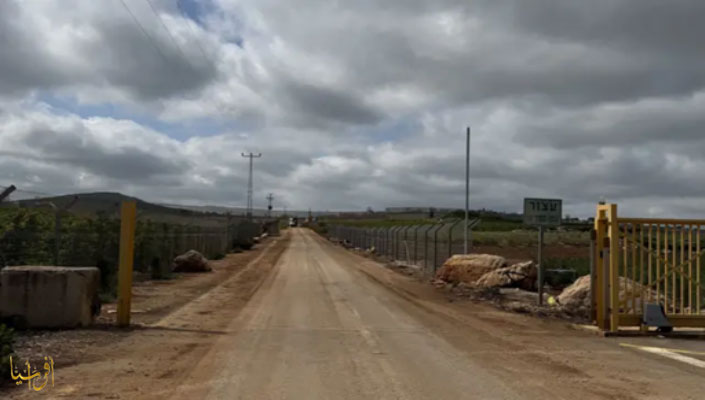
Afrasianet - For more than twenty-three years, Israeli civilians have not been able to reach the border line between Israel and Lebanon.
Today, arriving here is no longer just a field detail but a major shift in the nature of the border between Israel and Lebanon after months of war and escalation.
In Israel's northernmost part of the town of Metla, on the border with Lebanon, the entire landscape of the region has changed.
Destroyed homes, empty roads and large areas have turned into an open landscape of rubble, while Israeli towns are still trying to come back to life after a long evacuation and repeated strikes.
This change came after Israel took control of an area estimated at 10 kilometers or more inside Lebanon.
Military operations continue in southern Lebanon, which appeared to be "not included" in the U.S.-brokered ceasefire for weeks.
As we wandered through this border area, the first thing our eyes caught was the sprawling of destroyed houses in the opposite villages of southern Lebanon.
The wall separating the two sides does not obscure the scene of rubble and destruction, and it has not succeeded in containing the security situation or achieving a state of calm.
From "blue" to "yellow" line
For years, the "Blue Line" drawn by the United Nations after Israel's withdrawal from southern Lebanon in 2000 was the practical framework for separating the two sides, but the recent war has changed this reality, so that there is now talk of a yellow line separating the depopulated areas of the army control from the Lebanese areas where there is no Israeli control, and it refers to the borders of the security buffer zone, just as it happened in the Gaza Strip, where Israel named the line separating its forces from the areas controlled by Hamas the yellow line.
The Israeli military says its military presence there is aimed at establishing a security zone that would prevent Hezbollah fighters from returning to positions close to the border, but while there is talk of a buffer zone stretching several kilometers inside Lebanese territory, Israeli Defense Minister Yisrael Katz is referring to plans to control areas up to the Litani River and prevent the return of the Lebanese population to border villages until the security of northern Israel is guaranteed.
The Lebanese government and Hizbullah view this as a continuation of the occupation, a violation of Lebanese sovereignty and a violation of the provisions of the ceasefire.
Israeli forces occupied a "buffer zone" in southern Lebanon before the ceasefire took effect in April 2026, and according to Israeli newspapers including Haaretz, they are seeking to implement systematic demolitions in 55 villages.
The Israeli military says it is carrying out operations against the infrastructure of the Lebanese Hezbollah, which is listed as a terrorist organization by Israel, the United States and several other countries, including Arab countries, while the European Union only classifies the group's military wing as a terrorist entity.
This is the first time that IDF forces have remained inside Lebanese territory since the occupation of southern Lebanon between 1982 and 2000.
"We don't feel like there's a ceasefire"
In Metla, the sounds of explosions are still part of daily life in this border town, which has been one of the hardest-hit areas since clashes between Israel and Hezbollah began after the Gaza war began in October 2023.
Avi Nadeev, deputy mayor of Metulla, explained to BBC News Arabic that residents do not feel that there is a real agreement, saying: "We don't feel that there is a ceasefire for us, it is just ink on paper. The sounds of gunfire do not stop, whether from the Israeli army or as a result of operations inside Lebanon."
This feeling is inseparable from a long experience of evacuation and loss, according to Nadeev, who adds that this reality he lives today is very similar to what he witnessed 50 years ago when he was a young child.
At the time, residents were told to stay in their homes after 6 p.m. for fear of any military escalation or security risk, a reality that has not changed over the years from the city's vice president's point of view.
During the last war, tens of thousands of residents of the north were evacuated since its inception, several border towns were extensively damaged, and a large part of the population returned after the first truce following the announcement by Israeli political and military officials that the threat of Hezbollah no longer existed and that the towns in the north became safe, but after the return of war in the first week of March, many questioned these assurances.
A farmer who lost his home, land and friend
Lior Weinberg, an Israeli farmer from Metulla, makes the connection between security and daily life that has almost come to a standstill.
His home was hit by an anti-armor missile, and he has not returned to it yet. He also lost a farmer friend in a shelling close to his land.
For him, the issue is not just borders or military maps: Weinberg says that agriculture that was part of his life has been disrupted, trust in official statements has been eroded, and Weinberg describes what political officials are doing and what they profess as "lies and deception," saying that politics plays a big role in the deterioration of the security situation in northern Israel.
Speaking to BBC News Arabic, Weinberg noted that the political debate on security "does not reflect the reality on the ground," adding that the threat of missiles and drones still exists despite the presence of the Israeli army inside corresponding Lebanese areas.
He also believes that moving Hezbollah away from the border has mitigated some types of threats, but has not ended them, saying, "Thanks to the army and its presence there, we have not been exposed to anti-armor missiles as in the past, but we are still vulnerable to drones."
A suspended economy and absent tourism
The war has not only changed the security landscape, but it has also had a clear economic impact on hotels, restaurants, farms, and small businesses.
Inside a hotel that has been closed since 2023, the dust accumulating on furniture and hallways seemed to sum up the state of an entire sector, with the hotel's manager, Ilan Henig, telling BBC News Arabic that many businesses have closed, and that the return of customers and tourists is still a long way off.
This picture is supported by Israeli and international reports of a limited return of residents to the Metula and the continued closure of restaurants and businesses, despite government attempts to provide compensation and aid to the border areas.
In March, the Israeli Tax Authority announced the opening of applications for prepayments for economic damages in northern frontline towns.
Employers believe that compensation alone will not be enough to restore normalcy, as a hotel, restaurant or farm cannot operate smoothly in an area where residents hear the sounds of explosions and where return remains subject to military developments.
"Hizbullah is further than before, but no end to the war is imminent"
On the other side of the border, the humanitarian cost appears to be farther: South Lebanon's border villages have been heavily damaged, and there have been reports of continued Israeli raids and demolitions in several areas, including villages near the border.
The Associated Press also said that recent Israeli strikes in southern Lebanon have killed a number of people, amid Lebanese accusations that Israel has destroyed civilian and religious facilities, accusations that Israel has repeatedly said are linked to operations against Hezbollah infrastructure.
Prime Minister Benjamin Netanyahu and Defense Minister Yisrael Katz say Israel will not allow the Hezbollah threat to return to the border, and describe what is happening as a security necessity to protect towns in the north and prevent a recurrence of Hezbollah attacks.
But this situation opens up many questions: Is the buffer zone becoming a long-term reality? And what does this mean for the inhabitants of the destroyed Lebanese villages? Do the residents of northern Israel really feel safe, or do the new borders convey the danger rather than end it?
In Metla, the answer seems complicated: Residents see Hezbollah further than before, but they don't see an end to the war.
On the other hand, the Lebanese see destroyed villages and a delayed return.
The dividing line between Israel and Lebanon is no longer just a fence or a map, it has turned into an open area on questions of security, sovereignty and return, and on a new reality that has not yet been settled.

