
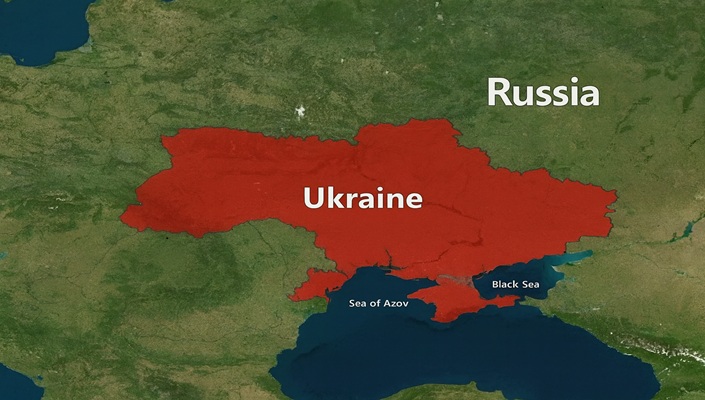
Afrasianet - Mazen Al Najjar - The outbreak of the war in Ukraine has revealed surprises and cracks in European construction. The war has taken Europe by surprise, and it looked different from what the world had known since the mid-20th century. It achieved peace among its nations out of the conviction that the wars of the industrial age were useless because of the casualties they expected in the tens of millions and total destruction, and they achieved stability, unity and prosperity at historic levels.
Europe's reaction to the Ukraine war was a coup against what it has learned from its history and conflicts, and it returned to the policies of militarization, wars and self-destruction, beat the drums of war and heavy armaments, armed Ukraine, and identified with the Biden administration's incitement to deepen the conflict, drain Russia and besiege it with the broadest economic sanctions in history, and brought down the curtain on the policies of openness and economic cooperation with its east.
In France, the concern came to a head when, on November 18, 2025, General Fabien Mandon, the (new) Chief of the Defence Staff, told a crowd of mayors that French society should prepare for the "loss of its sons" in a future conflict with Russia
Germany, the leader of the European Union, has lost its ability to lead and prevent the war from expanding and escalating. It could have led a position within NATO that avoided provoking Russia by entering Ukraine into the alliance, but it did not!
German writer and researcher Fabian Schidler warns that the European Union may be completely destroyed by being entrenched in a hard-line nihilistic stance toward Russia, but it is doing nothing to avoid the danger and stop the killings, but rather trying to undermine diplomatic efforts for a negotiated solution that would end the war. It was known from the beginning that Ukraine could not win the war, and that it had entered an impasse.
Russia offer no reason!
Recently, Europe's rising hysteria toward Russia reflects a desperate – even miserable – attempt by retreating and increasingly discredited European elites to salvage their failed strategy on Ukraine and their waning global influence.
In a study by the American political philosopher Paul Grenier and the Irish thinker Shane Fitzgerald, the researchers observed that the European political class was speaking of Russia in a tone of heightened metaphysical "panic."
The European Commission's mounting pressure on Belgium and Euroclear, which specialises in central capital and securities infrastructure – which holds some €200 billion of Russia's central bank's frozen assets to give up $140 billion – is quite remarkable.
This pressure comes despite the enormous legal, financial, and geopolitical risks and caveats to do so, and despite warnings from Euroclear's own leadership that such a move could destabilize global financial markets.
These actions reveal an unprecedented desperation to prolong a Ukrainian project that has failed to achieve any of its stated goals. Across the continent, officials are invoking the idea of collective sacrifice, spreading misleading historical narratives, and treating unconfirmed sightings of drones as evidence of hybrid warfare.
In France, the concern came to a head when, on November 18, 2025, General Fabien Mandon, the (new) Chief of the Defense Staff, told a crowd of mayors that French society should prepare for the "loss of its sons" in a future conflict with Russia.
These statements sparked a political firestorm. President Macron and his ministers were quick to confirm that French youth would not be sent to die in Ukraine, while General Mandon appeared on television to say that he was only meant to "alert and prepare" society for a "deterioration in security." Still, the symbol was unequivocally clear: a major European power normalizing the idea of a catastrophic military confrontation with nuclear-armed Russia.
Crowding and "panic marches"
The authors point to the emergence of the same psychological mechanism in a controversial claim made recently by Kaya Callas, the European Union's foreign policy chief: "In the last 100 years, Russia has attacked more than 19 countries. None of these countries have ever attacked Russia."
This claim is historically indefensible. The involvement of France, Britain, Canada, Australia, Japan, Italy, Greece, and the United States in the Russian Civil War in the early 1920s, and Nazi Germany's invasion of the Soviet Union in 1941 alone make this claim absurd.
European historians, some of whom are sympathetic to Callas's hardline stance, have reluctantly corrected this statement. But accuracy was never the end. The narrative was intended to mobilize, not to remind history.
Another manifestation of this claim is the "drone panic" sweeping the continent. Authorities in Germany, Denmark and Belgium have reported unidentified drones near airports, military bases and even nuclear sites. However, no video footage of these allegations has been published, any interceptions have been confirmed, or any evidence has been provided.
Belgian authorities have said they have been unable to identify who is responsible for flying the drones. Yet the authorities are hinting daily at Russia's involvement. The pattern is evident in the transformation of rumors into assumptions, and then into entrenched policies.
These events embody a profound transformation. Europe is not content with overreacting to Russia, but it is also dropping a crisis of self-confidence on Russia, using it as a cover or a hanger to cast its fears, failures, and internal divisions on it.
Imminent Ukrainian defeat and European panic
Grenier and Fitzgerald attribute Europe's growing panic toward Russia to three overlapping developments that deal a fatal blow to its strategy toward Ukraine:
• First, European elites now fear that they will be excluded from the peace deal. With growing signs that Washington and Moscow may explore a direct negotiated settlement through back channels, and with President Donald Trump increasingly frustrated with Kyiv's obstruction and hardening Europe's hardline stance, the United States, Ukraine, Britain, and the European Union are quietly sidelining.
For Brussels, Paris, Berlin, and London, the nightmare is not a US "withdrawal", but a US deal in which Washington ends the war on terms that give Moscow significant gains while forcing Europe to pay for a settlement that it had no role in drafting.
If such a U.S.-Russian peace deal materializes, it would be a major diplomatic affront to Europe since the 1956 Suez Crisis.
• The second development, which is also spurring the fledgling U.S. diplomatic endeavors, is the imminent defeat of the Ukrainian army on the battlefield as the Russian military advances in all sectors of the front. Russia's industrial development has led to overwhelming superiority in artillery, drones, missiles, and manpower.
Ukraine's defense lines are dwindling, mobilization is collapsing, and key defensive positions are in danger of collapsing. Even Western military assessments now acknowledge that Ukraine may not last long. Europe is aware that strategic defeat is not only possible, but inevitable!
• Third, the disintegration of Ukraine's political fabric. A series of corruption scandals, resignations of ministers, and, most recently, the departure of Andriy Yermak, Volodymyr Zelensky's most powerful adviser and gatekeeper, have shattered the moral narrative that European elites have relied on to justify war for their people.
Western intelligence leaks and European press reports are now publicly revealing systemic corruption, divisions, and forced mobilization inside Ukraine. What used to be marketed as a democratic bastion is increasingly seeing a war regime collapsing and losing control of its inner circle.
Taken together, these developments explain how European discourse is becoming hysterical. The diplomatic track is slipping out of Europe's hands, the political partner it invested in is falling apart, and the military front it has bet on is failing.
Europe's fear is not of Russian expansion, but of its exposure, marginalization, and forced to face the collapse of a project on which it has bet on the legitimacy of its existence.
Global Strategic Setbacks
According to Grenier and Fitzgerald, European hysteria toward Russia cannot be fully understood without realizing the decline of parallel European influence globally.
In Africa, the "France Africa" system collapsed with astonishing speed. Mali (2022), Burkina Faso (2022), Niger (2023), and others expelled French troops, reneged on defense treaties, and denounced Paris for its neo-colonial behavior. Russia, China, Turkey, and the Gulf states replaced Europe in the areas of security, mining, energy, trade, and media. France's grand mission to stabilize the Sahel region ended not in victory but in humiliation.
Strategically, the European Union has become a periphery in the Middle East. Gaza's diplomacy is managed by the United States, Qatar, Egypt, and Turkey, not Brussels or Paris. The Saudi-Iranian rapprochement has been engineered by China. Europe, once the maker of mandates and protectorates, has become a mere bystander without influence.
In Latin America, the long-awaited EU-Mercosur deal is decades late. China has already overtaken the EU as the region's largest trading partner and investor. Brazil, Argentina, and Mexico are increasingly treating the EU as a "regulatory" barrier rather than a partner.
In Asia, Europe's Indo-Pacific strategy has become symbolic: a few frigates and a few statements. The real structure of AUKUS, the Quadrilateral, the US-US-Japan, Korea, and the Association of Southeast Asian Nations (ASEAN) is moving forward without Europe's involvement.
Across the Global South, Europe has lost influence in the narrative and management of events. Countries from Brazil to South Africa to Indonesia have publicly criticized the EU's "double standards" on Gaza, Ukraine and sanctions.
Many countries reject the EU's attempts to weaponize trade and climate norms. The expansion of the BRICS group and the rise of non-Western financial instruments (such as the BRICS payment system, the Chinese payment system CIPS, and the Indian payment system RuPay) are weakening Europe's structural leverage.
This global erosion is exacerbating the hysteria of European elites. Russia is becoming a symbol of a broader realization that the EU is no longer respected and respected by spontaneity, moral authority, or strategic centralization.
The authors also monitor the decline of Europe's influence as a result of population shrinkage, which is quietly panic among elites. Shrinking workforce, an aging electorate, and falling fertility rates in Europe make long-term military mobilization and rearmament industry nearly impossible. Calls to "sacrifice our children" therefore seem desperate, simply because Europe has far fewer children.
A failed global vision
As Ukraine faces military defeat and the Zelensky regime disintegrates, the gap between official Western narratives and concrete reality will become irreconcilable. This has three main consequences:
• The European public has been told that Russia is isolated, bankrupt and militarily incompetent, while Ukraine is capable of achieving a decisive victory. Any very different outcome will lead to a breakdown of confidence in the main parties and EU institutions.
• The second is political fragmentation. The exchange of accusations will fragment the bloc. Eastern Europe will blame the hesitation of its west, while Western Europe will blame the hardliners in the Baltic states and Poland, and southern Europe will blame the North's economic inertia.
• Third, extremism, some elites will insist on their position, demanding a permanent confrontation with Russia. Others, especially European industrialists, farmers, and energy-intensive sectors, will demand international détente and economic realism.
Europe will have to choose between accepting a multipolar reality or clinging to the illusion of moral superiority and global jurisdiction and geopolitical centralism, which it illusions after 1991. The first option provides a difficult adjustment that could bring stability, while the second option ensures continued deterioration.
European hysteria toward Russia is the latest stage in a failed global vision of a continent whose elites have misunderstood the balance of power, excluded the Global South, sacrificed its economic base, and linked itself to American strategic fluctuations.
As the fate of Ukraine unfolds and Europe's influence continues to erode globally, the EU faces a crucial choice: renewal through realism, or decline through denial. All indications on its current trajectory are that it has indeed chosen the latter.

