
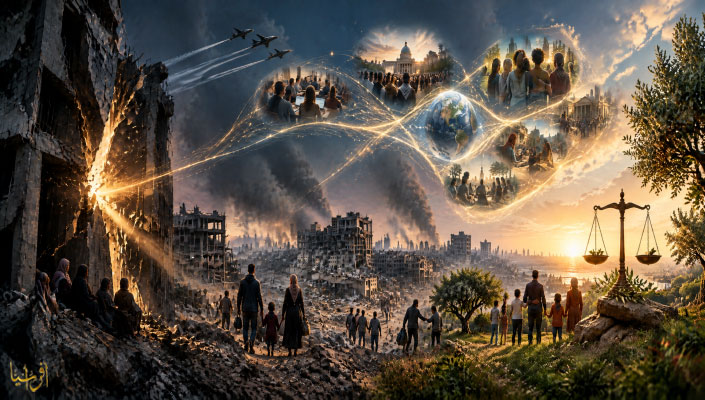
Israel's war of extermination is embodied in the Gaza Strip
Then he understands the present as a presence and not just as a time, and asks man to be imprisoned in it, not imprisoned in it."
Afrasianet = Haneen Zoabi - In her recent article, Gaza as a World Event, Nancy Fraser argues that Gaza has exposed a deep crisis in the moral and political order that has dominated the West since the 1970s, opening up a historical possibility that is no longer impossible.
Zionism, implicitly as in Fraser and explicitly as in others, or, in the terms of some literature, the "idea of Israel," lies at the heart of the grand concepts being revised, and at the heart of the current moral question facing the world, and the answer to this question is "what will reshape the future."
In the context of these transformations or "revelations," Zionism is no longer only discussed as a "project", questions that were not raised about Israel are now being raised, i.e., the state has deviated from the list of natural questions and natural scenarios that are usually raised vis-à-vis states.
In the same mood, Israeli historian Amos Goldberg, a specialist in the history of the Holocaust and genocide and one of the most prominent Israeli voices calling for the need to recognize the genocide not as an event but as the logic of Zionism, argues in an article published in Haaretz in August 2026 in response to Yigil Levy that "the term 'genocide' refers not only to deep moral, political, and cognitive destruction, on a historical scale," but also to "an event that will continue to haunt Israeli, Jewish, Palestinian, and world history for many years; and it refers to an uncompromising demand for responsibility, justice, and historical recognition of injustice."
These writings represent a mood that is also popularly embodied in images of Palestine in songs, stadiums and universities, and this represents more than just an individual emotion, it is a global moment, a moment of perception and a sense structure that changes not only in the direction of the Palestinian right and the duty of the moment to stand in solidarity with him, but also towards the global danger of the Israeli exception, and of Zionism as a colonial system and as a world order.
This article and the one that follows argue that capturing this moment is the horizon of any political activity, and wasting it is a disavowal of the genocide even if we do not deny it, and the disavowal of the genocide and not just acknowledging it or not denying it is what we must look for within any political activity, in order to know not only its moral position but also its political effectiveness, when the extermination of Gaza turns into a global event that reshapes the political system in what comes after it, no political activist can escape its commitment to the political horizon that was set by that moment, as the genocide is not just an event that demands recognition of its occurrence, the annihilation is a moment of reality that determines the political horizon of what we do or think we are doing.
In the essay cited above, Goldberg argues that acknowledging the genocide means acknowledging that it is part of the "story of Zionism," arguing, "We also have to examine the roots of our existence, the path of Zionism and the State of Israel since the Nakba, and indeed the modern history of the Jews." It is true that Goldberg is talking about a "way" and not an "essence," but the intellectual and moral integrity that I think he possesses will continue to shake him.
Setting off and fulfilling this global mood around "Zionism" is not only a moral demand, but also the political horizon available to a world that does not really want to deny genocide.
It is a moment of deep conceptual upheaval that occurs after existential and emotional assimilation, and not only as a political and moral position without the possibility of continuing. Solidarity with Gaza becomes an objective reading of the prospects of a historical moment, the moment when the big "realities" return to politics.
"After October 7 is not the same as before", is not a sentence that we say to emphasize that we are not fools, and it is not an idea that only means that reality has changed, but it is an idea that means that the previous dialectics that were adopted to build our narratives and effectiveness on the ground are over, and it is no longer possible to build citizen policies or others based on contradictions that we had adopted to build our effectiveness and perceptions as a whole, and the continued dependence of our effectiveness on contradictions and arguments that no longer exist is a denial of reality, and a moral withdrawal from its new obligations and costs.
This is not a perception about the "end of history", because the moment of Gaza, which ended old dialectics, is the same one that opens a new political horizon and new dialectics.
"After October 7 is not the same as before" is not a sentence that we say to emphasize that we are not fools, but rather a profound description that also applies to those who are afraid of revisions.
The expiration of the old narratives will shake political subjects who believe that they are still exercising their former role, and that they are still carrying their previous narratives, oblivious to the fact that the new reality will change the meanings and costs of those expired narratives, and they will not do so without the price of changing the subjects themselves.
The Political Discourse of the Interior: In the Dichotomy of Recognition and Disavowal
This article claims that at a time when the genocide is shaping a global historical moment, not in the sense of its occurrence or catastrophe, but in terms of its cognitive and political impact, and at a time when the genocide is forming a global discourse based on the recognition of the essential relationship between Zionism and the genocide, and the political effectiveness that this exposure requires centered on the need to hold Israel accountable and fight the exceptional immunity it has granted, a Palestinian political discourse and effectiveness at home is actively and frantically working to rehabilitate Israel and restore normal relations with the Israeli space and society, under the logic of "protecting the interior" from extermination.
In a sense, the interior places the definition of "protecting the Palistian" in stark contrast to a global historical moment that is also trying to protect the Palestinian. Surprisingly, and in other words, the interior is doing this disavowal of the global moment at the same time that it celebrates and admires it. This disavowal is not a passive repudiation, it is as I said: a frantic disavowal that leads to the aborting of the moment.
Alenka Zibanovic distinguishes between recognition and commitment, or between denial and disavowal, and this distinction helps us to understand the difference between, say, the classic state of denial carried out by Israeli liberals, and the Palestinian case based on support for genocide deniers, as such support represents a "way out" for Palestinians at home, and enables us to imagine a shared political destiny with genocide deniers in the face of the perpetrators of genocide.
We cannot accuse this Palestinian discourse/mentality/state of feeling of denying genocide, as it has been engaged, until the elections, "to the best of its ability" in making it clear that what is happening is genocide, and in demanding that Israel be condemned and punished, within limits, let's say a controversy, imposed by a state of Israeli intimidation and terrorism.
But what Zibanovich says is that there is a case of disavowal based specifically on the confession, a case in which the confession itself has allowed the repudiation to have the effect of the confession, that is, the more you confess, the more you feel that you can repudiate, which is what we can call an ineffectual confession.
Zibanovich calls the ineffectual recognition of major events a disavowal, in which the political self acknowledges the event, and at the same time withdraws from its obligations to it. Zibanovich points out that this repudiation is not an individual reaction, but a collective cognitive-political structure.
The problem with the popular discourse inside the country is not that it wants to survive, but that it does not link its survival to the political horizon of the moment, but to narratives built on Israeli dialectics and contradictions that Israel has expired on the other hand, and it does so not because of its ignorance of the changes of the Israeli reality and the blockage of its horizon, and the transformations of Israeli society towards absorbing the genocide as part of its cultural and psychological component and even as part of its new identity, but because of an emotional structure and deep existential stakes, and we will come to this point in the next article.
What makes genocide a revealing moment is not because it illustrates political and moral positions, but because it illustrates something deeper than mere political and moral positions.
The moment of Gaza is not a moment that you recognize and move on, but a moment that you acknowledge and change, otherwise you would not have recognized. Genocide is not something that shocks you and leaves you as you are, but a moment in which you live the shock of external collapses as internal collapses, otherwise you are outside of them and outside the history you are trying to shape.
Hence, the political response to the genocide cannot depend on anger, sadness, or the quest for survival, because the political and moral response to an event of the genocide of a people means loyalty to the horizon revealed by all the sacrifices and collapses that have occurred.
Within this horizon, it is possible to judge the effectiveness of a discourse that bases its logic on the slogan: "Between apartheid and extermination, we choose apartheid."
This trade-off is understandable and morally justified, but it is separate from the moment and from the genocidal reality it reveals, in which the culture and institutions of apartheid embrace and transforms extermination into an imminent possibility, a constant threat, and therefore it is detached from the political impact of this knowledge.
The problem with this discourse, then, is not that it wants to survive, but that it is born without the political horizon of its effectiveness, and lacking what the moment of extermination revealed: there is no safety and no survival for the Palestinian people with Zionism.
His problem is that he is born as the antithesis of the political horizon that the moment is proposing, a horizon that in order to be realized, it must be based on several things, including: frankly telling our people about the end of the dialectics on which we have built our understanding of our reality and our struggle, the dialectics of the contradiction between identity and citizenship, building a state of self-protection and alliance through the fact that anti-Zionism is clear and unreasonable, supporting a state of political instability in the Jewish state, refusing to participate in any activities in which Israel, its universities and centers participate internationally, and demanding that Israeli "partners" confront their society with the need to recognize genocide as the reality of Zionism, and demand that they engage in boycott and isolation campaigns against the Jewish state.
This is the possible political horizon, and this is loyalty that is not only understood as moral fulfillment, but as a fusion with a horizon in which survival is possible and meaningful.
________________

