

Composition, poetry, cinema and music.. "Palestine Moments" in Paris (Afrasia).
Afrasianet - The event combines an international conference, a fine arts exhibition, poetry and music evenings and a film screening, with the aim of shedding light on the humanitarian, cultural and environmental dimensions of the Palestinian cause, and opening a debate on the destruction of the land and the environment in Gaza and its relationship to the genocide.
Under the slogan "On this earth what is worth living", a cultural, artistic and academic event entitled "Moments of Palestine" continues at the University of Paris VIII in France, bringing together Palestinian and international artists, researchers and musicians, to discuss issues of land, memory, displacement and resilience in light of the Israeli war of annihilation in Gaza.
The event, which kicked off on Tuesday, combines an international conference, a plastic arts exhibition, poetry and music evenings, and a film screening, with the aim of shedding light on the humanitarian, cultural and environmental dimensions of the Palestinian cause, and opening a discussion about the destruction of the land and the environment in Gaza and its relationship to genocide alongside Palestinian steadfastness.
The activities opened on Tuesday with research sessions on the relationship between the Palestinian man and his land, the memory associated with the place, and the environmental repercussions of the war, with the participation of Palestinian artist Hani Zoroub, Palestinian sociologist Abher Al-Sakka from Birzeit University, researcher Jumana Bawazir from the Forensic Architecture Foundation in London, and historian and anthropologist, Stephanie Lat Abdullah.
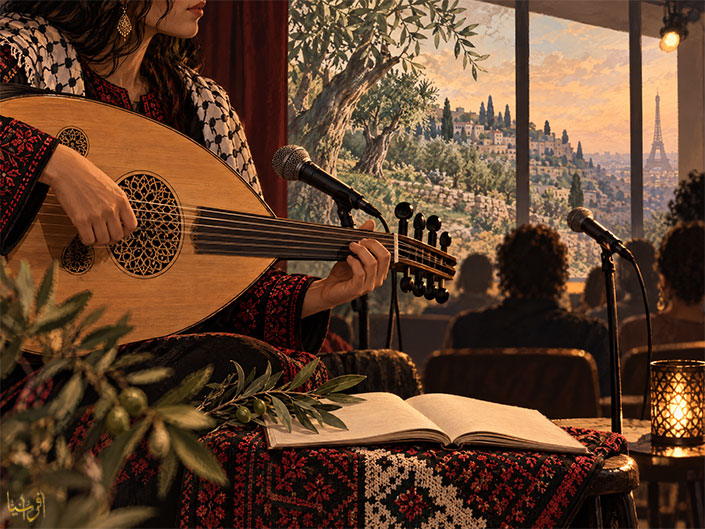
Other sessions also discussed the role of music and poetry in preserving the Palestinian identity, with the participation of musicians Camelia Gibran and Christine Zayed, in addition to a round table that dealt with forms of artistic solidarity with Palestine in France, interspersed with Palestinian songs presented by the artist Abeer Hamad and the musician Nazir Bouabid.
The university library witnessed the opening of a plastic exhibition that includes the works of 18 artists, including: Maysara Baroud, Raed Issa, Hani Zoroub, Mahmoud Al-Hajj, May Murad, and Nasser Al-Sumi.
The exhibition, which runs until November 12, explores Palestinian memory, experiences of loss, displacement and resilience through a variety of artworks.
The opening included the recitation of poems by the Palestinian poet Duha Al-Kahlout in Arabic, with readings translated into French, in addition to a concert by Christine Zayed, with the participation of the Eighth University of Paris Choir.
The activities continued on Wednesday with sessions focusing on the audio memory of the Gaza Strip, including an intervention entitled "The Original Recording: Audio Memories of Gaza", presented by sound engineer Mohammed Yaghi and researcher Od Forel, which examines the role of sound recordings in documenting Palestinian life and memory.
Other sessions will also address the experiences of Palestinian musicians in exile and the relationship between art and place and uprooting, in addition to an intervention by the writer Hassan Abu Nada and the sociologist Nasira Qaneef entitled "Gaza makes its way in the rock in order to survive."
In an intervention titled "Gaza Poetry: Housing and Resistance", researcher Munira Shati discusses the role of poetry in expressing the Palestinian experience in the Gaza Strip, while researcher Dorok Zaponian presents an intervention on the visual representation of destruction and the potential of the image in documenting scenes of extermination and destruction, before concluding the event with the screening of the documentary film "Jenin Jenin" by the late Palestinian director Mohammed Bakri, at the "Lycran" cinema in honor of his cinematic career.
This event comes as an extension of the series of "Palestine Moments" events organized by the University of Paris VIII, in an effort to combine academic research and artistic expression, and to highlight the role of Palestinian culture in preserving memory and confronting attempts to erase identity, especially in light of the war of extermination in the Gaza Strip.

