
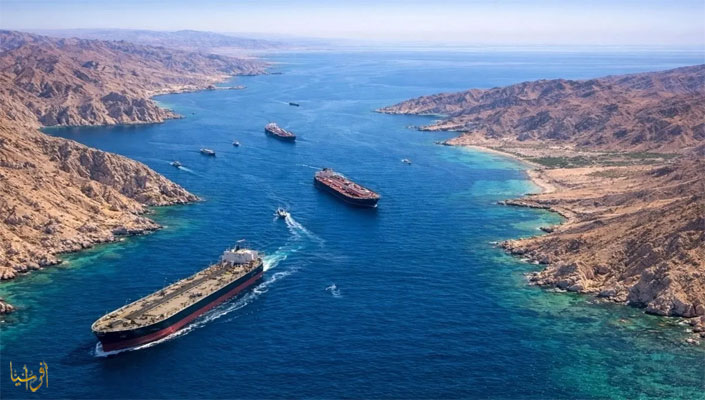
Hormuz: The Strait that was open to freedom of navigation before the war.
Afrasianet - President Donald Trump has plunged the United States into a war he has chosen to fight against Iran, a war he cannot easily win, and from which he simply cannot withdraw.
This war, as Trump has described it, was supposed to be just a "short walk" that will end in a few weeks, but it has now entered its seventh month with no sign of its end.
Trump has stated that he is willing to allow the conflict to continue for as long as it takes, in order to force Tehran to reopen the Strait of Hormuz (which was open to freedom of navigation before the war began) and negotiate an agreement on its nuclear program (despite expert assurances that Iran was not about to develop a nuclear weapon before the war began).
Both sides are currently in a dangerous stalemate, punctuated by intermittent bouts of fighting.
The two sides have traded strikes this week, with the United States targeting Iran's Lark Island, while Iran's Islamic Revolutionary Guard Corps (IRGC) has responded with attacks on U.S. bases in the region.
At the same time, there are no real negotiations aimed at a peaceful settlement of the conflict.
Repeated claims of victory: When Trump began this war in late February — at the primary instigation of Israeli Prime Minister Benjamin Netanyahu — he and his defense secretary, Pete Hegseth, repeatedly stressed that it would not be long or costly.
He also harshly criticized former U.S. leaders for implicating the United States in protracted wars. But Trump acted in a strategic vacuum: his administration underestimated the Iranian regime's resilience and readiness to confront the U.S. threat, nor did it expect external aggression to unite and cohesive Iranian society.
However, Trump repeatedly claimed a military victory, declaring that Iran's defensive capabilities had been destroyed, and that the United States had forced Iran, through intense strikes, to accept a peace deal.
But this claim was premature: Tehran had not only maintained and rebuilt its offensive capabilities at a faster pace than expected, but had also tightened its control over the Strait of Hormuz, using it as a vital leverage against the United States and the world. By May, the tide had tipped in Tehran's favor, which had no desire to negotiate a deal that did not meet its main demands, which included:
- A ceasefire on all fronts (including the Israeli attack on Hezbollah in Lebanon).
- Release billions of dollars in frozen Iranian assets.
- Obtain war reparations.
- The right to administer the Strait of Hormuz.
These demands were included in a memorandum of understanding Trump signed in June with Iran's leadership, which was then dominated by hardliners from Iran's Islamic Revolutionary Guard Corps (IRGC).
Because the deal was in Tehran's interest, Trump could not sustain it for long. As pressure mounted from prominent Republicans and from Benjamin Netanyahu, Trump backed away from the deal and launched new attacks.
Tehran, for its part, made no effort to salvage the deal; it was in its interest to inflict as much political damage on Trump as possible.
Since then, Trump has reimposed a U.S. blockade on Iranian ports aimed at depriving the Islamic regime of oil revenues, and has launched intermittent military strikes to intimidate Tehran. Still, stalemate remains the norm
"Economic Landing Day ":
As the midterm elections approached, the Trump administration last week announced what it called "Operation Economic Outcast," a wide-ranging sanctions package aimed at economically strangling Iran and isolating it internationally.
Treasury Secretary Scott Bisant has called the move an "Economic D-Day." However, this policy is unlikely to force Iran to capitulate, for a variety of reasons. None of Iran's neighbors—led by Pakistan, Iraq, and Turkey—have yet announced their intention to enforce these sanctions.
The only Gulf state that has suspended its financial transactions and trade with Iran is the United Arab Emirates, due to its close coordination with the United States and Israel.
As history shows, sanctions have rarely worked as a leverage tool; perhaps the only time they have proven effective was when they were imposed uniformly and comprehensively against South Africa's apartheid regime.
Iran's Islamist regime has successfully circumvented U.S.-led sanctions for most of its 47 years in power, through self-reliance and diversification of its trading partners.
Although the Iranian people have borne the brunt of these sanctions, the regime has held out.
While the Trump administration's new sanctions will cause immense suffering to the Iranian economy and people, the regime is likely to still be able to protect itself.
The Path to Solution The two sides cannot allow this confrontation to escalate again or slide into a new armed conflict. Nor can the Strait of Hormuz be kept closed, given the high costs it could incur for regional and global economies.
Tehran and Washington should return to the memorandum of understanding signed in June and engage in direct negotiations to reach a final settlement. Mediators from Pakistan and Qatar are still working to bring the two sides closer together.
There is also a desire on the part of the Gulf states to end this conflict, as they are already beginning to look to the future, to treat Iran as a powerful regional actor, while reducing their dependence on the United States as their main security guarantor.
No wonder Saudi Arabia, the richest of these countries, recently struck a mutual defense agreement with both Turkey (which has one of the strongest militaries in NATO and the Middle East) and Pakistan (the only country in the Muslim world to possess nuclear weapons).
Other regional states—Egypt in particular—have considered joining the deal, and Iran has also welcomed it. Although the future remains very uncertain, diplomacy remains the only way to end the war between the United States and Iran. It is a very difficult task, but it is still possible.

