
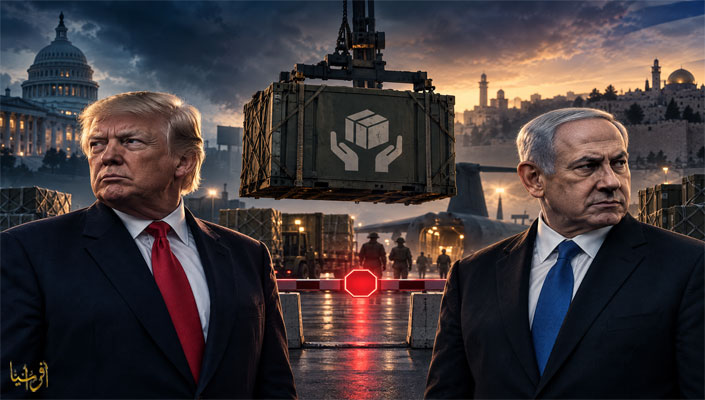
Afrasianet - Raeda Saliha - U.S. President Donald Trump's announcement of his intention to halt annual military aid to Israel by the end of this year has been met with widespread skepticism and criticism from human rights organizations, analysts and political figures, as an electoral maneuver aimed at absorbing the rising anger over Israel's continued funding and armament, without actually meaning an end to U.S. military support for Israel.
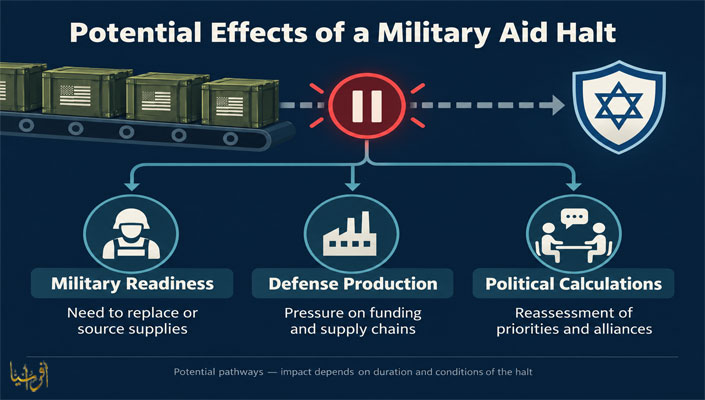
Critics have argued that the announcement, which came on the morning of the midterm elections, may be an attempt to give voters the illusion that Washington is moving to cut off aid to Israel, while the administration and its allies in Congress are working to pass legislation that would allow that support to be transferred to new forms of military and technological cooperation, away from traditional funding mechanisms and associated oversight.
The Middle East Institute's (IMEU) Policy Project called Trump a "serial liar," noting that since taking office, he has announced more than $20 billion worth of weapons to Israel. He said the president and his allies are aware that taxpayer-funded funding of Israel has become a political burden and are seeking to pass legislation that hides this support by integrating Israeli arms companies into the Pentagon.
The institute added that this step represents a process of substitution and camouflage of military support, which would lead to US funding of Israeli arms manufacturers in record amounts, rather than providing direct and public aid.
The AIPAC Tracker, which tracks money received by U.S. politicians from the American Israel Public Affairs Committee (AIPAC), called Trump's announcement a "misleading hype" aimed at making voters believe the president turned off the aid faucet, while the administration and Congress seek to replace it with a fusion in military technology.
The Washington-based Council on American-Islamic Relations (CAIR) also questioned whether the announcement would lead to a halt to Israel's armament, stressing that ending free military aid does not mean stopping U.S. arms sales to Israel.
The organization said that the sale of US weapons to a foreign government involved in war crimes is no less morally and legally dangerous than providing them for free, stressing the need to stop arming the Israeli government and end all forms of support that enable it to continue its wars and violations.
Defense analyst William Hartung said Trump's announcement "may be less significant than it seems," explaining that its timing represents a political blow to Israeli Prime Minister Benjamin Netanyahu, who is struggling to form a coalition that ensures he stays in power, but may not ultimately change the amount of U.S. money flowing into Israel.
Hartung noted that Congress is discussing legislation that would open the way for the joint development of U.S. and Israeli weapons in a wide range of areas, which could allow the continued flow of U.S. money into Israel's military industries, even if the mechanism for providing them changes.
One of the most prominent points of doubt is Article 219 of the draft National Defense Authorization Law for the fiscal year 2027, which provides for the establishment of a defense technology cooperation initiative between the two countries, including research, development, and co-production in the fields of missile defense, drones, artificial intelligence, and cybersecurity.
Dozens of human rights and civil society organizations called on Congress last September to drop the provision, warning that it would deepen the integration of the U.S. and Israeli defense industries and provide new channels for military cooperation at a time when the U.S. public increasingly rejects unconditional support for Israel.
Trump said in the interview that Israel can buy U.S. weapons as it wants, stressing that Washington will continue to help it if it needs them, which has reinforced criticism that the announcement is more about changing the form of funding than about a shift in U.S. policy toward Israel.
The declaration also faces a legal and political hurdle, as the memorandum of understanding signed in 2016 provides for $38 billion over ten years, and extends until the end of fiscal year 2028. Any change in annual funding requires congressional approval, and the president alone cannot automatically terminate scheduled fiscal commitments.
In Israel, the timing of the announcement has also raised questions. Former Israeli ambassador to Washington Michael Oren called the timing a "very opportunistic move" by Trump, while Israeli officials and experts argued that ending aid may not necessarily threaten Israeli security, but the surprise announcement raises concerns about Israel's place in U.S. policy.
Trump announced his decision during a phone interview with Fox News on Tuesday, saying he had reached an agreement with Netanyahu months ago to end about $4 billion in annual aid, adding that Israel had become a successful country and no longer needed the money.
Trump explicitly linked the decision to the political criticism Republicans are facing for supporting Israel, referring to Democratic Senate candidate Abdulrahman al-Sayed of Michigan, who has made cutting aid to Israel one of the centerpieces of his campaign.
But the existing U.S.-Israeli deal, struck under former President Barack Obama, provides for $38 billion over 10 years, including $33 billion for military funding and $5 billion for missile defense.
Netanyahu has previously spoken of his desire to gradually reduce Israel's dependence on U.S. aid over a decade and move from the status of a recipient country to a military and industrial partnership with Washington, which raises questions about whether Trump's announcement represents an actual end to the subsidy or a reformulation of it in a different context.
Greene: Trump's announcement of the cessation of aid to Israel reveals the extent of the decline in public support for this policy
Former Republican Rep. Marjorie Taylor Greene said Tuesday that U.S. President Donald Trump's announcement of his intention to halt U.S. aid to Israel reflects "how bad the poll results are" on the issue, referring to declining public support for continued U.S. support for Israel.
"Trump's approval of Israeli Prime Minister Benjamin Netanyahu to end annual aid to Israel will not change the outcome of today's election," Green wrote in a social media post.
She added that the move "will not end the war with Iran, nor will it stop Israel from killing innocent Palestinians," but it reveals "how bad the poll results on this issue are."
Greene recalled last year's attempt to pass a House amendment to stop funding Israel, noting that the amendment failed after only six members of Congress, including herself, voted in favor of it.
She said she was then subjected to accusations of anti-Semitism because of her stance, adding, sarcastically: "It's amazing how the Republicans are so close to a crushing defeat in the midterm elections that change hearts and minds."
Greene resigned from Congress earlier this year following a row with Trump over her criticism of his handling of the cases involving Jeffrey Epstein, a convicted sex offender who died and what she saw as the president's failure to focus on lowering the cost of living.
A Reading of the Extent of American Support for Israel...
The Israeli newspaper Yedioth Ahronoth said that US President Donald Trump announced yesterday that he would stop US aid to Israel, amounting to $4 billion annually, by the end of this year.
The decision ends a chapter in which Israel has been the largest recipient of U.S. foreign aid since World War II.
It noted that the current memorandum of understanding was only supposed to expire in 2028 and that the Israeli Finance Ministry was surprised by these statements.
Israel's Yedioth Ahronoth newspaper said U.S. aid began in 1949, one year after the state was established through a $100 million loan from the U.S. Export-Import Bank.
For almost two decades, this support has been modest, mostly in the form of loans, noting that Israel's main military sponsor in those years was France, which provided it with advanced military equipment and technology.
In 1968, one year after the Six-Day War, the Johnson administration approved the sale of Phantom jets to Israel, setting a precedent forAmerican support for Israel's qualitative military superiority over its neighbors after America entered the vacuum left by France under de Gaulle.
The Israeli newspaper Yedioth Ahronoth said the big turning point occurred in 1971, when Israel began receiving massive economic aid grants and Congress for the first time in its legislation allocated an amount to Israel.
Two years later, the Yom Kippur War of 1073 broke out with Egypt, with President Richard Nixon asking Congress on October 19, 1973 for $2.2 in emergency aid to compensate for the Israeli army's losses and to balance Soviet armaments for Egypt and Syria.
Of this amount, $1.5 billion was allocated in military grants, the largest grant package Israel has received so far, while the rest has been granted as loans, and since that war, organized efforts began in America to mobilize bipartisan support in Congress for aid to Israel.
The Israeli newspaper Yedioth Ahronoth said that the peace agreement with Egypt in 1979 opened a new era, as the United States transferred $7.5 billion to the two countries by a ratio of 3 to 2 in favor of Israel in order to enable the collapse of the state of war and the withdrawal from the Sinai.
For many years, economic aid helped prop up Israel's struggling economy, but in the 1990s, with the rise of the high-tech sector, the picture changed, noting that in his first term, Netanyahu announced in a speech to both houses of Congress in July 1999 that Israel would begin to gradually reduce economic aid.
She pointed out that since 1999 economic aid has been reduced by $120 million a year and military aid has increased by $60 million a year, and in 2008 Israel stopped receiving economic aid grants, and since then almost all support has been military.
Israel's Yedioth Ahronoth newspaper said aid had been limited since the late 1990s in a decade-long memorandum of understanding, with the first covering the years from 1999 to 2008 under the Clinton administration and guaranteeing at least $26.7 billion.
In 2007, the George W. Bush administration agreed to a $30 billion military package for the period from 2009 to 2018, allowing Israel to spend up to 26.3 percent of the money on purchases in domestic industry.
She pointed out that on September 14, 2016, the Obama administration signed the current memorandum of understanding worth $38 billion for the period from 2019 to 2028, including 33 billion military grants and 5 billion for missile defense, and this memorandum gradually eliminates the possibility of purchasing from Israel, so almost all the money is directed to the purchase of American products, which harmed the Israeli security industry, and in parallel, America has financed missile defense systems, as it has transferred since 2011 more than $6 billion to the Iron Dome alone, financing batteries, interceptors, co-production and maintenance, and is also a partner in the development of an arrow and a magic rod.
Israel's Yedioth Ahronoth newspaper said that after Oct. 7, the Biden administration decided to provide one-time aid worth about $14 billion, which later increased to $17.6 billion, and in fiscal year 2014 alone, according to congressional data, Israel received $12.5 billion, more than three times what it received the previous year.
According to the US Congressional Research Service, about $175 billion was transferred to Israel in nominal terms from 1946 to 2025, including about $124.5 billion in military aid, $34.3 billion in economic aid, and $16.1 billion for missile defense.
She pointed out that the amounts jump significantly when adjusted for inflation, as State Department data indicates about $298 billion in 2024 values, and according to the US Council on Foreign Relations, which also includes missile defense funding, the value is about three hundred and thirty billion dollars.
The Israeli newspaper Yedioth Ahronoth said that this era is now coming to an end, with Netanyahu telling The Economist magazine in January that he would not ask for a full renewal of the package and that he wanted to reduce aid within a decade, and that a partnership agreement is being negotiated between the two sides to replace the memorandum of understanding and that budgets are likely to be directed to joint security research and development.
The open question is whether this will happen in 2028 as planned or next year as Trump has announced.
Aid to Israel has become a controversial topic in recent years in America, with the progressive wing of the Democratic Party demanding that it be reduced, while part of the Republican camp opposes continued foreign funding from U.S. taxpayers.
The Israeli newspaper Yedioth Ahronoth said Trump could now offer his constituents billions of dollars in cuts in foreign spending while Netanyahu proposes a transition from U.S. dependence to security independence.
The Hebrew newspaper added that high-ranking economic sources in Israel told the Hebrew Health website that if Trump's statement is true, it represents a very dangerous decision for the Israeli treasury, noting that the waiver of two years of US aid means $8 billion, and asked where this amount came from, stressing that it would come from taxes on citizens.
A senior economic source angrily pointed out that it was Democrats who are allegedly hostile to Israel's aid that generously gave the subsidy while Trump and Republicans rescinded it, saying Trump's announcement today at a time when tens of millions of Americans elect their representatives to Congress is in fact an election propaganda move.
Source: Agencies - Yedioth Ahronoth newspaper

