
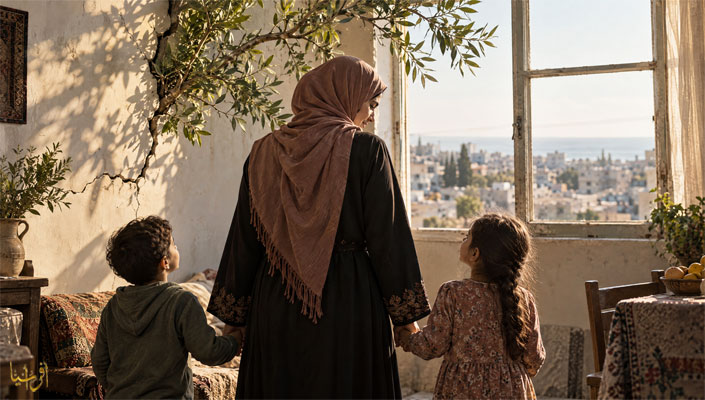
Afrasianet - Maryam Mashtawi - The woman puts her palm on her face. Perhaps she is trying to bring her tears inward, to the place where things that can no longer be said accumulate. Beside her, two children raise their eyes to her.
They are waiting for her face to be revealed, to shine with a small smile, to rearrange the world in a word, after the world has become wider than they can bear, and narrower than their loneliness.
She is their aunt. Their mother's sister who was killed by Israeli shelling in Gaza, along with their father and brothers.
This is how the tragedy is summed up in a line, while a woman needs another life to understand how her sister was absent and her children kept calling.
Sisters have a language that grows with them and no one pays attention to it.
A tone from which one knows each other's fatigue, a laugh that carries their childhood, and a small reproach that does not spoil love. When a sister dies, a witness of age is absent with her.
Someone who knows who we were before we learned to hide our weakness. How can a woman endure this absence, and then rise up to be the beginning of life for her sister's children?
She says that her nephews are a piece of her heart. I think of the heart when it becomes a place for others, how it manages its distress, and how it makes room for them between its cracks.
These children carry something from her sister, but they are not just her remnants. Each of them has a life that deserves to start anew, and their own little desires that should not be ashamed of the presence of grief.
The boy rests his chin on his hands and raises his eyes. I don't know what's going on in his head, and I'm afraid I'll attribute to him something he didn't say. It's enough for me that he's looking forward to his aunt's face.
The child needs a face that reassures him, features where he can let go of his fear, and then turn to a small matter: a toy, a piece of bread, or a passing question.
The child is watching her, too. In children's attention to the grief of adults, there is a hidden pain. They learn early to postpone their requests, and to test the tone of voice before they speak.
I hope this child does not have to. To ask for what she wants without apology, to be angry because something simple has upset her, reassured that her anger will not make the world more broken.
I think of the aunt when the noise of the day subsides, and the responsibilities of the night remain. Does she find room for her grief after the little ones go to sleep? Where does she put her need for her sister?
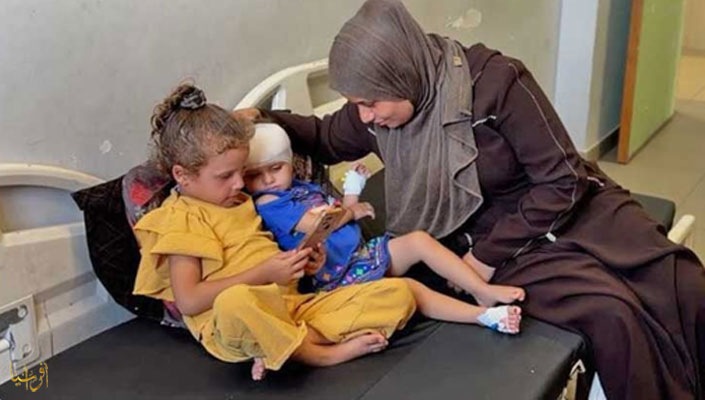
Who asks her if she eats, and if she can sleep? Who cares that the hand that is patted on the shoulders also needs a hand?
We say about women like this that they are strong, and then we go on reassuring of their strength. But a woman who is carrying her sister's children should not be left under the weight of praise.
She needs concrete help, someone who shares her care, who provides her with food and comfort. She needs to cry without fear of the whole house falling because her shoulders are shaking.
Motherhood that comes after loss carries difficult questions. How does an aunt take the place of the absent mother, while at the same time giving the children a presence on which they can depend?
How do you tell them about her without every talk becoming a wound? There is no ready-made recipe for this love.
There is daily trying, listening, mistakes forgiven by closeness, and tenderness that learns its way over time.
How cruel it is for the simplest rights to become wishes: a safe bed, clean water, a school, and a night that does not threaten the sleepers. Survival alone is not enough.
Then the need for care begins continuous, and to people whose survival can be trusted. These little ones need a tomorrow when they carry their bags and go to their ranks.
In Gaza, grieving families are overstretched. An aunt's arm expands, a crowded house makes room for a little one, and bread is divided again.
But this solidarity does not take responsibility away from the world. Tenderness alone cannot protect children from shelling, provide them with treatment, or restore their rights. They need real protection and justice, too.
I return to the palm of the woman who covers her face, and I hope that she can take it down without having to make up a smile. To find someone in front of her who can bear her tears, and to sit next to her without a speech about patience. Sometimes it is comforting to say to a bereaved person:
Sleep a little, I will stay here. To give him time to give birth and not to fear losing him.
This aunt is trying to give her sister's children a home from her presence. Let us give her what makes it possible, and let us remember that she has a life worth caring for, too.
Perhaps the little ones will look up to her one morning, and she will be preoccupied with ordinary details, and laugh at a simple matter. Then they will have some security, and the day will become day, not another test of their ability to endur.
The olive has another time
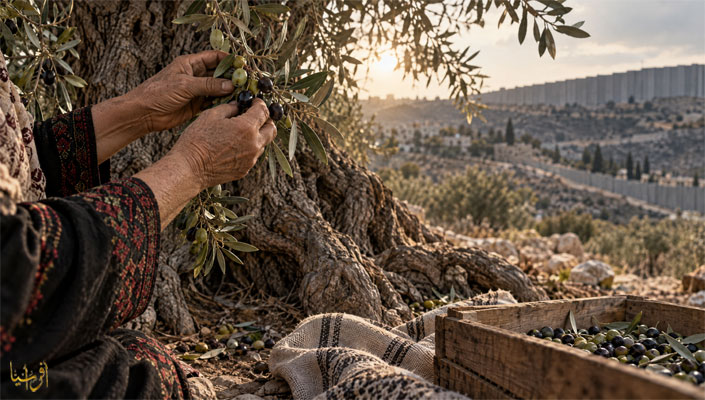
The olive has a way of counting the years that is not like ours. Its trunk expands slightly, knots a branch, and leaves a twist in its wood that the passer-by cannot see. When October comes, it reaches out its fruit to the hands that know how much pressure is on the grain and how the mature one separates from its branch.
Thus the season resumes an old tradition, until a weapon stands between the tree and whoever comes to pick it.
In Turmusaya, near Ramallah, an elderly Palestinian woman confronts the occupation soldiers after she was prevented from picking olives.
She says: "The country is our country and the land is ours." A short sentence, complete like a grain that has matured slowly. No introduction precedes it, and no apology mitigates its impact.
The woman calls her relationship the place, and the name of her owners is returned to the land in the moment In which they are meant to retreat.
I stop at the word "Elna." How can four letters accommodate all this certainty? In the colloquial word, there is a depth that the language of data does not give. It is as if the speaker is referring to a threshold whose height she knows, or to a jar whose place she knows in the darkness.
She speaks her right from within her daily life, where a person does not need to explain why he goes to his land at the time of the harvest.
I don't know how long this woman meant her trees, or who planted them, but the olive farmer teaches the body precise knowledge: the position of the foot on the sloping soil, the branch that should be grazed with it, and the difference between a healthy fruit and one that has been damaged.
A knowledge that is formed by repetition, and it settles in the fingers, so that the hand seems to be working as if it is retrieving words that it has memorized for a long time.
Picking is a date that has its own smell. Light dust hangs from the clothes, a green bitterness that remains on the palm, and grains roll over the tent and gather before folding it.
In these small details, belonging takes its tangible form. One goes to the field to work, and then returns with something in his clothes.
The ground enters the house in the form of a smell, before the oil enters his vessels.
When the owner of the land prevents him from reaching his tree, he cuts off this path at its simplest links. The fruits remain on the branches, and the work stops, while the season goes on according to his calculations. Ripening has its unexpected time.
The rain has a date that may change the conditions of harvesting. What appears to be a fleeting military affair penetrates into the livelihood of an entire year and the order of the days on which it was built.
The soldier has the power to stop the move. In the woman's words, she knows the reason for that step and its destination. Here the distance between the ability to prevent and the right to prevent is revealed.
A weapon can block the road, but it does not make the relationship between the farmer and his land emergent, nor does it erase the years of work just because the owner is required to justify his presence at the edge of the field.
There is a particular insult in asking a person, literally or implicitly, what he is doing in his place. His arrival becomes an exception, his work is questionable, and he wastes time in explaining He was supposed to start his day with it.
Prohibition here takes over something of a lifetime, too. Hours that could have been filled with useful work are wasted at a checkpoint.
I think about the distance that an olive grain travels to become oil. In collecting it, carrying it, waiting for its turn in the press, and in the fatigue that precedes the first bowl is full.
Every drop is the result of labor, and it has a value that those who pay for it with their efforts know. When a woman deprives her of her season, this tangible product is taken away from her, and what she would have managed with it in her life's affairs.
The land has a time that goes beyond the season as well. Whoever plants a tree knows that between planting and fruiting there is waiting, and that care continues when the giving is not plentiful.
In this work, there is confidence in the possibility of continuity, and a willingness to exert effort before the results appear.
Therefore, the disruption of agriculture affects the future, and weakens people's ability to plan for what comes after their urgent need and to invest in their survival.
I don't want to make Zaytouna a witness who speaks for women. The woman has said enough.
Her phrase remains hanging in the field, clear in its direction. What is required is that she be able to complete what she came for: to ripen the tree, to pick the fruit, to bear her crop, and to return when she has finished her work.
The decision to leave is in her hands, and her day is judged by how much she has accomplished, her body is tired, and the evening is approaching. She regains, along with her land, her simple right to the time of her day.

