
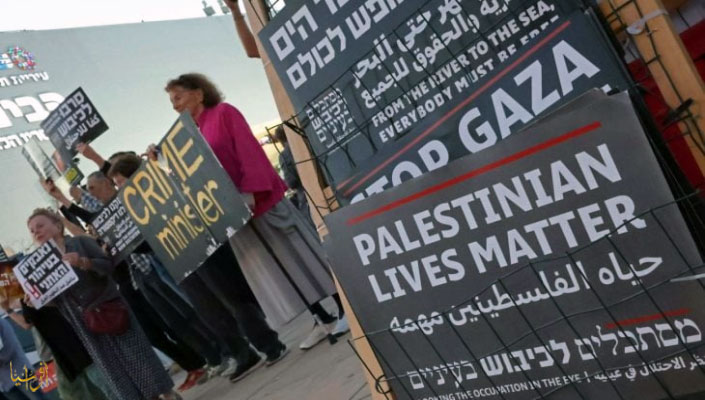
Afrasianet - Alaa Joma'a - At a time when the crackdown on filmmakers of a film about the Gaza war is escalating inside Israel, and has gone so far as to demand that their citizenship be revoked, a new investigation by the German magazine Der Spiegel has captured the pressures faced by Israelis who reject the war or criticize the occupation and their country's policies toward the Palestinians.
Through testimonies from a teacher, director, journalist and historian, the investigation, published by the magazine on Saturday, traces what its authors describe as the shrinking space for protest within Israeli society since the October 7, 2023, attack and the war that followed it in Gaza. The pressures they spoke of ranged from physical assault to threats of suspension, family breakups and betrayal campaigns.
The magazine's investigation comes at a time of fierce controversy in Israel after the documentary "Naza," about the Israeli military's operations in Gaza, won the Special Jury Prize at the Venice Film Festival.
The controversy over the film has gone from a controversy over its content within days to a political campaign against its directors, Yuval Abraham and Rachel Tzur, while Prime Minister Benjamin Netanyahu announced a push for a legislative initiative that would expand cases in which Israeli citizenship can be revoked.
From film criticism to talk about nationality
Der Spiegel's investigation hinges on the climate that surrounds Israeli voices critical of the war, a debate that has gained new momentum with NAZA.
The film is based on testimonies from Israeli military and intelligence personnel, including unidentified people, and includes accusations about the mechanisms of target selection during the Gaza war and the use of technological and intelligence systems in military operations.
"The film is based on testimonies from Israeli military and intelligence personnel, including unidentified people, and includes accusations about the mechanisms for selecting targets during the war in Gaza and the use of technological and intelligence systems in military operations"
________________
The Israeli military rejected the accusations in the film and questioned the reliance on anonymous sources, stressing that decisions regarding targets and attacks are not made independently by automated systems. The film also drew widespread criticism from Israeli officials and politicians.
But the attack did not stop at the limits of criticism of the film. Israeli Culture Minister Mickey Zohar demanded that the directors be stripped of their citizenship, accusing them of treason.
Netanyahu then announced two legislative initiatives, one to expand the possibility of revocation of citizenship under certain conditions, and the other to increase compensation in defamation cases, in the context of talking about Israelis accused of damaging the image of the army and the state abroad.
The announcement does not mean a decision to revoke the directors' citizenship, but rather a legal amendment to the matter. Israeli President Isaac Herzog, despite his criticism of the film, rejected the idea of revoking the citizenship of its makers.
The campaign went beyond political statements. The Berliner Zeitung newspaper reported on protests in front of the family home of director Rachel Tzur and of escalating threats against filmmakers. In contrast, film industry figures and rights organizations announced their support for the directors.
Teacher Faces Beating, Risk of Losing Work
Der Spiegel goes beyond the film's case, presenting cases of Israelis who say they have paid a price for their anti-occupation activism or their stance on the war.
One of the most prominent is the story of Yael Lefkowitz, a 52-year-old teacher who is an activist in the organization "Looking at the Occupation in the Eye."
Lefkowitz says she was near the Palestinian West Bank town of Qusra in late February to support a Palestinian family when masked men in a vehicle arrived and attacked her with sticks and iron bars.
She showed the magazine's journalists a recording of the attack. According to her account, a 70-year-old friend of hers was hit in the head after being beaten and was later taken to intensive care.
She says that Israeli police, army and ambulance teams did not arrive despite distress requests, and that the group was eventually forced to leave the scene in a Palestinian ambulance.
But the repercussions of her activism did not stop there. After October 7, the teacher says that her attitudes against war and occupation caused tension within her family, and she was excluded from some family gatherings.
She also faced the risk of losing her job at an elementary school in Jaffa after the parents of a pupil filed a complaint against her accusing her of extremism.
The Ministry of Education summoned her to a hearing on suspicion of "inappropriate behaviour by a female teacher", before she was eventually able to keep her job. She told Der Spiegel that for her, continuing to be active is a way for her to "remain human in front of this horror".
An argument over talking about the occupation
The magazine also recounts the experience of director Shai Carmeli Pollack, who, during his meeting with Der Spiegel journalists, found himself in a direct confrontation with a man in a Tel Aviv restaurant after hearing him talk about the war and the occupation.
According to the report, the man approached their table and got into an argument with the director, accusing him of portraying Israelis as murderers and profiting from the abuse of his country.
Pollack believes that the incident reflects the climate that has become surrounding the debate over the Palestinians and the war, and he says he no longer feels the same freedom to express his views even in Tel Aviv.
His film "The Sea" has already sparked controversy in Israel. The work tells the story of a 12-year-old Palestinian boy from the West Bank who tries to reach Tel Aviv to see the sea for the first time.
"Fear of being accused of sympathizing with Hamas has led journalists to stay away from criticism of the war, while the suffering of Palestinian civilians has remained limited to a large part of the Israeli media"
________________
The film was shot in the summer of 2023, before the outbreak of the current war, and won the Israeli Ophir Prize in 2025, but Culture Minister Mickey Zohar attacked the award and announced his intention to stop government funding for its distribution ceremony.
Gaza is out of the picture
Der Spiegel does not limit the issue to activists and filmmakers, but rather asks the question of how the war itself has been portrayed inside Israel.
Journalist Anat Saragosti, who is in charge of press freedom at the Israeli Journalists' Syndicate, says that the fear of being accused of sympathizing with Hamas has pushed journalists to stay away from criticizing the war, while the suffering of Palestinian civilians has remained limited to a large part of the Israeli media.
Saragosti has previously publicly criticized what she sees as Israel's one-sided coverage of the war, saying that the mainstream media has largely ignored Palestinian victims and the humanitarian crisis in Gaza.
Speaking to the magazine, she believes that this shift is not only after October 7, but can also be seen in the language used for years, including the decline in the use of the term "occupied territories" in contrast to the widespread use of the term "Judea and Samaria" when talking about the West Bank.
Archive of what's happening in Gaza
Israeli historian Lee Mordechai chose to counter what he sees as a lack of documentation by gathering material related to the war in Gaza.
Since December 2023, Mordechai has been working on the "Bearing Witness" project, which collects reports, testimonies, photographs, and videos related to what is happening in the Strip.
The project itself is defined as an attempt to document the humanitarian and political crisis and preserve materials related to it.
Der Spiegel says the archive now includes thousands of materials and volunteers are involved in collecting and cataloguing them. Some Israeli anti-occupation organizations are increasingly turning their rhetoric abroad as their hopes of influence within the Israeli Jewish community have waned.
________________

